
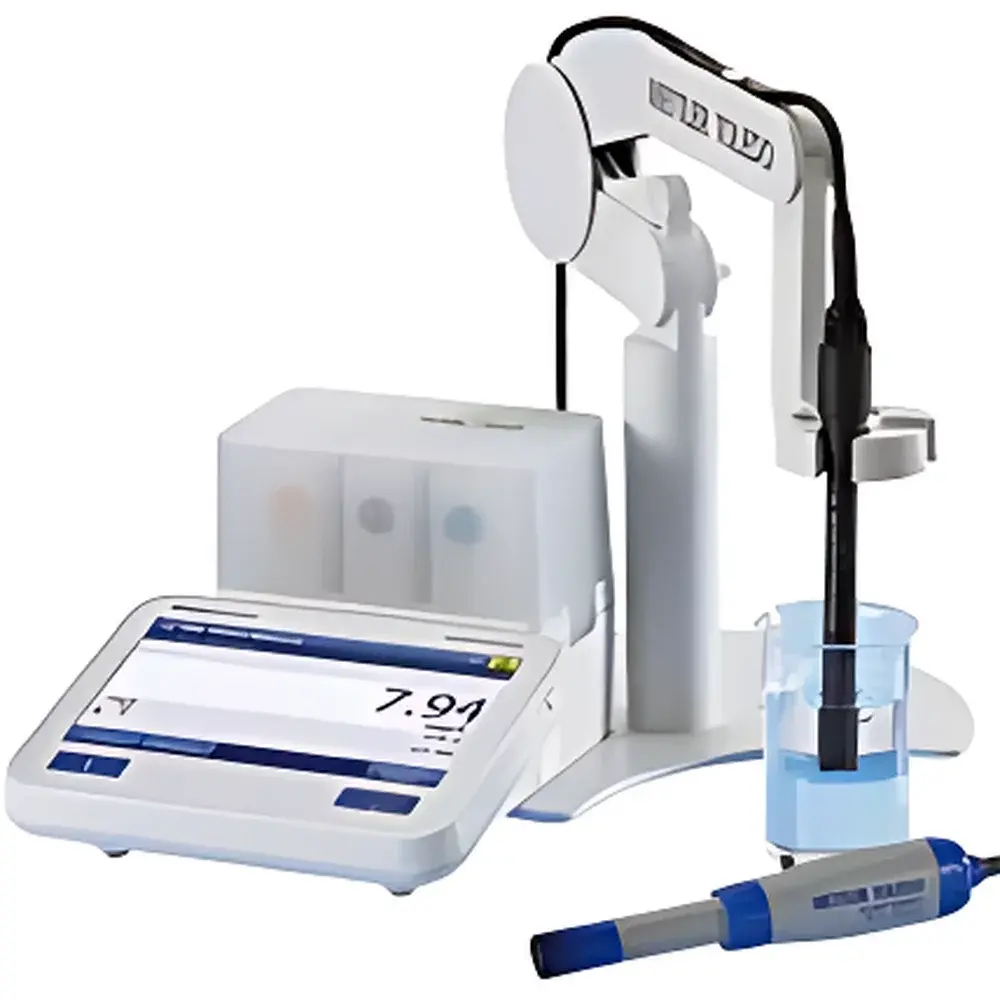
METTLER TOLEDO SevenExcellence S900 Dissolved Oxygen and BOD Analyzer
| Brand | METTLER TOLEDO |
|---|---|
| Origin | Switzerland |
| Model | S900 |
| Instrument Type | Portable |
| Measurement Range | 0–50 mg/L |
| Accuracy | ±0.1 mg/L |
| Repeatability | ±0.05 mg/L |
| Detection Limit | 0 mg/L |
| Sensor Interface | Digital (InLab® OptiOx) |
| Channel Configuration | Single-channel, modularly expandable |
Overview
The METTLER TOLEDO SevenExcellence S900 Dissolved Oxygen and BOD Analyzer is a high-precision, portable benchtop instrument engineered for reliable quantification of dissolved oxygen (DO) in aqueous environmental and wastewater samples—critical for assessing ecosystem health, regulatory compliance, and biological treatment efficiency. Unlike conventional electrochemical Clark-type sensors, the S900 integrates exclusively with the InLab® OptiOx digital optical dissolved oxygen sensor, which employs luminescence quenching technology based on the Stern–Volmer principle. This solid-state, membrane-based optical method eliminates oxygen consumption during measurement, eliminates electrolyte refills, and provides immunity to flow rate variations, sulfide interference, and electrode poisoning—making it ideal for long-term monitoring, field deployment, and BOD5 incubation workflows. The S900 platform is built upon METTLER TOLEDO’s validated SevenExcellence architecture, featuring ISO/IEC 17025-aligned traceability, GLP/GMP-compliant data integrity tools, and full audit trail support per FDA 21 CFR Part 11 requirements.
Key Features
- Digital optical DO sensing via InLab® OptiOx probe: No polarization time, zero drift, and <15-second response time (t90) across full 0–50 mg/L range
- Integrated BOD calculation module: Automatically computes 5-day biochemical oxygen demand (BOD5) using initial/final DO readings, dilution factor, and incubation temperature—aligned with ASTM D5210 and ISO 5815-1 standards
- Single-channel core design with hot-swappable modular expansion: Supports future integration of pH, conductivity, ion-selective, or redox modules without hardware replacement
- High-resolution color touchscreen with intuitive wizard-driven workflows for DO calibration (air saturation or Winkler titration reference), sensor diagnostics, and BOD protocol setup
- Onboard data storage (≥10,000 measurements) with timestamp, operator ID, sensor serial number, and environmental metadata (temperature, atmospheric pressure, salinity)
- Robust IP67-rated housing with chemically resistant casing; operates continuously for >24 hours on rechargeable Li-ion battery
Sample Compatibility & Compliance
The S900 is validated for use with natural waters (rivers, lakes, estuaries), municipal and industrial wastewater, activated sludge, and treated effluents. Its optical sensor exhibits minimal fouling in turbid or organic-rich matrices and maintains stable performance across salinities up to 35 g/kg (seawater-equivalent). Calibration is performed using two-point air-saturation (at local barometric pressure) and zero-oxygen solution (sodium sulfite), meeting EPA Method 4500-O G and ISO 5814:2012 specifications. All measurement records include embedded electronic signatures, automatic version-controlled firmware logs, and exportable .csv/.pdf reports compliant with ISO/IEC 17025 clause 7.7 and EU Water Framework Directive reporting templates.
Software & Data Management
Data acquisition and reporting are managed via METTLER TOLEDO LabX® software (optional standalone or networked license). LabX enables automated report generation with customizable templates, statistical process control (SPC) charts for trend analysis, and secure cloud synchronization with role-based access control. Raw sensor signals—including luminescence decay curves—are stored in native format for retrospective validation. All data entries enforce mandatory fields (e.g., calibration date, sensor status flag), and system-generated audit trails record every user action—including edits, deletions, and parameter changes—with immutable timestamps and login identifiers—fully satisfying FDA 21 CFR Part 11 and EU Annex 11 requirements for regulated laboratories.
Applications
- Regulatory wastewater discharge monitoring per NPDES permits and EU Urban Wastewater Treatment Directive
- BOD5 determination in compliance with ISO 5815-1 and APHA Standard Methods 5210 B
- Process control in activated sludge bioreactors and membrane bioreactors (MBRs)
- Environmental impact assessments and limnological surveys of eutrophication-sensitive water bodies
- Educational laboratory instruction in environmental chemistry and analytical instrumentation
- Field-based rapid assessment of hypoxic zones and oxygen sag curves in receiving streams
FAQ
Does the S900 support automatic atmospheric pressure compensation?
Yes—the integrated barometric sensor continuously adjusts DO concentration calculations in real time, eliminating manual correction factors required by older analog meters.
Can the InLab® OptiOx sensor be used for continuous immersion in wastewater?
Yes—its ruggedized PEEK housing and anti-fouling optical window are rated for uninterrupted operation up to 30 days in secondary effluent; routine cleaning with mild detergent is recommended every 72 hours.
Is BOD calculation compliant with ISO 5815-1:2012?
Yes—the instrument applies standardized temperature correction (θ = 1.047), validates dilution ratios against defined acceptance criteria, and flags outliers per ISO 5815-1 Annex A.
How is calibration traceability maintained?
Each InLab® OptiOx sensor carries a factory-issued calibration certificate with NIST-traceable reference values; users may perform verification checks using certified Winkler titration standards.
Can multiple S900 units synchronize measurement protocols across a lab network?
Yes—via LabX central server deployment, enabling uniform method templates, shared calibration schedules, and cross-instrument QC trending.
Related Products







