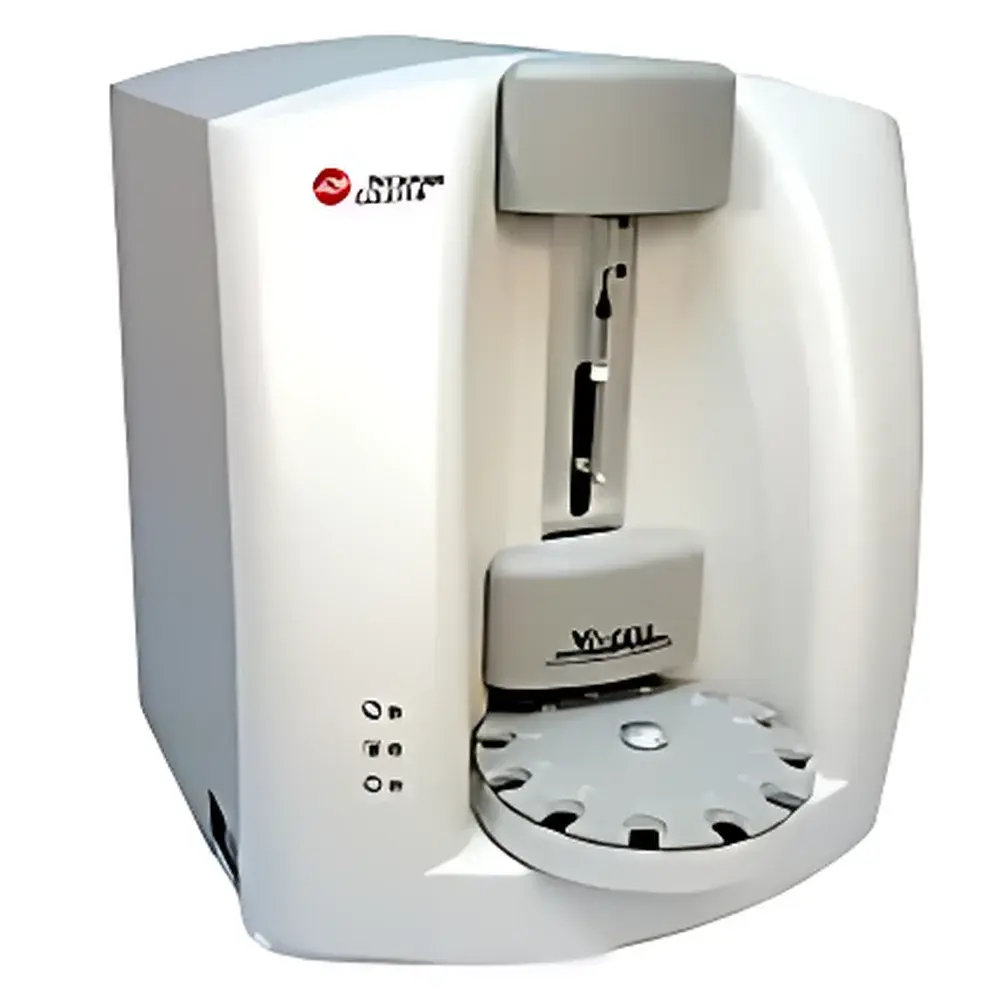
Beckman Coulter Vi-CELL XR Automated Viability Analyzer
| Brand | Beckman Coulter |
|---|---|
| Model | Vi-CELL XR |
| Origin | USA |
| Product Type | Automated Cell Viability and Counting System |
| Sample Volume Range | 0.5–100 µL |
| Cell Size Detection Range | 2–700 µm |
| Imaging Sensor | 1394 × 1040 CCD array |
| Interface | IEEE 1394 (FireWire) |
| Focus Mechanism | Motorized Auto-Focus |
| Reagent Kits Available | Vi-CELL XR Quad Pack, Vi-CELL AS/S Quad Pack |
| Calibration Standards | Vi-CELL Concentration Control, Vi-CELL Focus Control |
| Data Export Format | Native Excel (.xlsx), CSV, TIFF image archives |
| Compliance | Designed for GLP/GMP-aligned workflows |
Overview
The Beckman Coulter Vi-CELL XR Automated Viability Analyzer is an image-based, trypan blue exclusion assay platform engineered for precision, reproducibility, and regulatory traceability in mammalian cell culture monitoring. Unlike flow cytometry or impedance-based counters, the Vi-CELL XR employs high-resolution brightfield microscopy coupled with motorized auto-focus and standardized staining protocols to quantify viable and non-viable cells based on membrane integrity—without reliance on fluorescent dyes or complex fluidics. It delivers statistically robust cell concentration (cells/mL), viability (%), average diameter (µm), and morphological descriptors—including circularity, aspect ratio, and pixel-based area distribution—for each sample. The system is purpose-built for bioprocess development, upstream biomanufacturing QC, and cell therapy process characterization where consistent, auditable, and image-anchored data are required across campaigns and facilities.
Key Features
- Automated sample handling with programmable pipetting for volumes between 0.5 µL and 100 µL—enabling low-volume bioreactor sampling without dilution bias.
- Motorized z-axis auto-focus calibrated against NIST-traceable Vi-CELL Focus Control standards, ensuring optical consistency across instruments and over time.
- 1394 × 1040-pixel monochrome CCD imaging sensor optimized for high-contrast trypan blue-stained cell visualization under standardized illumination.
- Proprietary image segmentation algorithm trained on >10,000 manually annotated cell images, minimizing false positives in debris-rich or aggregated cultures (e.g., CHO, HEK293, hybridoma).
- Integrated calibration verification using Vi-CELL Concentration Control material—certified for ±5% accuracy against reference hemocytometer counts at 1 × 10⁶–1 × 10⁷ cells/mL.
- Onboard storage of raw TIFF image stacks, analysis logs, and operator metadata—retained for ≥180 days unless archived externally.
Sample Compatibility & Compliance
The Vi-CELL XR accommodates suspension-adapted mammalian lines (CHO, Vero, Jurkat, iPSC-derived progenitors), primary human PBMCs, and insect cells (Sf9, Sf21), provided samples fall within the 2–700 µm detection range and exhibit minimal clumping post-trypsinization or gentle mechanical dissociation. It supports standard trypan blue (0.4%) and alternative dyes (e.g., propidium iodide for fixed samples) via protocol customization. The system aligns with ASTM E2877-22 (Standard Guide for Cell Counting by Image Analysis) and ISO 20391-2:2019 (Biotechnology — Cell counting — Part 2: Protocol for counting viable cells using automated image-based methods). When deployed with validated IT infrastructure, it satisfies data integrity expectations under FDA 21 CFR Part 11 for electronic records and signatures—particularly when paired with audit-trail-enabled laboratory information management systems (LIMS) or electronic lab notebooks (ELN).
Software & Data Management
Vi-CELL Software v5.x provides a secure, role-based interface for method creation, instrument control, and report generation. Each analysis generates a timestamped, digitally signed PDF report containing summary statistics, histogram distributions (size/viability), and thumbnail previews of all acquired fields-of-view. Raw image archives (.tiff), processed binary masks (.png), and tabular data (.xlsx, .csv) are exportable with embedded metadata (operator ID, date/time, instrument serial number, reagent lot). Batch processing supports up to 96 samples per run with customizable pass/fail criteria (e.g., CV < 10% across triplicates). All user actions—including parameter edits, reanalysis, and report exports—are logged in an immutable audit trail compliant with ALCOA+ principles (Attributable, Legible, Contemporaneous, Original, Accurate, Complete, Consistent, Enduring, Available).
Applications
- Upstream bioprocess monitoring: Real-time tracking of viability decay, size drift, and morphology shifts during fed-batch or perfusion culture—feeding dynamic models for harvest timing and media optimization.
- Cell banking & release testing: Quantitative assessment of cryopreserved vials pre- and post-thaw, including viability recovery kinetics and aggregate formation metrics.
- Monoclonal antibody production: Correlation of early passage viability profiles with final titer and product quality attributes (e.g., glycosylation heterogeneity).
- Regenerative medicine: Characterization of mesenchymal stromal cells (MSCs) and induced pluripotent stem cells (iPSCs) across differentiation stages—leveraging morphological parameters as surrogate biomarkers.
- Method transfer & multi-site harmonization: Standardized protocols and image-based reference libraries enable cross-laboratory comparability in global clinical trial support environments.
FAQ
Does the Vi-CELL XR require daily calibration?
No—calibration is performed per ASTM E2877-22 using certified Vi-CELL Focus Control and Vi-CELL Concentration Control materials before each analytical batch or at user-defined intervals (e.g., weekly). Full system verification is recommended after maintenance or software updates.
Can the system analyze adherent cells without trypsinization?
No—the Vi-CELL XR requires single-cell suspensions. Adherent lines must be detached using enzymatic (e.g., trypsin/EDTA) or non-enzymatic (e.g., Versene) methods followed by gentle resuspension and filtration to remove aggregates.
Is raw image data retained indefinitely?
Raw TIFF files and analysis metadata are stored onboard for 180 days. Long-term archival requires integration with network-attached storage (NAS) or LIMS via secure file transfer protocols (SFTP/HTTPS).
How does the Vi-CELL XR handle cell clumps or debris?
The software applies adaptive thresholding and watershed segmentation to distinguish touching cells; users may adjust minimum separation distance and minimum object area parameters to optimize for specific cell types or culture conditions.
What reagent kits are supported for routine operation?
Vi-CELL XR Quad Pack (for 400 tests), Vi-CELL AS/S Quad Pack (for automated sample prep with dual-chamber cassettes), and lot-specific control materials (175478, 175474) are fully validated and supplied with certificate of analysis.