
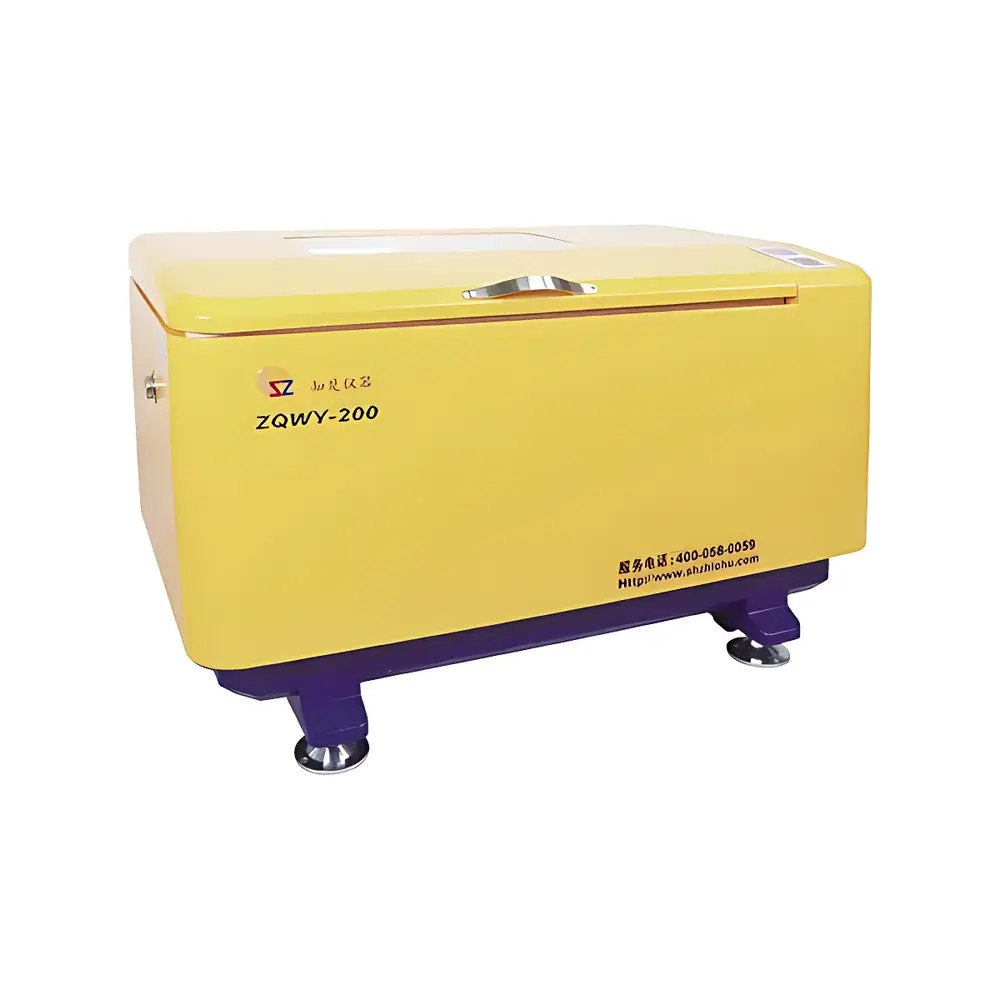
Zhichu ZQWY-200 Horizontal Full-Temperature Orbital Shaker Incubator
| Brand | Zhichu |
|---|---|
| Origin | Guangdong, China |
| Manufacturer Type | Authorized Distributor |
| Product Category | Domestic |
| Model | ZQWY-200 |
| Instrument Type | Full-Temperature Orbital Shaker Incubator |
| Timer Range | 0–999.9 h |
| Oscillation Frequency | 10–300 rpm (Φ26 mm platform) |
| Oscillation Amplitude | Φ26 mm (standard), Φ50 mm (optional) |
| Temperature Range | 4–60 °C (ambient: 23–25 °C) |
| Shelf Count | 3 |
Overview
The Zhichu ZQWY-200 Horizontal Full-Temperature Orbital Shaker Incubator is an engineered solution for controlled microbial growth, cell culture expansion, biochemical reaction optimization, and suspension-based fermentation under precisely regulated temperature and orbital agitation conditions. Designed around a horizontal configuration with triple-tiered stainless-steel shelves, it integrates P.I.D. microcomputer temperature control, servo-driven orbital motion, and forced-air convection to deliver uniform thermal distribution and high reproducibility across extended incubation periods. Its operational principle relies on consistent orbital shaking (±1 rpm accuracy) combined with active refrigeration and heating—enabled by a high-efficiency, eco-friendly R134a compressor—to maintain stable setpoints from sub-ambient (4 °C) to elevated (60 °C) ranges. This architecture supports long-term, unattended operation in GLP-compliant laboratories, academic research facilities, and bioprocess development environments where thermal stability, mechanical reliability, and contamination control are critical.
Key Features
- Triple-tiered horizontal shaker platform (905 × 530 mm per shelf) supporting scalable culture volumes—from 250 mL × 60 flasks to 5000 mL × 8 vessels—using either standard stainless-steel or optional one-piece polymer universal clamps.
- High-precision servo motor drive system with three-dimensional eccentric cam mechanism ensuring smooth, low-vibration orbital motion (Φ26 mm standard amplitude; Φ50 mm optional) and extended mechanical service life.
- Intelligent P.I.D. temperature control with ±0.1 °C setpoint resolution and ±1 °C uniformity (measured at 37 °C), validated via internal multi-point sensor array and real-time feedback compensation.
- Energy-efficient refrigeration subsystem featuring imported hermetic compressor, non-ozone-depleting R134a refrigerant, and programmable defrost cycles (1–250 s duration; 30–600 min interval) to prevent evaporator icing during prolonged low-temperature operation.
- UL-listed safety architecture including over-temperature alarm, automatic power cutoff upon thermal or electrical fault detection, and auto-restart function with parameter retention after unexpected power interruption.
- Human-centered ergonomics: front-access UV germicidal lamp (254 nm), electrostatically coated steel enclosure, R-corner mirror-finish 304 stainless steel interior, tempered double-glazed observation door, and adjustable leveling feet with integrated casters.
Sample Compatibility & Compliance
The ZQWY-200 accommodates a broad spectrum of vessel formats—including Erlenmeyer flasks (250–5000 mL), test tubes, culture bags, and custom bioreactor modules—via its modular clamp system. The forced-air convection design incorporates side-mounted ventilation ducts to ensure adequate O2 exchange for aerobic cultures without compromising thermal homogeneity. All wetted surfaces meet ISO 8573-1 Class 3 purity standards for non-sterile laboratory equipment. While not certified for ISO 13485 or FDA 21 CFR Part 11 out-of-the-box, the instrument’s audit-ready data logging (when paired with optional RS485/USB interface and compliant software) supports traceability requirements under GLP and GMP frameworks. Temperature and speed calibration certificates are available upon request per ISO/IEC 17025-accredited protocols.
Software & Data Management
Standard operation utilizes an industrial-grade backlit LCD interface with password-protected parameter locking to prevent inadvertent setting changes. Optional upgrade paths include a capacitive touchscreen controller enabling simultaneous display of setpoints and real-time values (temperature, rpm, remaining time), directional control (forward/reverse oscillation), and intuitive multi-level menu navigation. Data export is supported via USB flash drive (CSV format) or RS485 Modbus RTU protocol for integration into LIMS or SCADA systems. Firmware supports timestamped event logging—including door openings, alarm triggers, and defrost cycles—with configurable retention depth (up to 30 days). Audit trail functionality complies with ALCOA+ principles when used with validated third-party data acquisition software.
Applications
- Microbial cultivation (e.g., E. coli, Bacillus, yeast) for protein expression, plasmid amplification, and metabolic studies.
- Mammalian and insect cell suspension culture in serum-free or chemically defined media.
- Enzyme kinetics assays requiring precise thermal and mixing control.
- Biochemical oxygen demand (BOD) testing and environmental microbiology sample processing.
- Pharmaceutical stability testing per ICH Q1 guidelines under controlled agitation conditions.
- Bioprocess scale-down modeling for upstream development and media optimization.
FAQ
What is the maximum load capacity per shelf?
Each shelf supports up to 60 × 250 mL flasks using stainless-steel universal clamps—or equivalently, 15 × 2000 mL vessels—subject to balanced weight distribution and center-of-gravity constraints.
Can the unit operate continuously at 4 °C?
Yes. The compressor-based cooling system, combined with programmable defrost logic, enables uninterrupted operation at minimum setpoint for durations exceeding 72 hours.
Is UV sterilization integrated into routine operation?
The 254 nm UV-C lamp is manually activated via dedicated control and operates independently of temperature/shaking functions; exposure duration and frequency are user-defined.
Does the shaker support external data acquisition?
Via optional RS485 interface (Modbus RTU), real-time temperature, speed, and timer values can be streamed to host PCs or PLCs for centralized monitoring and archival.
What maintenance intervals are recommended?
Compressor oil inspection every 24 months; fan filter cleaning every 3 months; door gasket integrity check quarterly; annual verification of temperature uniformity and speed accuracy using NIST-traceable references.




