
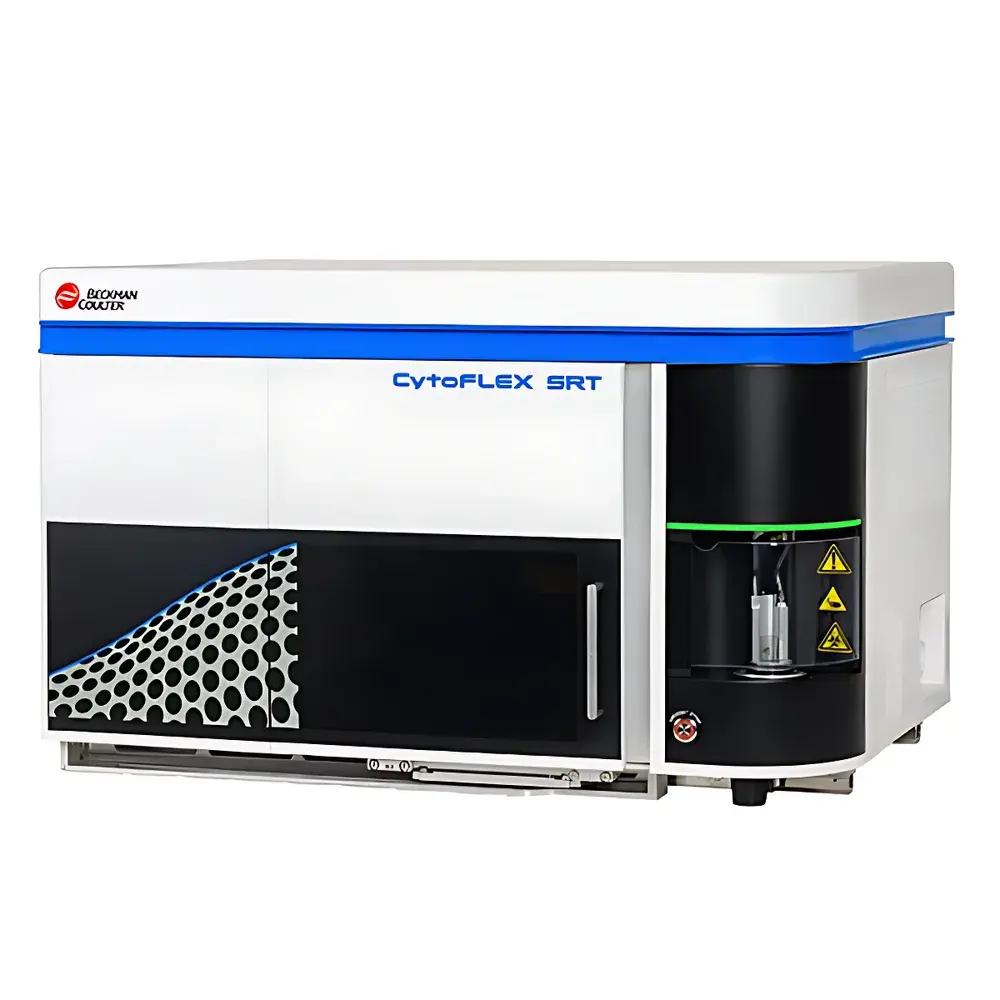
CytoFLEX SRT Flow Cytometer and Cell Sorter by Beckman Coulter
| Brand | Beckman Coulter |
|---|---|
| Origin | USA |
| Manufacturer Type | Authorized Distributor |
| Product Category | Imported Instrument |
| Model | CytoFLEX SRT |
| Price Range | USD $15,000–$120,000 (FOB) |
| Technology Platform | Sorting Flow Cytometry |
| Product Type | High-Performance Benchtop Flow Cytometer with Integrated Cell Sorting |
| Intended Use | Research-Only |
| Sample Delivery Rate | 10–100 µL/s (continuously adjustable) |
| Sorting Output | 4-way electrostatic sorting |
| Voltage Adjustment Required | Yes |
| Optical Configuration | V-B-Y-R (Violet-Blue-Yellow-Green-Red) up to 15 fluorescence detectors |
| Biosafety Options | Optional aerosol containment system compatible with Class II biological safety cabinets |
Overview
The CytoFLEX SRT Flow Cytometer and Cell Sorter is a fully integrated, benchtop-scale instrument engineered by Beckman Coulter for high-fidelity, research-grade cell analysis and fluorescence-activated cell sorting (FACS). Leveraging the proven optical architecture of the CytoFLEX platform—featuring high-sensitivity photodiodes and low-noise electronics—the SRT variant extends analytical capability with real-time, electrostatic droplet-based sorting. Its core measurement principle relies on hydrodynamic focusing combined with multi-laser excitation (violet, blue, yellow-green, and red lasers) and parallel detection across up to 15 fluorescence channels and 4 scatter parameters (FSC, SSC, and two extended-angle scatter signals). Designed for laboratories prioritizing reproducibility, minimal hands-on time, and spatial footprint efficiency, the CytoFLEX SRT operates under laminar flow conditions optimized for low sample consumption and high sort purity (>99% at >70% yield in standard mode), meeting benchmark performance criteria for primary cell isolation, rare-event enrichment, and functional subpopulation characterization.
Key Features
- Compact, self-contained benchtop design (63 × 53 × 48 cm) enabling deployment in shared core facilities or individual labs without dedicated infrastructure.
- V-B-Y-R laser configuration supporting simultaneous excitation of fluorochromes spanning 405 nm to 640 nm, with customizable filter sets and detector gain control per channel.
- Real-time, software-guided drop delay calibration and automated fluidic alignment—eliminating manual optimization of sheath pressure, vibration frequency, or nozzle-to-collection-tube geometry.
- Four-way electrostatic sorting with independent voltage control per collection path, enabling parallel sorting of distinct populations into tubes, plates (96-/384-well), or slides.
- “Discard Capture” mode: dynamically redirects non-target events—typically discarded as waste—into designated recovery vessels, preserving precious samples for downstream validation or reanalysis.
- Integrated aerosol management: optional HEPA-filtered exhaust module or compatibility with certified Class II biosafety cabinets ensures compliance with institutional biosafety level 2 (BSL-2) requirements.
Sample Compatibility & Compliance
The CytoFLEX SRT accommodates suspension cells (mammalian, insect, yeast, bacteria), dissociated tissues, and microbeads ranging from 0.2 µm to 50 µm in diameter. It supports both sterile and non-sterile workflows, with stainless-steel fluidics and autoclavable sample injection ports. The system conforms to IEC 61010-1:2010 for laboratory equipment safety and meets electromagnetic compatibility (EMC) standards per FCC Part 15 and CE EN 61326-1. While designated for research use only (RUO), its audit trail functionality—including user login logs, protocol versioning, and timestamped sort event records—aligns with GLP documentation expectations and provides foundational traceability for preclinical assay development.
Software & Data Management
Acquisition and sorting are controlled via CytExpert SRT Software (v3.0+), a Windows-based application compliant with FDA 21 CFR Part 11 for electronic records when deployed with validated IT infrastructure. The software features intuitive workflow templates for common applications (e.g., stem cell isolation, T-cell subset sorting), real-time histogram gating with Boolean logic (AND/OR/NOT), and automatic compensation matrix calculation using single-stained controls. All raw FCS 3.1 files include embedded metadata (instrument settings, operator ID, date/time stamp) and support export to FlowJo, FCS Express, or custom Python/R pipelines via open API. Audit trails are encrypted and stored locally; backup policies follow institutional data governance frameworks.
Applications
- Isolation of antigen-specific T cells and B cells for adoptive immunotherapy development.
- Enrichment of rare circulating tumor cells (CTCs) from peripheral blood with post-sort viability >90%.
- Sorting of CRISPR-edited clones based on dual-reporter expression (e.g., GFP+ / mCherry−).
- Functional phenotyping of immune cell subsets using cytokine capture assays coupled with intracellular staining.
- High-content screening of transfected or transduced cell pools prior to clonal expansion.
- Microbial community profiling via fluorescent in situ hybridization (FISH)-based sorting of phylogenetically resolved taxa.
FAQ
What is the minimum recommended cell concentration for reliable sorting?
For optimal droplet formation and event discrimination, a concentration of 1 × 10⁶ cells/mL is recommended; lower concentrations may require increased acquisition time but remain technically feasible.
Can the CytoFLEX SRT be upgraded from a non-sorting CytoFLEX model?
No—SRT is a dedicated hardware platform. The sorting module (including piezoelectric actuator, charge induction plate, and high-voltage power supply) is factory-integrated and not retrofittable to standard CytoFLEX analyzers.
Is 21 CFR Part 11 compliance validated out-of-the-box?
The instrument and software meet technical prerequisites for Part 11 compliance; however, formal validation—including risk assessment, IQ/OQ/PQ protocols, and organizational SOPs—must be performed by the end user’s quality unit.
What nozzle sizes are supported, and how do they affect resolution and throughput?
Standard configuration includes a 100-µm ceramic nozzle; optional 70-µm and 130-µm nozzles are available. Smaller nozzles improve resolution for submicron particles but reduce maximum flow rate and increase clogging risk with debris-rich samples.
Does the system support index sorting?
Yes—CytExpert SRT supports index sorting with coordinate mapping to well positions in multiwell plates, enabling retrospective correlation of phenotype with functional readouts.



