
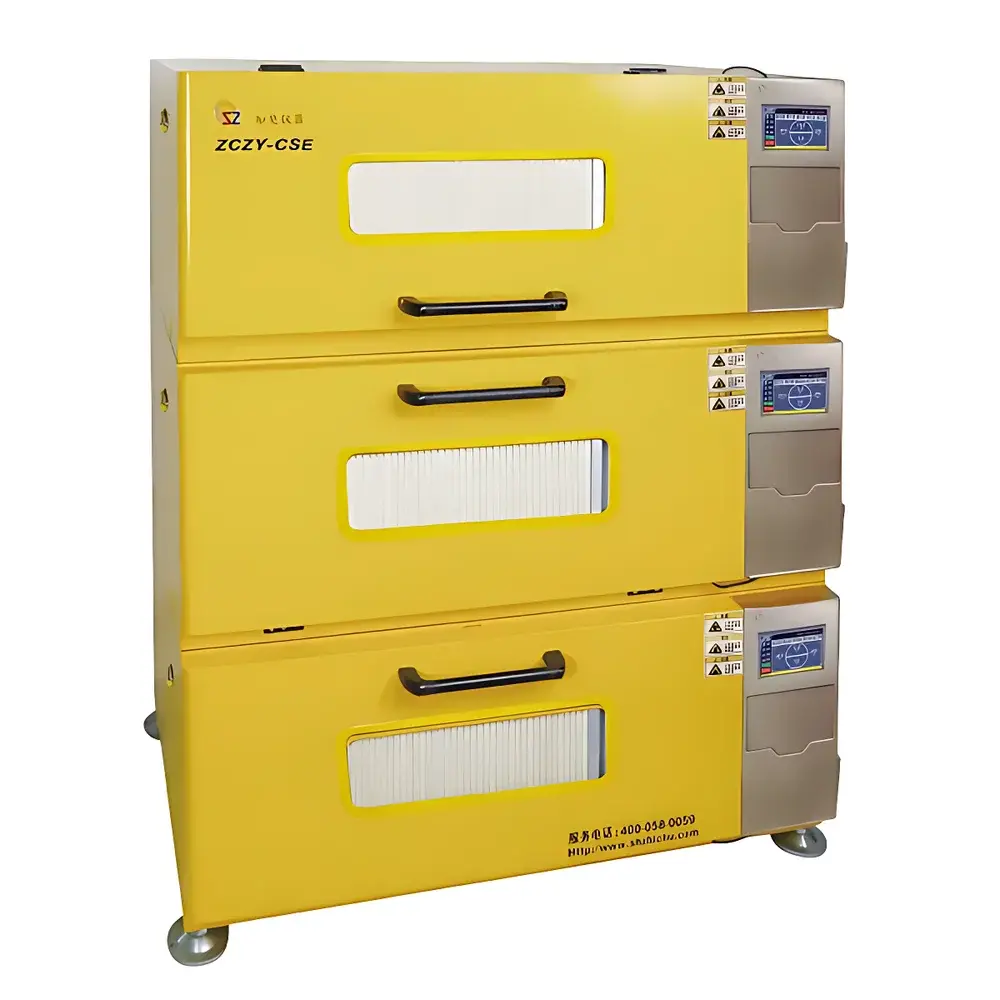
Zhichu ZCZY-CSE Modular Ultra-Large-Capacity CO₂ Incubator Shaker
| Brand | Zhichu |
|---|---|
| Origin | Guangdong, China |
| Model | ZCZY-CSE |
| Instrument Type | CO₂-Regulated Temperature-Controlled Orbital Shaker |
| Timer Range | 0–999.9 h |
| Oscillation Frequency | 10–250 rpm (Φ50 mm platform) |
| Oscillation Amplitude | Φ50 mm (standard), Φ26 mm (optional) |
| Temperature Range | 4–60 °C (ambient 23–25 °C) |
| Number of Shaking Decks | 3 |
| Temperature Uniformity | ±0.5 °C (at 37 °C) |
| Temperature Accuracy | ±0.1 °C |
| Humidity Range | Ambient to 90 % RH |
| Humidity Control Accuracy | ±5 % RH |
| Humidity Resolution | 1 % RH |
| CO₂ Range | 0–20 % |
| CO₂ Accuracy | ±0.1 % |
| CO₂ Sensor | Imported NDIR Infrared Sensor |
| CO₂ Decay Time | 30 min (from 5.0 % to 4.5 %) |
| Display | LCD Touchscreen Interface |
| Control Algorithm | PID Microprocessor-Based |
| Cooling Medium | Eco-Friendly Non-CFC Refrigerant |
| Noise Level | <55 dB(A) |
| Deck Dimensions (L×W) | 1000 × 630 mm per deck |
| Max Capacity (per deck, stainless steel clamps) | 250 mL × 77, or 500 mL × 45, or 1000 mL × 28, or 2000 mL × 18 |
| Power Supply | AC 220 V ±10 %, 50–60 Hz |
| External Dimensions (L×W×H, 3-deck) | 1430 × 895 × 1740 mm |
| Net Weight (3-deck) | ~758 kg |
| Sterilization | Built-in UV Lamp |
| Data Logging | 5-year internal storage with curve visualization (temperature, CO₂, humidity, speed) |
| Door Design | Dual-mode opening (top-hinged upper deck |
| Interior Material | Rounded-corner (R-angle) 304 stainless steel with >99 % antibacterial performance |
| Insulation | High-efficiency polyurethane foam |
| Defrost Cycle | Adjustable interval (30–600 min) and duration (1–250 s) |
| Rotation Direction | Programmable forward/reverse |
| Security | Password-protected interface lock |
| Optional | Remote monitoring via mobile app |
Overview
The Zhichu ZCZY-CSE Modular Ultra-Large-Capacity CO₂ Incubator Shaker is an integrated bioprocessing platform engineered for high-throughput microbial, mammalian, and hybridoma cell culture under precisely controlled environmental conditions. It combines three independent orbital shaking decks—each capable of simultaneous yet individually programmable operation—within a single vertically stacked enclosure. The system employs forced-air convection with PID microprocessor regulation to maintain temperature uniformity of ±0.5 °C at 37 °C across the full chamber volume. CO₂ concentration is actively regulated using a calibrated non-dispersive infrared (NDIR) sensor with ±0.1 % accuracy and real-time feedback control, ensuring stable pH in bicarbonate-buffered media. Humidity is dynamically managed from ambient levels up to 90 % RH, minimizing evaporation during extended incubation. Its modular architecture enables configuration as one-, two-, or three-deck units (ZCZY-ASE/BSE/CSE), optimizing floor space while delivering up to 54 L total working volume per deck when configured with 2000 mL vessels.
Key Features
- Triple-deck modular design with independent temperature, CO₂, humidity, and agitation control per level—enabling parallel experiments under distinct physiological conditions.
- Three-dimensional eccentric triple-crank drive mechanism ensures smooth, low-vibration orbital motion with long-term mechanical stability and minimal bearing wear.
- Rounded-corner (R-angle) 304 stainless steel interior with antimicrobial surface treatment (>99 % bacterial inhibition), facilitating rapid cleaning and reducing biofilm formation risk.
- Tool-free, screwless stainless steel door assembly with dual-opening logic: top-hinged for upper deck access; bottom-hinged for mid- and lower-deck service—allowing full drawer-style extraction of each shaking plate.
- Eco-friendly refrigerant-based cooling system with adjustable refrigeration capacity and programmable timed defrost cycles (interval: 30–600 min; duration: 1–250 s), preventing evaporator icing during sub-ambient operation.
- Integrated UV-C germicidal lamp with manual activation for routine chamber decontamination between runs.
- Touchscreen LCD interface displaying real-time and setpoint values for temperature, CO₂, humidity, speed, and remaining time—all on a unified screen without mode switching.
- Password-protected parameter locking to prevent unauthorized modification and ensure protocol integrity in GLP/GMP environments.
Sample Compatibility & Compliance
The ZCZY-CSE accommodates standard laboratory vessels ranging from 250 mL Erlenmeyer flasks to 2000 mL bioreactor bottles, supported by either universal stainless steel clamps or optional one-piece molded plastic clamps enabling single-hand loading/unloading. Its 1000 mm × 630 mm deck size provides ample spacing for heat dissipation and gas exchange. The chamber meets ISO 13485-aligned manufacturing practices and incorporates design elements supporting compliance with FDA 21 CFR Part 11 requirements—including audit-trail-capable data logging, user authentication, and electronic signature readiness (when paired with validated software). CO₂ containment performance—verified by 30-minute decay time from 5.0 % to 4.5 %—ensures reproducible gas-phase stability critical for sensitive suspension cultures. The unit operates within IEC 61000-4 electromagnetic compatibility standards, enhanced by built-in ferrite magnetic rings to suppress signal interference.
Software & Data Management
Internal firmware supports continuous recording of temperature, CO₂ concentration, relative humidity, and oscillation speed for up to five years. Time-series curves are rendered directly on the touchscreen display for immediate trend assessment. All logged data—including timestamps, operator IDs, and alarm events—are exportable via USB port in CSV format for external analysis in MATLAB, Python, or LIMS platforms. Optional cloud-connected mobile application enables remote monitoring of operational status, real-time alerts for out-of-spec conditions (e.g., overtemperature, CO₂ deviation, power loss), and historical data review. Data encryption and secure TLS transmission protocols align with institutional IT security policies. Firmware updates are performed locally via USB, preserving regulatory traceability.
Applications
This platform is routinely deployed in academic research laboratories for aerobic fermentation optimization, recombinant protein expression in E. coli and Pichia pastoris, and stem cell expansion under hypoxic CO₂ modulation. Biopharmaceutical QC labs utilize it for media qualification, growth curve validation, and stability testing of cell banking materials. Industrial biotechnology facilities apply the ZCZY-CSE in seed train scaling, metabolic flux analysis, and high-density fed-batch pre-culture development. Its precise humidity control supports filamentous fungal cultivation and algae photobioreactor pre-acclimation, while the UV sterilization function facilitates rapid turnover between sterility-critical applications.
FAQ
Can the ZCZY-CSE operate with different CO₂ concentrations on each deck?
No—the CO₂ sensor and gas distribution manifold serve the entire chamber uniformly. All decks share the same CO₂ environment.
Is the humidity control active during cold incubation (e.g., 8 °C)?
Yes—humidification remains functional across the full 4–60 °C range, though condensation management is optimized via intelligent dew-point tracking and periodic heating of the humidifier reservoir.
What is the maximum flask fill volume recommended for 2000 mL vessels at 250 rpm?
For optimal oxygen transfer and mixing homogeneity, fill volume should not exceed 30 % of nominal capacity (i.e., ≤600 mL) at ≥200 rpm on Φ50 mm amplitude.
Does the system support 21 CFR Part 11 compliance out of the box?
The hardware includes essential features (audit trail, user roles, electronic signatures), but formal validation requires site-specific IQ/OQ/PQ documentation and integration with a compliant LIMS or ELN.
How often must the CO₂ sensor be recalibrated?
Factory calibration is stable for 12 months under normal use; annual verification against certified gas standards is recommended, with field recalibration possible using zero-air and span-gas inputs.




