
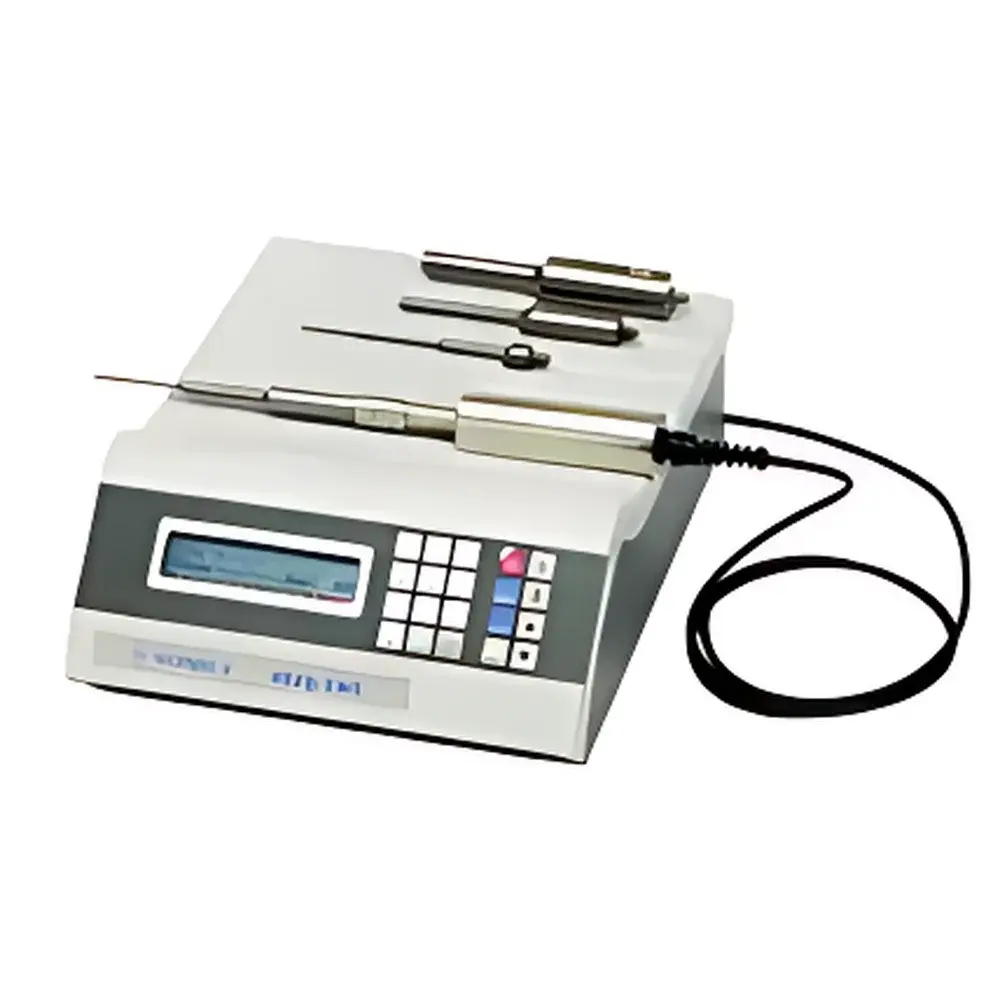
Sonics VCX150PB / VCX150 Ultrasonic Cell Disruptor
| Brand | Sonics |
|---|---|
| Origin | USA |
| Model | VCX150PB / VCX150 |
| Output Power | 150 W |
| Frequency | 20 kHz |
| Sample Volume Range | 150 µL – 150 mL |
| Display | Digital Power Readout |
| Control | Microprocessor-Based |
| Pulse Mode | Manual or Programmable (1–59 s ON/OFF, up to 10 h timer) |
| Transducer | CV188 (VCX150PB) / CV18 (VCX150) |
| Probe Options | φ2 mm, φ3 mm, φ6 mm, φ13 mm (Ti-6Al-4V alloy) |
| Dimensions (H×W×D) | 115 × 250 × 320 mm (VCX150PB), 115 × 250 × 320 mm (VCX150) |
| Weight | 3.0 kg (VCX150PB), 3.2 kg (VCX150) |
| Input Voltage | 220–240 V, 50/60 Hz |
Overview
The Sonics VCX150PB and VCX150 are benchtop ultrasonic cell disruptors engineered for precise, reproducible lysis of microbial, mammalian, and plant cells in research and quality control laboratories. Operating on the principle of high-intensity ultrasonic cavitation—where rapid pressure fluctuations generate microbubbles that collapse violently near cellular structures—these instruments deliver controlled mechanical energy to disrupt membranes, solubilize inclusion bodies, shear chromatin, and extract intracellular components without significant thermal degradation when used with appropriate cooling. Designed for routine and method-critical applications, both models feature a fixed 20 kHz resonant frequency optimized for maximum energy transfer efficiency across a broad range of biological matrices. The VCX150PB integrates a manually adjustable pulse generator for fine-tuned duty cycle control, while the VCX150 adds remote footswitch operation and an extended 10-hour programmable timer—making it suitable for unattended overnight processing under GLP-compliant conditions.
Key Features
- 150 W net acoustic output power with real-time digital power display and microprocessor-based feedback control ensures consistent amplitude delivery across varying sample loads and viscosities.
- Automatic frequency tracking maintains resonance stability during prolonged operation, minimizing probe overheating and extending transducer lifespan.
- Two distinct pulsing architectures: VCX150PB offers manual dial-adjustable pulse duration (1–59 s); VCX150 supports both manual and footswitch-triggered pulsing, with programmable ON/OFF intervals for reproducible thermal management.
- Modular probe system compatible with four standard titanium alloy (Ti-6Al-4V) probes—φ2 mm (150 µL–5 mL), φ3 mm (250 µL–10 mL), φ6 mm (10–50 mL), and φ13 mm (50–150 mL)—each calibrated for defined amplitude outputs (75–207 µm peak-to-peak).
- Robust aluminum chassis with integrated ventilation and thermally isolated electronics housing ensures stable performance during extended runs.
- Compliance-ready design supports audit trails when paired with optional accessories such as the 830-00009 water-jacketed cooling chamber (10 mL capacity) or the 630-0447 25 mm ID flow-through cell (sample/probe isolation for hazardous or temperature-sensitive samples).
Sample Compatibility & Compliance
These disruptors accommodate viscous lysates, suspension cultures, tissue homogenates, and low-conductivity buffers—including Tris-HCl, PBS, RIPA, and guanidine-based formulations—without requiring impedance matching. Probe selection is determined by sample volume, cell type rigidity (e.g., Gram-positive bacteria vs. HEK293 cells), and downstream application requirements (e.g., native protein extraction vs. DNA shearing). All configurations meet IEC 61010-1 safety standards for laboratory electrical equipment. When operated with validated protocols and traceable calibration records, the VCX150 series supports compliance with ISO/IEC 17025, USP , and FDA 21 CFR Part 11 when integrated with compliant data acquisition software (e.g., Sonics’ optional PC interface module with timestamped log export).
Software & Data Management
While the VCX150PB and VCX150 operate as standalone instruments with front-panel controls, they support external monitoring and protocol archiving via RS-232 serial interface (optional cable kit 630-0450). Third-party LabVIEW or Python-based automation scripts can log power, time, and pulse status in CSV format for electronic lab notebook (ELN) integration. Firmware updates are performed using Sonics’ proprietary utility, ensuring version traceability. All user-defined parameters—including total run time, pulse width, and duty cycle—are retained in non-volatile memory after power cycling, supporting repeatable method execution per SOP documentation requirements.
Applications
- Preparation of soluble antigen extracts from E. coli inclusion bodies for immunoassay development.
- Chromatin immunoprecipitation (ChIP) sample prep via controlled nuclear lysis and DNA fragmentation.
- Exosome isolation workflows requiring gentle yet effective membrane disruption without RNA degradation.
- High-throughput screening of enzyme expression clones where consistent lysis efficiency directly impacts activity assay fidelity.
- Formulation development for biologics, including forced degradation studies of monoclonal antibodies under mechanical stress.
- Environmental microbiology: direct lysis of biofilm-associated bacteria from filter membranes prior to qPCR analysis.
FAQ
What is the difference between the VCX150PB and VCX150 models?
The VCX150PB features a manually adjustable pulse dial and no footswitch; the VCX150 includes a programmable 10-hour timer, footswitch compatibility, and identical core specifications.
Can I use the same probe for both models?
Yes—both accept the full range of Sonics CV-series probes (CV18/CV188 compatible), though probe mounting threads and torque specifications must be verified per factory documentation.
Is amplitude calibration traceable to NIST standards?
Sonics provides factory calibration certificates with each probe; users may perform in-house verification using a calibrated hydrophone system per ASTM E1001 guidelines.
How do I prevent sample overheating during sonication?
Use pulsed mode with ≥1:1 duty cycle, immerse samples in ice-water baths or water-jacketed chambers (e.g., 830-00009), and limit total active time per 1 mL aliquot to ≤60 seconds unless validated otherwise.
Are these instruments suitable for GMP manufacturing environments?
Yes—when deployed with documented IQ/OQ protocols, calibrated probes, and electronic logging (via optional interface), they meet baseline requirements for equipment qualification in pharmaceutical QC labs.



