
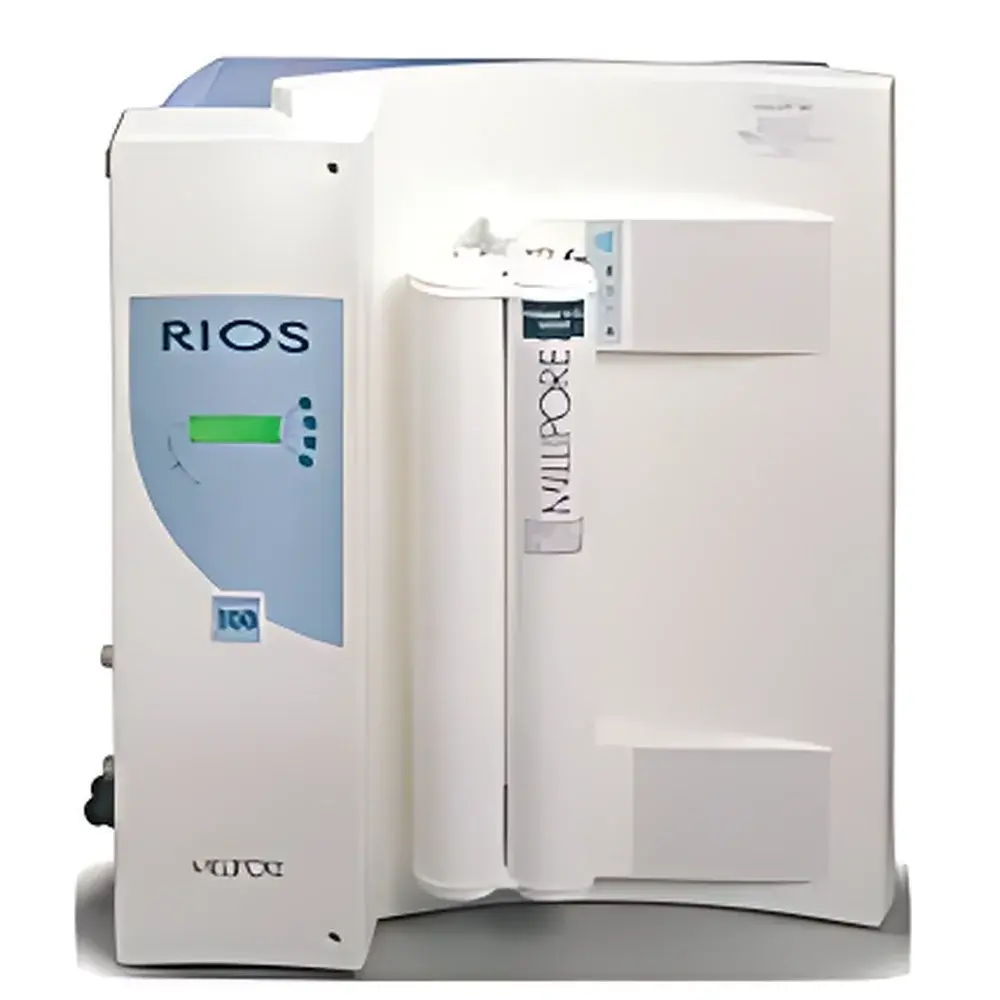
Merck Millipore RiOs 30 Ultra-Pure Water System
| Brand | Merck Millipore |
|---|---|
| Origin | France |
| Model | RiOs 30 |
| Feed Water Requirement | Municipal tap water or pretreated water |
| Resistivity | >10 MΩ·cm (at 25°C) |
| Heavy Metals & Soluble Silica | <0.1 ppb |
| Total Organic Carbon (TOC) | <30 ppb |
| Microbial Count | <0.001 CFU/mL |
| Particles (>0.1 µm) | <1/mL |
| Purification Grade | ASTM Type III Reagent Water |
| Compliance | Meets ISO 3696:1987, CLSI EP21-A, and USP <1231> for purified water |
Overview
The Merck Millipore RiOs 30 Ultra-Pure Water System is a robust, modular laboratory water purification platform engineered for continuous production of high-purity Type III water—designed to serve as feedstock for downstream ultra-pure water systems (e.g., Milli-Q®), as well as for routine laboratory applications including glassware rinsing, autoclave and washer feed, buffer preparation, and general analytical chemistry workflows. Built upon a reverse osmosis (RO)-based core architecture with integrated pre-treatment, dual-stage RO, and post-RO polishing, the RiOs 30 delivers consistent, trace-contaminant-controlled water under variable inlet conditions. Its real-time, multi-point monitoring system continuously tracks critical process parameters—including feed conductivity, RO permeate conductivity, membrane rejection ratio, operating pressure, and temperature—ensuring full transparency and reproducibility across daily operation cycles. The system operates without external control cabinets, integrating all sensors, actuators, and logic within its compact footprint for streamlined validation and reduced infrastructure dependency.
Key Features
- Modular design supporting scalable upgrades: optional UV oxidation, degassing, and distribution loop integration for extended system configurations
- Intelligent RO water recovery management: adjustable reject-to-permeate ratio enables optimization of water conservation and membrane longevity based on local feed quality and regulatory constraints
- Integrated pre-treatment cartridge system: standardized quick-change housings accommodate varying municipal water chemistries (e.g., chlorine, hardness, iron); validated for >12 months service life under typical lab usage
- Onboard resistivity sensor at point-of-use (POU) and in-loop locations; calibrated per ASTM D1193 and traceable to NIST standards
- Automated self-cleaning reservoir module with periodic UV irradiation and controlled drainage cycle to suppress biofilm formation in storage tanks
- Leak detection circuitry with automatic shutoff and audible/visual alerts compliant with IEC 61000-6-4 EMC requirements
Sample Compatibility & Compliance
The RiOs 30 is validated for use with standard municipal potable water supplies meeting WHO Guidelines for Drinking-water Quality and EU Directive 98/83/EC. It consistently produces water meeting or exceeding the specifications for ASTM Type III reagent water (ASTM D1193-20), ISO 3696:1987 Class 3, and USP Purified Water monograph. All wetted materials—including RO membranes, housing polymers, and sensor diaphragms—are USP Class VI certified and extractables-tested per ICH Q5C. The system supports GLP/GMP-aligned documentation packages, including IQ/OQ protocols, calibration records, and maintenance logs compatible with FDA 21 CFR Part 11-compliant electronic signature workflows when paired with Millipore’s LabManager™ software suite.
Software & Data Management
While the RiOs 30 operates as a standalone unit with intuitive front-panel interface, it natively supports digital integration via RS-485 Modbus RTU and optional Ethernet/IP connectivity. Integrated event logging captures timestamped entries for alarm triggers, cartridge replacement prompts, conductivity excursions, and UV lamp runtime—all exportable in CSV format for audit trail reconstruction. When deployed with Merck Millipore’s LabManager™ v4.2 or higher, the system contributes to centralized water quality dashboards, predictive maintenance scheduling, and automated report generation aligned with ISO/IEC 17025 clause 7.7 requirements for equipment monitoring.
Applications
The RiOs 30 serves as a foundational purification stage across diverse laboratory environments: clinical diagnostics labs utilizing automated analyzers requiring low-ionic-strength feedwater; pharmaceutical QC laboratories performing dissolution testing and cleaning validation where TOC and endotoxin limits are critical; academic research facilities maintaining large-volume buffer preparation workflows; and industrial R&D centers operating multiple parallel Milli-Q® systems whose performance stability depends on consistent, low-particulate, low-TOC feed. Its capacity (up to 30 L/h nominal flow) and modular expandability make it particularly suitable for mid-to-high throughput labs consuming 500–3,000 L/day of purified water.
FAQ
What feed water quality is required for optimal RiOs 30 performance?
Municipal tap water meeting EPA or local drinking water standards is acceptable; however, inlet hardness >150 ppm CaCO₃ or free chlorine >0.5 mg/L requires optional pre-treatment customization.
Can the RiOs 30 be validated for GMP environments?
Yes—full IQ/OQ documentation kits, calibration certificates traceable to national metrology institutes, and change control templates are available upon request.
Is remote monitoring supported out of the box?
Standard models include local data logging; Ethernet-enabled variants (RiOs 30-E) provide native SNMP and HTTP API access for integration into building management systems.
How often must consumables be replaced?
Pre-filters: every 6–12 months depending on feed quality; RO membranes: typically 2–3 years with proper pre-treatment and monitoring; UV lamps: annual replacement recommended for consistent germicidal efficacy.
Does the system meet environmental sustainability criteria?
Yes—the adjustable RO recovery function reduces wastewater generation by up to 40% versus fixed-ratio systems, and all plastic components comply with RoHS 2011/65/EU and REACH SVHC screening protocols.



