
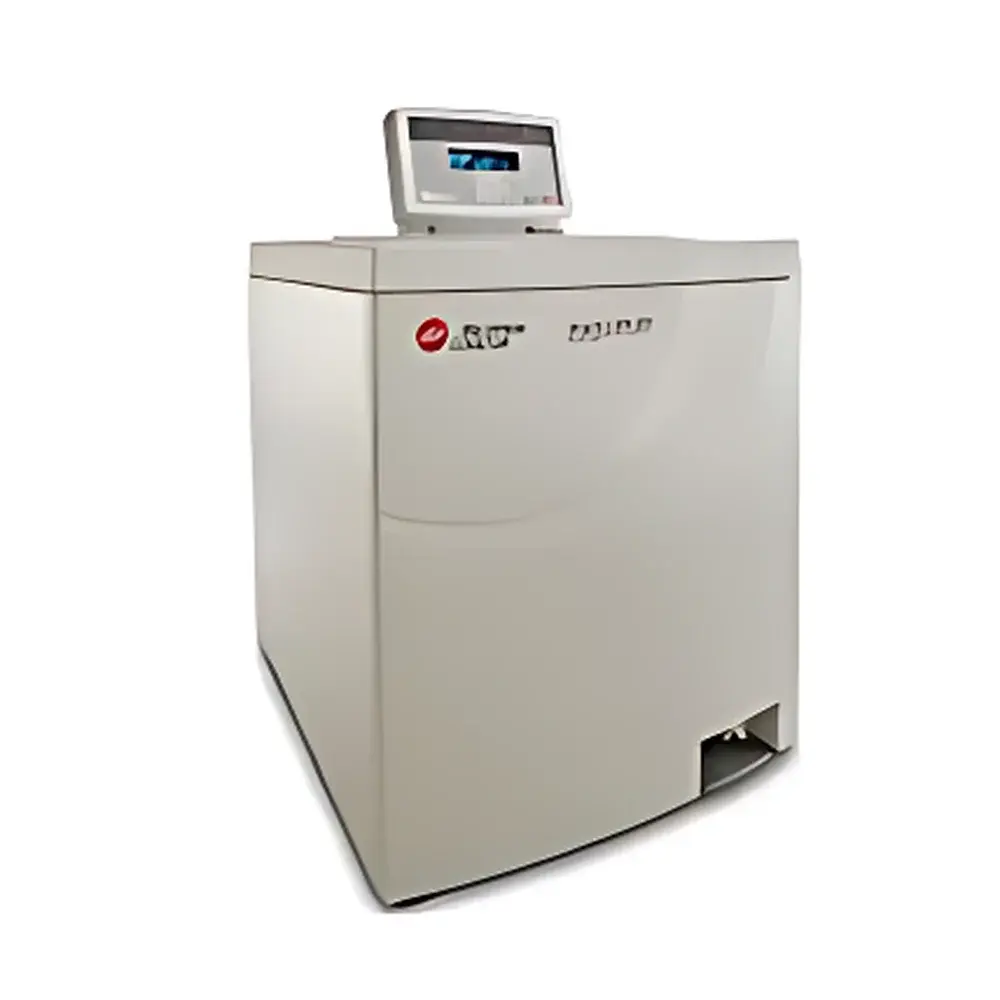
Beckman Coulter Avanti J-26S XP High-Speed Floor Model Centrifuge
| Brand | Beckman Coulter |
|---|---|
| Origin | USA |
| Model | Avanti J-26S XP |
| Instrument Type | Floor-standing centrifuge |
| Speed Range | Up to 26,000 rpm |
| Maximum RCF | 82,000 × g |
| Maximum Capacity | 6 L |
| Dimensions (W×D×H) | 86 × 71 × 86 cm |
| Rotor Compatibility | Fixed-angle, swing-bucket, and elutriation rotors |
| Safety Certification | IEC 61010-2-020, UL 61010-2-020, CE marked |
| Temperature Control Range | –10 °C to +40 °C |
| Imbalance Tolerance | ±3 g per bucket (at max speed) |
| Noise Level | ≤59 dBA at 2 m |
| Drive System | Patented Variable Reluctance Drive (VRD) |
| Rotor Recognition | Automatic RFID-based rotor identification |
| Biocontainment | Biosafety-certified rotors, sealed rotor lids, and aerosol-tight centrifuge chamber |
Overview
The Beckman Coulter Avanti J-26S XP is a high-performance, floor-standing preparative centrifuge engineered for demanding applications in biopharmaceutical development, clinical diagnostics, and academic research laboratories. It operates on the principle of sedimentation under controlled gravitational force (RCF), enabling rapid and reproducible separation of biological particles—including whole cells, subcellular organelles, viruses, and macromolecular complexes—based on differences in size, density, and shape. With a maximum rotational speed of 26,000 rpm and an RCF of 82,000 × g, the system delivers exceptional resolution for high-throughput processing of up to 6 liters per run. Its variable reluctance drive (VRD) architecture ensures precise acceleration/deceleration profiles, reduced mechanical wear, and energy-efficient operation—validated against IEC 61010-2-020 and UL 61010-2-020 safety standards.
Key Features
- Automatic RFID-based rotor recognition: Prevents overspeed operation by validating rotor model, maximum speed, and compatibility with current temperature and acceleration settings.
- J-Lite ultra-lightweight rotors: Engineered from advanced aluminum-magnesium alloys, reducing rotor mass by ~50% versus conventional designs—enabling faster spin-up/spin-down times and improved thermal stability during prolonged runs.
- Biosafety-integrated architecture: Includes aerosol-tight rotor chambers, hermetically sealed biocontainment lids, and validated biosafety rotors compliant with WHO BSL-2/BSL-3 handling requirements for infectious agents.
- Ergonomic human-centered design: Low-height chamber access (71 cm working height), foot-activated door release, and intuitive touchscreen interface reduce operator fatigue and improve workflow continuity.
- Precision temperature management: Dual-stage refrigeration system maintains setpoint accuracy within ±1 °C across the full operating range (–10 °C to +40 °C), critical for heat-sensitive samples such as primary cell isolates and protein complexes.
- High imbalance tolerance: Supports ±3 g imbalance per bucket at maximum speed—enhancing operational robustness in routine QC/QA environments where sample loading variability is common.
Sample Compatibility & Compliance
The Avanti J-26S XP accommodates a broad spectrum of sample formats: standard conical tubes (15–50 mL), centrifuge bottles (up to 1 L), microplates (24-well or 96-well formats), and specialized elutriation chambers for continuous-flow cell separation. All rotors are certified to ISO 13485 for medical device manufacturing environments and support GLP/GMP-compliant workflows through audit-trail-enabled software logging. The system meets FDA 21 CFR Part 11 requirements when operated with optional CyberLab™ software, ensuring electronic record integrity, user authentication, and change control for regulated laboratories.
Software & Data Management
CyberLab™ software (optional) provides comprehensive instrument control, method validation, and data traceability. Users can define, store, and recall SOP-compliant protocols with password-protected access levels. Real-time monitoring includes RCF, temperature, vacuum status, and rotor lifetime tracking. Export functions support CSV, PDF, and XML formats compatible with LIMS integration. All run logs include timestamps, operator ID, rotor serial number, and deviation alerts—fully aligned with ISO/IEC 17025 documentation requirements for accredited testing laboratories.
Applications
- Preparative isolation of mitochondria, lysosomes, and nuclei from mammalian tissue homogenates.
- Clarification and concentration of monoclonal antibodies and viral vectors in upstream bioprocessing.
- High-yield pelleting of bacterial cultures (e.g., E. coli, Bacillus) for plasmid DNA extraction or recombinant protein expression.
- Continuous counterflow centrifugal elutriation for label-free, viability-preserving separation of heterogeneous cell populations (e.g., stem cells, PBMC subsets).
- Processing of diagnostic specimens including serum, plasma, CSF, and bronchoalveolar lavage fluid under CLIA- and CAP-accredited conditions.
FAQ
What regulatory standards does the Avanti J-26S XP comply with?
It conforms to IEC 61010-2-020, UL 61010-2-020, CE marking directives, and supports FDA 21 CFR Part 11 compliance when paired with CyberLab™ software.
Can this centrifuge be used for BSL-3 agents?
Yes—when equipped with biosafety-certified rotors (e.g., Type 70 Ti, JA-25.50), sealed rotor lids, and operated within a certified BSL-3 facility, it meets CDC/NIH containment guidelines for select infectious agents.
Is rotor lifetime tracked automatically?
Yes—the system logs cumulative run hours, maximum speed history, and thermal cycles per rotor via embedded RFID; alerts trigger when service thresholds are approached.
Does the instrument support remote monitoring?
With optional Ethernet connectivity and CyberLab™ software, real-time status, alarms, and method execution can be supervised via secure web interface or enterprise LIMS.
What maintenance intervals are recommended?
Annual preventive maintenance is advised, including vacuum pump oil replacement, refrigeration system calibration, and rotor inspection per Beckman Coulter Technical Bulletin TB-112.
Related Products



