
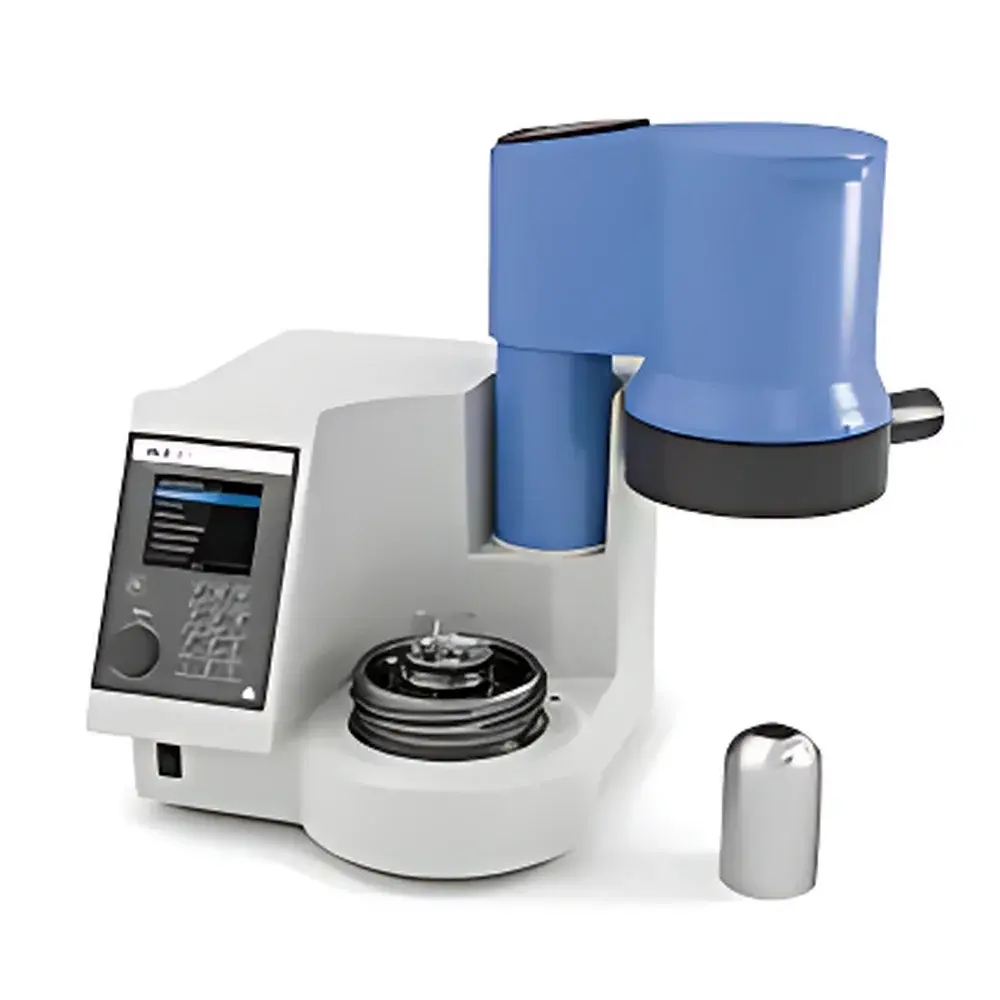
IKA C1 Package 1/10 Isoperibol Oxygen Bomb Calorimeter System
| Brand | IKA |
|---|---|
| Origin | Germany |
| Model | C1 Package 1/10 |
| Compliance | DIN 51900, ISO 1928 |
| Cooling Requirement | RC 2 basic recirculating chiller (included) |
| Software Compatibility | C6040 Calwin (optional) |
| Sample Capacity | Up to 500 initial tests with included consumables |
| Includes | C1.10 combustion vessel, C5010.5 large crucible holder, C6 large quartz crucible, calibration records (n=25), ignition wires, combustion aids, and accessory kit |
Overview
The IKA C1 Package 1/10 Isoperibol Oxygen Bomb Calorimeter System is a fully integrated, compact benchtop solution for precise determination of gross calorific value (GCV) in solid and liquid fuels, foodstuffs, waste materials, and research-grade organic compounds. Engineered for high reproducibility and operational efficiency, the system implements the classical isoperibol principle—where the calorimeter vessel is maintained at near-constant temperature by a thermostatically controlled water jacket—and applies the Rietveld correction formula for rigorous thermal equilibrium analysis. Unlike traditional adiabatic or static adiabatic systems, the C1’s isoperibol architecture eliminates complex active jacket temperature control while retaining metrological rigor required for compliance with DIN 51900 and ISO 1928. Its modular design replaces legacy threaded oxygen bombs with a quick-connect C1.10 combustion vessel, significantly reducing setup time and operator exposure to high-pressure oxygen handling. The system is not standalone: it requires synchronization with the RC 2 basic recirculating chiller (supplied in this package) to ensure stable thermal inertia and minimize drift during extended measurement cycles.
Key Features
- Compact isoperibol configuration with minimal footprint—optimized for shared laboratory spaces and ISO 17025-accredited testing environments
- Quick-release C1.10 combustion vessel with integrated safety interlock and pressure-rated sealing (up to 30 bar O₂)
- Pre-configured RC 2 basic chiller unit delivering ±0.01 °C temperature stability across the full operating range (15–30 °C ambient)
- Dual-port interface supporting simultaneous connection to analytical balance (RS-232/USB), PC (Ethernet), and optional C1.50 dot-matrix printer
- Factory-preloaded calibration dataset (25 certified benzoic acid runs) traceable to NIST SRM 39i and IKA-certified reference materials
- Integrated ignition circuit with selectable current profiles (standard NiCr wire or Pt wire via C1.123 option) for optimized combustion of low-volatility or heterogeneous samples
Sample Compatibility & Compliance
The C1 Package 1/10 supports a broad matrix of sample types—including coal, biomass pellets, plastics, pharmaceutical excipients, animal feed, and municipal solid waste—with mass ranges from 0.5 g to 1.2 g (depending on energy density). Combustion efficiency is enhanced via optional accessories: C5 VA stainless steel crucibles for halogen-rich samples; C12/C12A combustion bags for volatile or powdered matrices; and C9/C10 gelatin or acetyl tributyl citrate capsules for liquid or semi-solid specimens. All hardware and procedural workflows conform to DIN 51900 Annex A (determination of heat of combustion of solid and liquid fuels) and ISO 1928:2009 (solid mineral fuels—determination of gross calorific value). For regulated laboratories, the optional C6040 Calwin software provides audit-trail functionality compliant with FDA 21 CFR Part 11 and GLP data integrity requirements when deployed with electronic signature modules.
Software & Data Management
While the C1 operates autonomously via front-panel controls, integration with IKA’s C6040 Calwin software (sold separately) enables advanced data governance: automated calculation of net calorific value (NCV) using ASTM D3176 moisture and ash corrections; LIMS-ready CSV/Excel export with embedded metadata (operator ID, sample ID, calibration certificate number); and configurable report templates aligned with EN 14918 or UNI EN ISO 18125 reporting standards. Calwin supports multi-instrument fleet management—allowing centralized firmware updates, method library deployment, and cross-system validation documentation. Raw thermogram data (temperature vs. time, ±0.001 °C resolution) is retained in native .cal format for retrospective reprocessing without loss of precision.
Applications
- Fuel certification labs performing routine GCV verification per ASTM D2015 or ISO 1928 for coal, coke, and alternative fuels
- Food science departments quantifying metabolizable energy content (kcal/g) in accordance with AOAC 968.10 and ISO 9831
- Waste-to-energy facilities assessing higher heating value (HHV) of RDF/SRF streams prior to incineration
- Pharmaceutical R&D evaluating excipient compatibility and energetic stability of API formulations
- Academic thermodynamics laboratories conducting fundamental studies on combustion enthalpy and oxygen stoichiometry
FAQ
Is the RC 2 basic chiller mandatory for C1 operation?
Yes—the C1’s isoperibol performance depends critically on stable jacket temperature control; the RC 2 basic is the only chiller validated for seamless synchronization with the C1’s thermal feedback loop.
Can the C1 be used without Calwin software?
Yes—basic operation, data logging, and report generation are fully functional via the built-in display and optional printer; Calwin adds regulatory compliance features and advanced post-processing.
What consumables are included in the “500-test starter kit”?
The package contains 25 pre-calibrated benzoic acid tablets (C723), 25 C1.103 ignition wires, 50 C6 large quartz crucibles, 100 C12 combustion bags (40 × 35 mm), and 200 C710.4 cotton ignition threads.
Does the system support automatic oxygen charging?
No—oxygen pressurization (typically 30 bar) is performed manually via the C1.30 venting station (optional accessory) to maintain full operator control over gas purity and fill consistency.
Is third-party LIMS integration possible without Calwin?
Yes—raw ASCII output via RS-232 or Ethernet allows custom middleware ingestion, though audit-trail and electronic signature capabilities require Calwin licensing.




