
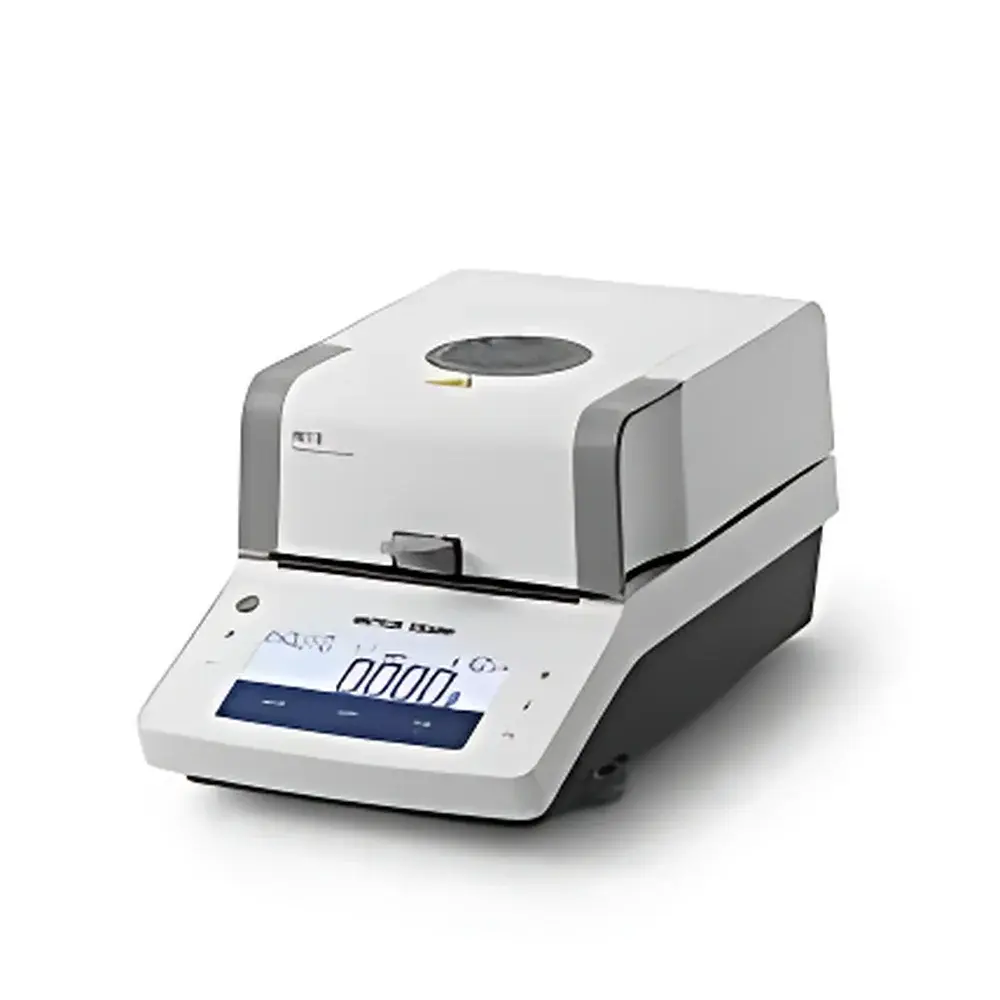
METTLER TOLEDO HE83 Entry-Level Infrared Moisture Analyzer
| Brand | METTLER TOLEDO |
|---|---|
| Origin | Switzerland |
| Model | HE83 |
| Readability | 0.01% |
| Repeatability (sd, 2g sample) | 0.15% |
| Repeatability (sd, 10g sample) | 0.05% |
| Moisture Range | 1–100% MC |
| Sample Capacity | 81 g |
| Minimum Sample Mass | 0.5 g |
| Drying Temperature Range | 50–200 °C |
| Heating Profile Options | Standard, Rapid |
| Display Modes | %MC, %DC, %AM, %AD, g |
| Method Storage | 2 methods + 1 result |
| Interface | RS232 for external printer |
Overview
The METTLER TOLEDO HE83 Entry-Level Infrared Moisture Analyzer is a robust, benchtop thermogravimetric instrument engineered for routine moisture content determination in quality control laboratories, production environments, and educational settings. It operates on the principle of loss-on-drying (LOD), combining integrated precision weighing with controlled infrared heating via a circular halogen lamp. This configuration ensures uniform thermal energy distribution across the sample surface, minimizing edge effects and promoting consistent drying kinetics. Unlike traditional oven-drying methods requiring hours, the HE83 delivers reliable moisture results in minutes—without compromising measurement traceability or regulatory compliance. Designed for daily high-throughput operation, the system integrates a built-in analytical balance and heating module within a single mechanical housing, eliminating inter-unit calibration drift and enhancing long-term stability.
Key Features
- Circular halogen lamp heating system providing rapid, homogeneous sample heating with adjustable temperature control from 50 °C to 200 °C
- Integrated high-resolution weighing unit with 0.01% readability and factory-calibrated linearity, supporting sample loads up to 81 g
- Backlit LCD display offering real-time visualization of multiple moisture-related parameters: % Moisture Content (%MC), % Dry Content (%DC), % Absorbed Moisture (%AM), % Absorbed Dry Basis (%AD), and absolute mass (g)
- Pre-programmed drying profiles—including Standard and Rapid modes—to accommodate diverse sample matrices and throughput requirements
- Onboard calibration routines for both weighing and heating subsystems, ensuring ongoing metrological integrity without external service intervention
- RS232 serial interface compliant with industry-standard protocols, enabling direct connection to external printers for GxP-compliant hardcopy output with time stamps and operator identification fields
Sample Compatibility & Compliance
The HE83 accommodates solid, semi-solid, and granular samples with minimum mass requirements as low as 0.5 g—making it suitable for pharmaceutical excipients, food powders, polymers, ceramics, and agricultural commodities. Its validated moisture range spans 1–100% MC, covering both low-moisture materials (e.g., anhydrous APIs) and highly hygroscopic substances (e.g., starch-based formulations). The instrument supports method development aligned with ASTM E1447, ISO 12879, and USP <921>, and its data output architecture facilitates audit-ready documentation required under FDA 21 CFR Part 11 when paired with compliant printer firmware and lab-controlled access protocols. All internal calibration records are stored with date/time stamps and user identifiers, satisfying GLP and GMP traceability expectations.
Software & Data Management
While the HE83 operates as a standalone instrument with no PC dependency, its embedded firmware provides full method management for two independent drying protocols plus one active result set per session. Each method stores target temperature, heating profile type, termination criteria (time-based or slope-based), and display preferences. All measurements include automatic timestamping and sequential result indexing. When interfaced with an RS232-compatible thermal or dot-matrix printer, the device outputs raw mass data, intermediate weight readings, final moisture percentage, method ID, operator code (if entered), and environmental conditions (if external sensors are connected via optional I/O modules). No proprietary software installation is required—output formatting adheres to ANSI/ISO standard print syntax for seamless integration into existing LIMS or paper-based QC workflows.
Applications
- Pharmaceutical manufacturing: Moisture verification of active pharmaceutical ingredients (APIs), excipients, and finished dosage forms per USP <921> and EP 2.5.12
- Food & beverage QA/QC: Rapid assessment of flour, dairy powders, coffee beans, and snack products to ensure shelf-life stability and microbial safety thresholds
- Chemical and polymer processing: Monitoring residual solvent content in resins, catalysts, and battery electrode slurries prior to compaction or coating
- Agricultural testing labs: Determination of grain moisture content for storage classification and trade compliance (e.g., ISO 6540, ISO 712)
- Academic research: Teaching thermogravimetric principles, method validation exercises, and comparative LOD studies against Karl Fischer titration
FAQ
Does the HE83 require external calibration weights or service tools for routine operation?
No—the instrument includes automated internal calibration routines for both the weighing cell and heating system, accessible via the front-panel menu. External calibration is only necessary during annual metrological verification or after physical impact events.
Can the HE83 be used for volatile organic compound (VOC) analysis?
No—it measures total volatile loss under defined thermal conditions and does not distinguish between water and other volatiles. For selective water quantification in VOC-rich matrices, Karl Fischer titration remains the reference method.
Is the RS232 interface compatible with modern label printers or only legacy dot-matrix devices?
The interface complies with standard EIA/TIA-232-F electrical signaling and ASCII command sets. While optimized for industrial thermal printers, it can drive any RS232-enabled printer supporting ESC/P or Epson FX emulation.
How does the HE83 handle samples that spatter or foam during drying?
Users may mitigate this by pre-drying at lower temperatures (e.g., 50–80 °C) using the Standard profile, applying glass fiber filters, or reducing initial sample mass. The instrument’s slope-based termination logic helps prevent over-drying artifacts in such cases.
Are method files exportable to other METTLER TOLEDO instruments like the HG63 or HR83?
Method parameters are not directly transferable due to hardware-specific thermal response characteristics and firmware architecture differences. However, established drying profiles can be manually replicated on higher-tier models with expanded functionality.




