
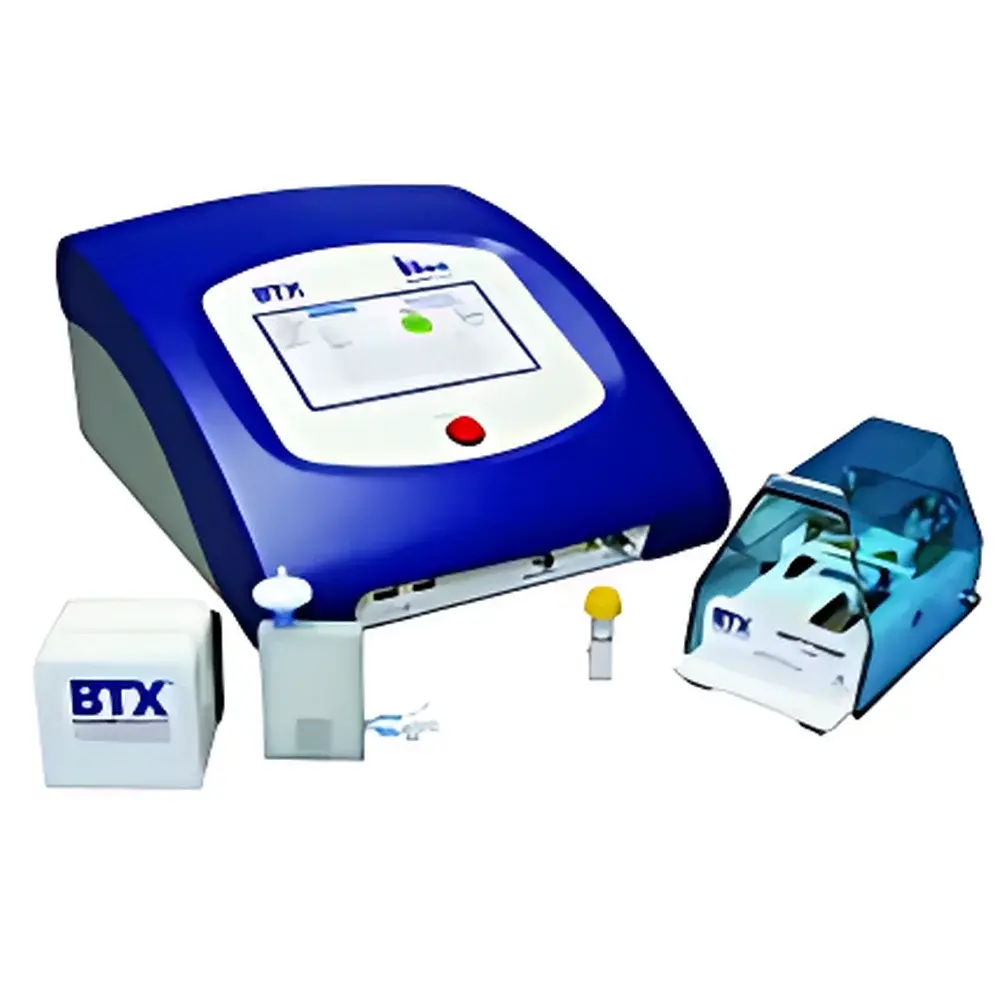
BTX Agile Pulse Max Large-Volume Electroporation System
| Origin | USA |
|---|---|
| Manufacturer Type | Authorized Distributor |
| Origin Category | Imported |
| Model | Agile Pulse Max |
| Product Type | Cell Analysis System |
| User Interface | Color Touchscreen |
| Voltage Range | 50–1200 V |
| Pulse Duration | 5 µs – 10 ms |
| Inter-Pulse Interval | 20 µs – 1 s |
| Data Export | USB Flash Drive |
| Operating Temperature | 10–40 °C |
| Input Voltage | 100–250 VAC |
| Dimensions (L×W×H) | 32.0 × 20.0 × 39.9 cm |
| Weight | 11.34 kg |
Overview
The BTX Agile Pulse Max Large-Volume Electroporation System is an engineered platform for high-efficiency, scalable nucleic acid and macromolecule delivery into mammalian cells—specifically optimized for volumes up to 10 mL per run. Unlike conventional electroporators designed for microliter-scale cuvettes, the Agile Pulse Max leverages proprietary Agile Pulse segmented waveform technology to deliver precisely controlled, multi-phase electrical pulses that minimize thermal stress while maximizing membrane permeabilization kinetics. This approach enables reproducible transfection of sensitive primary cells—including B lymphocytes, dendritic cells, and T cells—under conditions compatible with Good Manufacturing Practice (GMP)-aligned process development. The system operates on the principle of reversible electroporation, where transient, voltage-dependent pore formation in the plasma membrane allows exogenous molecules (e.g., plasmid DNA, mRNA, siRNA, peptides, or viral vectors) to enter the cytosol with minimal cytotoxicity and high functional payload retention.
Key Features
- Agile Pulse segmented waveform architecture: Delivers programmable, multi-step pulse trains (e.g., pre-pulse conditioning followed by main electroporation and post-pulse stabilization), enhancing transfection efficiency across heterogeneous cell populations.
- Large-volume compatibility: Supports standardized BTX large-volume electroporation chambers (up to 10 mL sample volume), enabling scalable transfection without compromising viability or expression uniformity—critical for therapeutic cell manufacturing.
- Full experimental traceability: Built-in logging captures all critical parameters (voltage, pulse duration, interval, temperature, chamber ID, operator timestamp) and stores them locally with optional export via USB drive for audit-ready documentation.
- Remote operation & intuitive interface: Equipped with a responsive color touchscreen and Ethernet-enabled control architecture, allowing integration into centralized lab management systems and remote protocol execution from a networked workstation.
- Flexible program management: Stores >100 user-defined protocols with hierarchical naming, versioning, and parameter locking—supporting both routine SOP deployment and iterative optimization under GLP-compliant workflows.
Sample Compatibility & Compliance
The Agile Pulse Max is validated for use with suspension and adherent mammalian cell types, including primary human B cells, hybridomas, HEK293, CHO, and Jurkat lines. Its pulse parameter range (50–1200 V, 5 µs–10 ms, 20 µs–1 s intervals) accommodates diverse electrophysiological thresholds across cell sizes and membrane capacitances. The system complies with IEC 61010-1:2010 for laboratory electrical safety and meets electromagnetic compatibility (EMC) requirements per EN 61326-1. While not FDA-cleared as a medical device, its design supports adherence to ISO 13485-aligned quality systems when deployed in preclinical or clinical-grade cell therapy process development. All firmware and software components are compatible with 21 CFR Part 11–ready data integrity configurations when integrated with validated LIMS or ELN platforms.
Software & Data Management
The embedded operating system provides real-time parameter monitoring and post-run summary reports, including calculated field strength (V/cm), total energy delivered (J/mL), and estimated pore resealing time based on empirical models. Data export is restricted to non-proprietary CSV format via USB 2.0 interface—ensuring interoperability with third-party analysis tools (e.g., Python pandas, MATLAB, GraphPad Prism). Audit trails include immutable timestamps, user login IDs, and checksum-verified parameter logs—enabling full traceability required for internal QA reviews and regulatory submissions. Optional firmware updates are digitally signed and delivered through secure HTTPS channels.
Applications
- B-cell cloning and monoclonal antibody production: Efficient plasmid transfection into primary B cells for rapid hybridoma generation and recombinant IgG expression.
- Cancer immunotherapy: Electroporation of mRNA encoding tumor-associated antigens or chimeric antigen receptors (CARs) into autologous T or NK cells at clinically relevant scales.
- Replication-defective viral vector production: High-yield transfection of HEK293T or Sf9 cells for lentiviral, AAV, or baculovirus manufacturing.
- Functional genomics: siRNA- or CRISPR RNP-mediated knockdown/knockout in primary immune cells with minimized off-target effects.
- Peptide-based therapeutics: Delivery of synthetic immunomodulatory peptides into antigen-presenting cells for vaccine development studies.
FAQ
Is the Agile Pulse Max suitable for GMP-compliant manufacturing environments?
Yes—its deterministic pulse delivery, full parameter logging, and compatibility with electronic signature and audit trail configurations support alignment with Annex 11 and FDA Process Validation Guidance when implemented within a qualified infrastructure.
Can I validate my own electroporation chamber designs with this system?
The Agile Pulse Max accepts custom chamber geometries provided they meet BTX’s mechanical and electrical interface specifications (e.g., electrode spacing tolerance ±0.1 mm, impedance range 50–500 Ω); validation must include field homogeneity mapping and thermal profiling per ISO/IEC 17025 guidelines.
Does the system support automated liquid handling integration?
It offers RS-232 and TCP/IP command-line interfaces for bidirectional communication with robotic workstations; integration requires third-party driver development and is documented in the OEM API Reference Manual.
What maintenance is required to ensure long-term calibration stability?
Annual verification of voltage output accuracy (±2% full scale) and pulse timing fidelity (±0.1 µs) using NIST-traceable oscilloscope and high-voltage probe is recommended; no user-serviceable internal calibration is permitted.




