
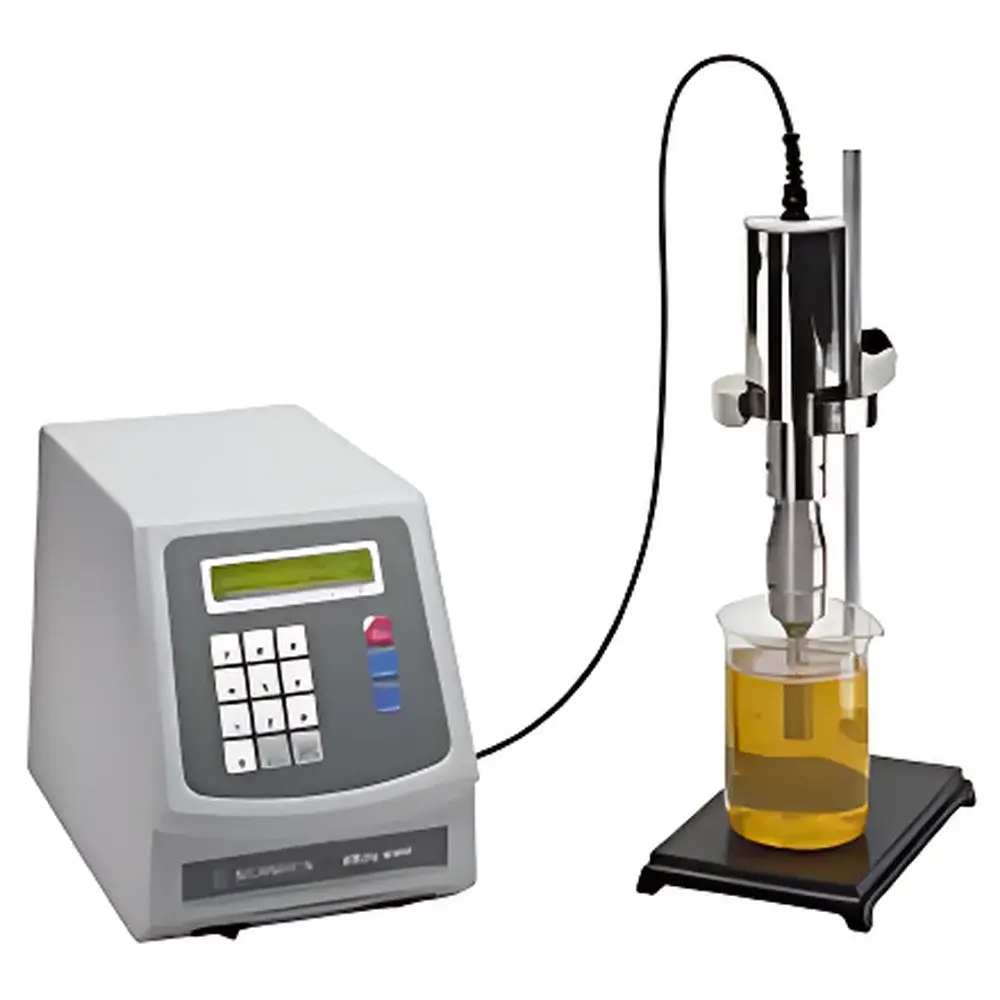
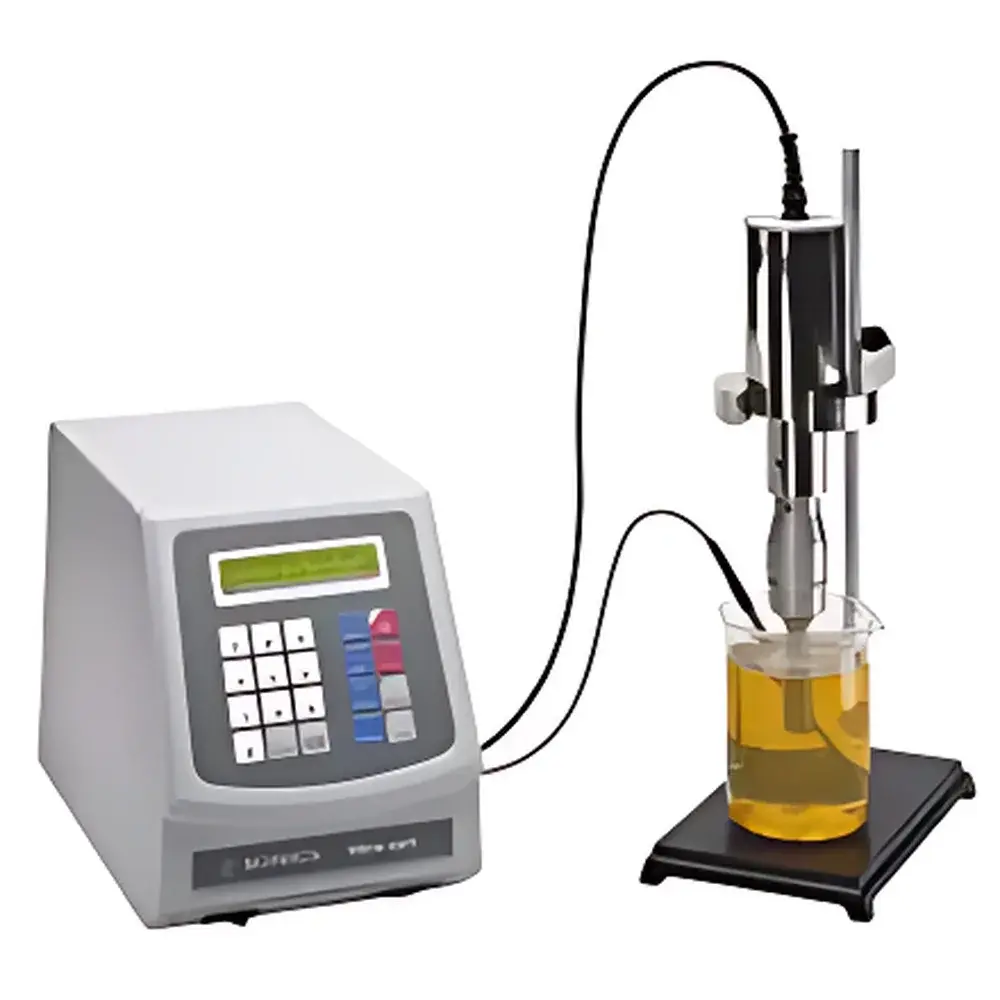
Sonics VC800/VCX800 Ultrasonic Cell Disruptor
| Brand | Sonics |
|---|---|
| Origin | USA |
| Model | VC800/VCX800 |
| Ultrasonic Output Power | 800 W |
| Operating Frequency | 20 kHz |
| Temperature Range | 1–100 °C |
| Sample Volume Capacity | 250 µL to several liters |
| Number of Samples per Run | 1 |
Overview
The Sonics VC800 and VCX800 Ultrasonic Cell Disruptors are high-performance, microprocessor-controlled laboratory instruments engineered for reliable and reproducible cell lysis, tissue homogenization, nanoparticle dispersion, and DNA shearing. Based on piezoelectric ultrasonic energy conversion, these systems generate intense cavitation in liquid media via a titanium alloy probe (horn), inducing localized shear forces, shockwaves, and microstreaming that disrupt cellular membranes and subcellular structures. Unlike bead-beating or enzymatic methods, ultrasonic disruption offers precise control over energy delivery without introducing exogenous contaminants or requiring consumables. The VC800 serves as a robust entry-level platform with digital power display and pulse modulation, while the VCX800 integrates an optional stainless-steel temperature probe and closed-loop thermal regulation—critical for heat-sensitive biomolecules such as proteins, plasmids, and ribonucleoprotein complexes.
Key Features
- 800 W nominal ultrasonic output power at 20 kHz, delivered via a CV26 sealed piezoelectric transducer (PZT ceramic) with integrated cooling and corrosion-resistant housing
- Microprocessor-based control architecture supporting programmable protocols: up to 10 user-defined methods stored internally on VCX800; 99 min 59 sec timer on VC800, extended to 10 hours on VCX800
- Pulse mode operation with independent ON/OFF timing control (1–10 s adjustable ON duration, 1 s fixed OFF interval), minimizing thermal accumulation during extended processing
- Digital real-time monitoring of critical operational parameters: actual delivered power (W), amplitude (%), elapsed/remaining time, temperature (VCX800 only), pulse count, and instantaneous frequency tracking
- Automatic frequency tuning and amplitude compensation ensure consistent energy transfer across varying sample viscosities and volumes
- Compact footprint (235 × 190 × 340 mm) and lightweight design (6.8 kg), enabling integration into biosafety cabinets or cold rooms
- Titanium alloy (Ti-6Al-4V) probe with 13 mm tip diameter, optimized for sample volumes from 10 mL to 250 mL; compatible with threaded replaceable tips for multi-scale applications
Sample Compatibility & Compliance
These disruptors accommodate a broad range of biological matrices—including bacterial cultures (E. coli, Bacillus), yeast, mammalian cells (HEK293, CHO), plant tissues, and subcellular fractions—without compromising integrity of target analytes when operated within validated thermal and amplitude limits. The VCX800’s integrated temperature monitoring (1–100 °C range) supports compliance with Good Laboratory Practice (GLP) and Good Manufacturing Practice (GMP) requirements where thermal stability is mandated. While not certified to ISO/IEC 17025, the instrument’s traceable power calibration, repeatable amplitude settings, and audit-ready parameter logging align with internal validation protocols for QC laboratories conducting USP Analytical Instrument Qualification. All electrical components conform to IEC 61010-1 safety standards for laboratory equipment.
Software & Data Management
Both models operate autonomously via front-panel interface with no external software dependency. The VCX800 provides timestamped, non-volatile storage of all executed runs—including setpoints, actual values, and error codes—for retrospective review. Data export is not natively supported; however, manual transcription of displayed parameters satisfies basic documentation needs under FDA 21 CFR Part 11 when paired with controlled lab notebooks and SOPs. For regulated environments, users may integrate the device into broader LIMS workflows via external environmental monitoring systems linked to the optional temperature probe output (0–5 V analog signal). Firmware updates are performed by authorized Sonics service centers only, ensuring configuration integrity.
Applications
- Preparative-scale lysis of Gram-negative and Gram-positive bacteria for inclusion body recovery or soluble protein expression
- Chromatin fragmentation in ChIP-seq workflows, achieving fragment sizes between 200–500 bp with reproducible duty cycles
- Emulsification of lipid nanoparticles (LNPs) and nanostructured lipid carriers (NLCs) in mRNA vaccine development
- Disaggregation of amyloid fibrils and protein aggregates for structural biology studies
- Homogenization of fibrous or lipid-rich tissues (liver, adipose, brain) prior to nucleic acid or metabolite extraction
- Deagglomeration of metal oxide nanoparticles (e.g., TiO₂, ZnO) in suspension stability testing per ASTM D7865
FAQ
What is the difference between VC800 and VCX800?
The VCX800 includes an integrated temperature control module with real-time monitoring and optional feedback regulation, whereas the VC800 lacks thermal sensing capability.
Can the instrument process multiple samples simultaneously?
No—both models are designed for single-sample processing per cycle. Parallel throughput requires sequential runs or use of multi-probe accessories (sold separately).
Is the transducer waterproof or submersible?
The CV26 transducer is hermetically sealed against moisture, dust, and corrosive vapors but is not rated for full immersion; it must remain above liquid level during operation.
What maintenance is required for long-term reliability?
Routine inspection of probe threads and tip erosion, annual recalibration of power output by authorized service personnel, and replacement of damping gaskets every 24 months under continuous use.
Does Sonics provide IQ/OQ documentation support?
Yes—Sonics supplies standardized Installation Qualification (IQ) and Operational Qualification (OQ) templates aligned with pharmaceutical industry expectations; site-specific Performance Qualification (PQ) must be conducted by the end user.
Related Products



