
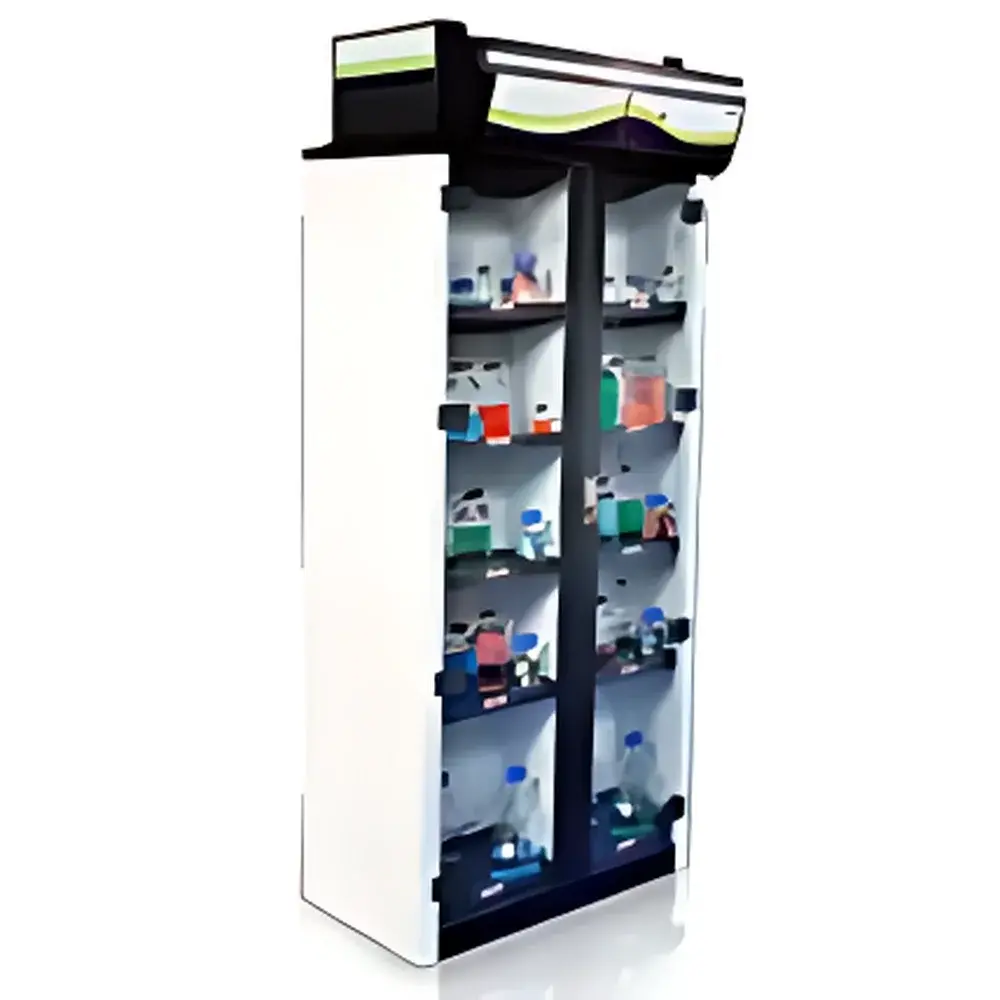
Erlab Captair Smart Filtered Chemical Storage Cabinet
| Brand | Erlab |
|---|---|
| Origin | France |
| Model | Captair Smart |
| Airflow Capacity | 70 m³/h (822), 220 m³/h (834 & 1634) |
| Construction | Galvanized steel with epoxy-polyester coating + chemical-resistant polypropylene (PP) transparent panels |
| Filter Options | HF2 AS / HF2 BE+ / HF2 F / HF2 K (for 822) |
| Compliance | JG/T 385–2012, CE, ISO 9001:2008, 3Q (IQ/OQ/PQ) documentation available |
| Remote Monitoring | e-Guard software (real-time status, alerts, parameter adjustment) |
| Safety Indicators | LED status light + audible fault coding (door ajar, filter saturation, fan failure) |
| Filter Life Monitoring | Molecode S (organic), Molecode A (inorganic), Molecode F (formaldehyde) sensors |
| Max Storage (500 mL bottles) | 50+ (822), ~160/120 (834), ~320/240 (1634) |
| Power Supply | 100–240 V AC, internal 24 V DC circuitry |
| Filter Capacity Data | Validated adsorption mass per chemical at 1% of OEL (TWA), per Erlab Chemical Compatibility Guide (>600 substances documented) |
Overview
The Erlab Captair Smart Filtered Chemical Storage Cabinet is an engineered containment solution designed for the safe, ventilated storage of volatile organic compounds (VOCs), inorganic acids, aldehydes, ammonia, and particulate-laden reagents in research, quality control, and production laboratories. Unlike conventional ventilated cabinets that exhaust to the outside environment, the Captair Smart employs a closed-loop, recirculating air purification system based on multi-stage, application-specific activated carbon and specialty sorbent filtration. Air is continuously drawn from the cabinet interior, passed through replaceable filter modules selected according to stored chemical classes, and returned—cleaned—to the laboratory space at a certified airflow rate (70 m³/h for model 822; 220 m³/h for models 834 and 1634). This design eliminates ductwork requirements while maintaining consistent negative pressure inside the cabinet, preventing fugitive emissions and reducing HVAC load. The system operates 24/7 and is validated to meet JG/T 385–2012—the Chinese industry standard governing performance, safety, and testing methodology for filtered chemical storage cabinets—including minimum adsorption capacity thresholds at 1% of the occupational exposure limit (OEL/TWA) for benchmark chemicals such as isopropanol, cyclohexane, and hydrochloric acid.
Key Features
- Modular, chemically tailored filtration: Select from HF2 or GF4 series filters—each engineered for distinct hazard profiles (e.g., HF2 AS for organics; GF4 BE+ for mixed organic/inorganic vapors; GF4 F for formaldehyde; GF4 K for ammonia; GF4 HP for fine particulates).
- Real-time, sensor-driven filter life monitoring: Molecode® digital sensors (S, A, F variants) quantify breakthrough risk by tracking dynamic adsorption saturation against chemical-specific OEL-based thresholds—not generic time-based replacement schedules.
- Integrated safety feedback system: Dual-mode status indication via front-panel LED and programmable audible alarm sequences—distinct tones encode fault conditions including door-open state, filter end-of-service, and centrifugal fan failure.
- Robust, corrosion-inhibiting construction: All structural components fabricated from galvanized steel substrate, uniformly coated with a hybrid epoxy-polyester finish resistant to splashes, fumes, and long-term chemical exposure; transparent viewing panels made from UV-stabilized, chemical-grade polypropylene (PP).
- Configurable storage architecture: Multiple access options—sliding doors (822), full-height hinged doors or drawer systems (834), or scalable multi-door configurations (1634)—optimized for bottle size, frequency of access, and inventory density (up to 320 × 500 mL containers).
- Compliance-ready documentation package: Includes CE Declaration of Conformity, ISO 9001:2008 Quality Management System certification, full 3Q validation protocol (Installation Qualification, Operational Qualification, Performance Qualification), and third-party test reports verifying adherence to JG/T 385–2012.
Sample Compatibility & Compliance
The Captair Smart accommodates both solid and liquid chemical reagents across ICH Q5, USP , and GLP-aligned storage practices. Its filtration matrix is validated against >600 substances listed in the Erlab Chemical Compatibility Guide, with adsorption capacities reported at 1% TWA—a scientifically rigorous metric aligned with occupational hygiene frameworks. Cabinet operation complies with JG/T 385–2012 mechanical integrity, airflow uniformity, and leakage rate requirements. CE marking confirms conformity with EU Machinery Directive 2006/42/EC and Electromagnetic Compatibility Directive 2014/30/EU. While not intrinsically rated for Class I Division 1 hazardous locations, the unit’s 24 V DC internal circuitry and sealed fan assembly minimize ignition risk in typical lab environments. For regulated pharmaceutical or clinical labs, e-Guard software supports ALCOA+ data integrity principles and can be configured to generate audit trails compliant with FDA 21 CFR Part 11 when deployed on validated IT infrastructure.
Software & Data Management
The e-Guard communication platform enables secure, browser-based remote supervision of up to 32 Captair Smart units on a single network. Users access real-time operational parameters—including airflow velocity, filter saturation index (% remaining capacity), door status, and fan RPM—as well as historical trend logs exportable in CSV format. Configuration changes (e.g., alarm thresholds, notification recipients, filter type assignment) are executed remotely without physical access. Alarm events trigger automated email/SMS notifications with diagnostic codes, supporting rapid response and preventive maintenance planning. All data exchanges use TLS 1.2 encryption; local data residency options are available to meet regional data sovereignty requirements (e.g., GDPR, PIPL). Audit trail functionality records user login, parameter modification, and alarm acknowledgment timestamps—essential for GxP-regulated environments requiring traceability per Annex 11 and ISO/IEC 17025.
Applications
- Academic and industrial R&D labs storing flammable solvents (acetone, ethanol, THF), corrosive inorganics (HCl, HNO₃, HF), and toxic aldehydes (formaldehyde, acetaldehyde).
- Pharmaceutical QC laboratories managing reference standards, impurity controls, and stability study samples under controlled ambient conditions without external venting.
- Contract manufacturing organizations (CMOs) requiring documented, repeatable storage compliance for API intermediates and high-potency compounds.
- Environmental testing facilities handling EPA Method 8260/8270 analytes where vapor containment prevents cross-contamination between sample batches.
- Educational institutions seeking pedagogically transparent safety infrastructure—integrated LED indicators and audible diagnostics support student training in hazard recognition and equipment stewardship.
FAQ
How is filter service life determined—and is it based on time or usage?
Filter replacement is determined dynamically using Molecode® sensors calibrated to chemical-specific breakthrough curves. Service life is calculated in real time against 1% of the substance’s OEL (TWA), not calendar time—ensuring optimal utilization and eliminating premature replacement.
Can the cabinet be integrated into an existing laboratory BMS or safety management system?
Yes. e-Guard supports Modbus TCP and RESTful API interfaces for bidirectional integration with building management systems (BMS), EHS platforms, and CMMS solutions—enabling centralized alarm aggregation and preventive maintenance scheduling.
Does the unit require external ducting or make-up air compensation?
No. The Captair Smart is a recirculating system: purified air is returned to the lab. No external exhaust or dedicated make-up air supply is needed—reducing installation complexity and energy overhead.
What validation documentation is provided for GMP or GLP audits?
A complete 3Q package (IQ/OQ/PQ protocols and executed reports), JG/T 385–2012 third-party test certificates, CE DoC, ISO 9001:2008 certificate, and filter compatibility data per Erlab’s published chemical guide are supplied with each unit.
Is ozone generation or UV-C irradiation used in the purification process?
No. Purification relies solely on physical adsorption and chemisorption within certified activated carbon and impregnated sorbent media—no reactive byproducts, ozone, or UV exposure are introduced into the airstream.



