
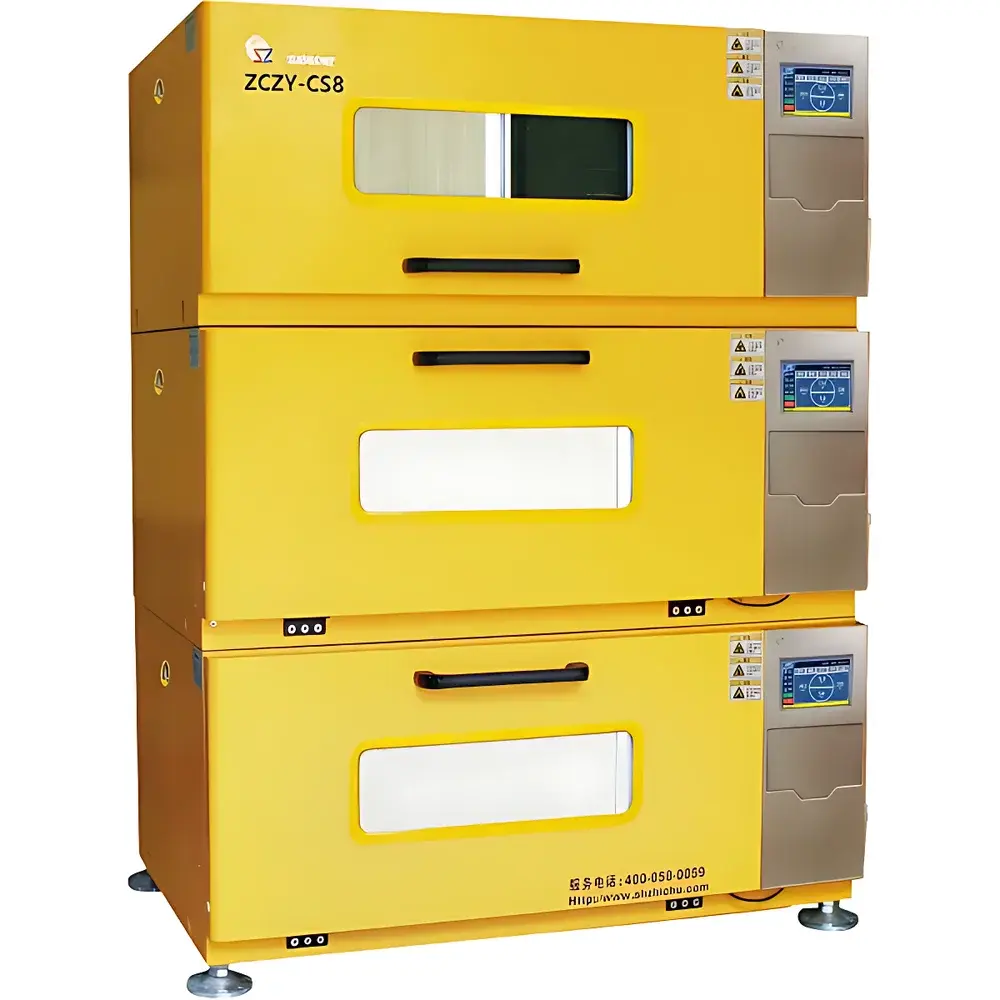
ZhiChu ZCZY-CS8 Modular CO₂ Incubator Shaker
| Brand | ZhiChu |
|---|---|
| Origin | Guangdong, China |
| Manufacturer Type | Authorized Distributor |
| Product Category | Domestic |
| Model | ZCZY-CS8 |
| Instrument Type | CO₂-Controlled Temperature-Controlled Orbital Shaker |
| Timer Range | 0–999.9 h |
| Oscillation Frequency Accuracy | ±1 rpm |
| Orbit Diameter | Ø50 mm (standard), Ø26 mm (optional) |
| Temperature Range | 4–60 °C (ambient 23–25 °C) |
| Number of Shaking Platforms | 3 |
Overview
The ZhiChu ZCZY-CS8 Modular CO₂ Incubator Shaker is an integrated life science platform engineered for simultaneous control of temperature, CO₂ concentration, humidity, and orbital agitation—optimized for suspension cell culture, microbial fermentation, protein expression, and bioprocess development under physiologically relevant conditions. Unlike conventional shakers or standalone incubators, this system employs a patented three-dimensional eccentric drive mechanism to deliver smooth, low-vibration orbital motion across up to three independently controlled decks. Its core measurement and control architecture integrates an imported infrared CO₂ sensor (0–20% range, ±0.1% accuracy), PID-driven microprocessor temperature regulation (±0.1 °C setpoint accuracy, ±0.5 °C uniformity at 37 °C), and programmable humidity management via dual-stage evaporative humidification. Designed for long-term stability in demanding laboratory environments, the unit utilizes eco-friendly refrigerant, adjustable cooling capacity, and intelligent defrost scheduling (1–250 s duration, 30–600 min intervals) to maintain uninterrupted operation—even during extended low-temperature runs.
Key Features
- Modular 1–3 deck configuration: Maximizes usable workspace per floor area; each deck operates with independent temperature, speed, CO₂, and timer settings
- Three-axis eccentric drive system: Ensures mechanical durability, minimal harmonic resonance, and consistent orbital performance over >20,000 hours of continuous operation
- CO₂ control: High-sensitivity NDIR sensor with automatic calibration compensation; leak rate <0.5% CO₂/h (5% → 4.5% decay in ≥30 min)
- Humidity management: Dual-tier stainless steel humidification trays achieve ≥90% RH at 37 °C; full-access bottom chamber allows tool-free cavity rinsing
- Intelligent safety architecture: Over-temperature alarm + auto-cutout, power-fail recovery with state retention, door-open immediate stop, UV-C germicidal lamp (254 nm)
- Human-centered interface: 7-inch capacitive LCD touchscreen with multi-parameter overlay (real-time temp/CO₂/speed/time curves), password-protected parameter locking, bidirectional rotation toggle
- Thermal integrity: Double-glazed, heated tempered glass door with anti-fog heating elements; R-cornered 304 stainless steel interior (99% bacterial inhibition per ISO 22196)
- Acoustic optimization: Noise emission <55 dB(A) at 1 m; integrated ferrite magnetic rings suppress EMI from motor and control circuits
Sample Compatibility & Compliance
The ZCZY-CS8 accommodates standard microbiological and mammalian culture vessels—including Erlenmeyer flasks (250–2000 mL), baffled bottles, and roller bottles—via interchangeable universal plastic clamps or stainless steel fixtures. Each deck supports up to 66 × 250 mL flasks (stainless) or 60 × 250 mL (plastic), with clamp plates secured via one-touch release. The chamber’s gas-tight construction meets ISO 13485-aligned sealing validation protocols, while its temperature and CO₂ control algorithms comply with GLP-relevant traceability requirements. Data logging adheres to ALCOA+ principles: time-stamped, immutable records (5-year local storage), exportable via USB 2.0 in CSV format. Optional remote monitoring via secure iOS/Android app enables real-time alerts and historical trend review—supporting audit readiness for FDA 21 CFR Part 11–governed workflows when paired with user-defined electronic signatures.
Software & Data Management
Embedded firmware provides continuous acquisition of temperature, CO₂ concentration, rotational speed, humidity, and elapsed time at 10-second intervals. All parameters are visualized as synchronized time-series plots on the main display, with zoom, pan, and cursor-based value interrogation. Logged datasets include metadata (operator ID, protocol name, deck assignment) and support configurable export triggers (e.g., on cycle completion or manual save). USB export generates timestamped folders containing raw data files, summary PDF reports, and calibration history logs. Optional cloud synchronization (via TLS 1.2–secured gateway) enables cross-site collaboration and centralized instrument fleet oversight—compatible with LIMS integration through RESTful API endpoints (documentation available under NDA).
Applications
- Mammalian cell line expansion under 5% CO₂ and 37 °C with orbital agitation (e.g., CHO, HEK293 suspension cultures)
- High-density bacterial fermentation (E. coli, Pseudomonas) requiring precise pH buffering via CO₂ saturation
- Yeast and filamentous fungal cultivation where dissolved O₂ transfer correlates with shake frequency and amplitude
- Stem cell aggregate formation assays requiring gentle, sustained agitation in humidified, CO₂-regulated environments
- Biopharmaceutical process development: Scale-down modeling of bioreactor hydrodynamics using controlled orbit diameter (Ø26 mm vs. Ø50 mm) and variable speed profiles
- Antibiotic susceptibility testing under simulated physiological gas composition and thermal conditions
FAQ
What is the maximum flask capacity per deck?
Each deck holds up to 66 × 250 mL Erlenmeyer flasks using stainless steel universal clamps—or 60 × 250 mL with molded plastic clamps.
Can the CO₂ sensor be recalibrated in-house?
Yes—the infrared sensor supports two-point calibration using certified zero gas (N₂) and span gas (5% CO₂ in N₂); procedure documented in the service manual.
Is the unit compliant with electromagnetic compatibility (EMC) standards?
It meets IEC 61326-1:2013 Class B emission and immunity requirements for laboratory use.
How is data integrity ensured during power interruption?
Non-volatile memory retains all active protocols and real-time states; system resumes exact operational parameters upon power restoration.
What maintenance is required for the humidification system?
Dual-stage trays require weekly deionized water replenishment and monthly citric acid descaling; no tools needed for tray removal or chamber rinse access.




