
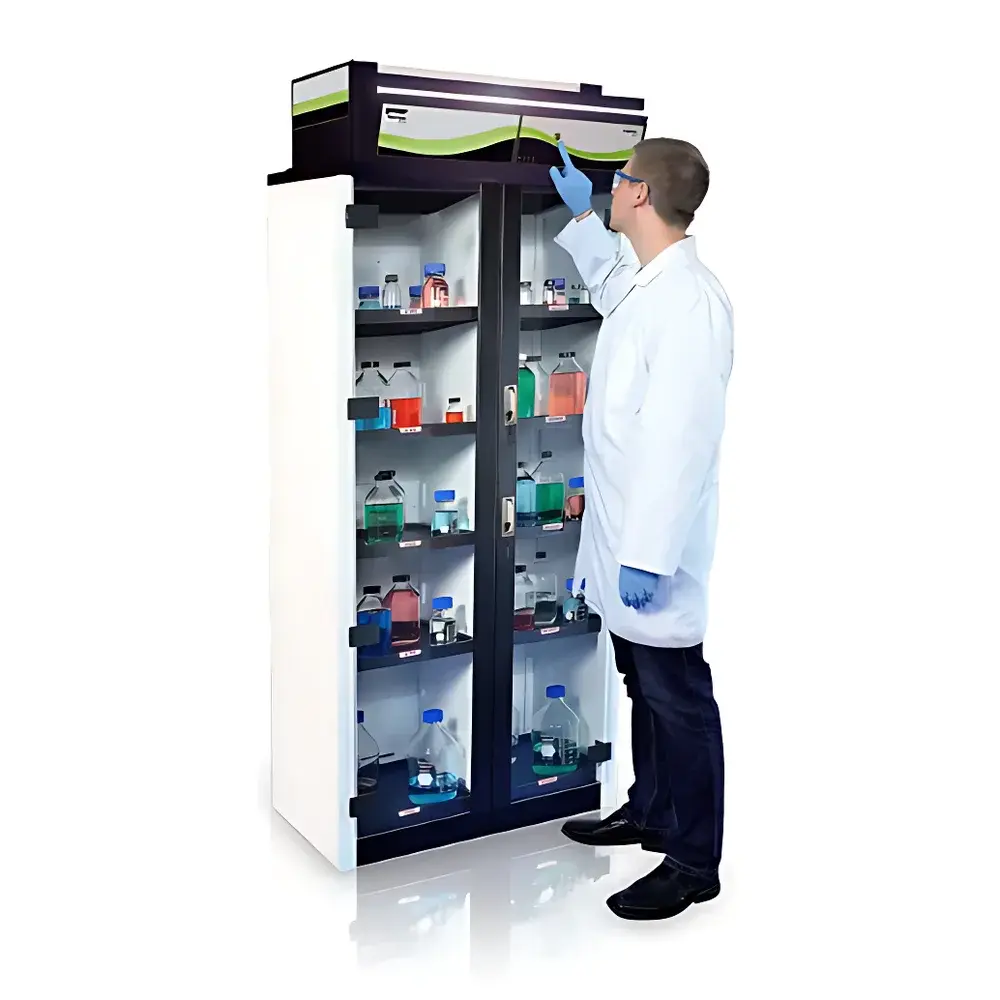
Erlab 834 SMART Recirculating Chemical Storage Cabinet
| Brand | Erlab |
|---|---|
| Origin | Germany |
| Model | 834 SMART |
| Cabinet Type | Ductless (Recirculating) Chemical Storage Cabinet |
| Construction | Full-steel with Chemically Resistant Polypropylene (PP) Interior Panels and Acid-Resistant Coated Galvanized Steel Frame |
| Airflow Mode | Fully Recirculating (No External Ducting) |
| Airflow Capacity | 200–230 m³/h |
| Working Area Dimensions (W×D×H) | 900 × 529 × 2140–2300 mm |
| Lighting | Integrated LED Illumination |
| Electrical Supply | 100–240 V AC, 50–60 Hz |
| Internal Circuit | 24 V DC |
| Safety Certification Compliance | JG/T 385–2012 (China), SEFA 9 (USA), AFNOR NF X 15-211:2009 (France), BS 7989 (UK), DIN 12927 (Germany), EN 1822:1998 (HEPA H14 / ULPA U17) |
| Filtration System | Patented Modular Dual-Layer Filter Cartridge Assembly (Primary + Safety Backup Filter) |
| Filter Types | Molecode® S (Organic Solvents), Molecode® A (Inorganic Acids), Molecode® F (Formaldehyde) |
| Filter Saturation Detection | Real-time Electrochemical Sensor-Based Alerting |
| Face Velocity Monitoring | Integrated Digital Anemometer |
| Safety Interlock | Dual-point Mechanical Lock |
| Software Integration | eGuard™ Remote Monitoring & Configuration Platform |
| ESP Pre-Use Safety Protocol | Erlab Safety Process — Customized Filter Lifetime & Application Suitability Assessment |
Overview
The Erlab 834 SMART Recirculating Chemical Storage Cabinet is an engineered solution for the safe, compliant, and intelligent containment of hazardous chemicals in laboratory environments where ducted exhaust infrastructure is unavailable or impractical. Unlike conventional fume hoods that require permanent building ventilation integration, this cabinet operates on a closed-loop recirculation principle: ambient air is drawn through the work area, passed sequentially through a dual-stage, application-specific filtration system, and returned to the laboratory at ≤1% of the Threshold Limit Value (TLV) or Time-Weighted Average (TWA) concentration for each targeted chemical class. This design eliminates external ductwork while maintaining full adherence to international occupational health and safety standards—including JG/T 385–2012, SEFA 9, AFNOR NF X 15-211, BS 7989, and DIN 12927—ensuring consistent protection for personnel, facilities, and the environment.
Key Features
- Patented modular filtration architecture supporting interchangeable Molecode® S (organic solvents), Molecode® A (inorganic acids), and Molecode® F (formaldehyde) filter cartridges—each validated against >600 chemicals per Erlab’s Chemical Compatibility Handbook.
- Dual-layer filter configuration: primary filter positioned below the fan assembly, with a redundant safety filter mounted above—ensuring continuous containment integrity even during primary filter saturation.
- Real-time, sensor-driven saturation detection with visual (LED halo ring status indicator) and auditory (distinctive pulse-coded alarm sequences) feedback for critical events including face velocity deviation, fan failure, and filter exhaustion.
- Integrated digital anemometer providing continuous face velocity monitoring at the sash opening plane, with configurable alert thresholds aligned to SEFA 9 and AFNOR requirements.
- Full-steel structural frame with interior cladding of chemically inert polypropylene (PP) panels and acid-resistant polymer-coated galvanized steel—resistant to corrosion from spills, vapors, and routine decontamination protocols.
- eGuard™ cloud-connected platform enabling remote access to operational logs, real-time cabinet status, filter life estimation, alarm history, and firmware updates via web browser or mobile application.
Sample Compatibility & Compliance
The 834 SMART cabinet is validated for storage of volatile organic compounds (e.g., acetone, ethanol, toluene), corrosive inorganic acids (e.g., hydrochloric, nitric, sulfuric), and low-molecular-weight aldehydes including formaldehyde. Each filter type undergoes independent testing per ISO 10121-1 and EN 15445 methodologies. Third-party verification reports—including TÜV SÜD (AFNOR NF X 15-211), SGS (SEFA 9), and Tongji University (JG/T 385–2012)—confirm compliance across mechanical stability, airflow uniformity, containment efficiency, and electrical safety. All units carry CE marking under EN 1822:1998 for HEPA H14 and ULPA U17 particulate filtration performance. The cabinet supports GLP/GMP-aligned audit trails via eGuard™’s encrypted event logging, including timestamped filter change records, access logs, and alarm acknowledgments—fully compatible with FDA 21 CFR Part 11 electronic signature requirements.
Software & Data Management
eGuard™ serves as the central interface for lifecycle management of the 834 SMART cabinet. It provides role-based user authentication, customizable notification rules (SMS/email/push), and exportable CSV reports for maintenance scheduling and regulatory submissions. The platform archives all operational parameters—including cumulative runtime, fan speed profiles, face velocity trends, and filter saturation curves—for retrospective analysis. Audit-ready data retention spans ≥12 months with optional on-premise server deployment for institutions requiring data sovereignty. Firmware updates are delivered over secure HTTPS with SHA-256 signature validation, ensuring integrity and traceability.
Applications
This cabinet is deployed in analytical chemistry labs, pharmaceutical QC/QA suites, academic research facilities, and clinical diagnostics centers where space-constrained layouts, historic building limitations, or temporary lab configurations preclude ducted ventilation. Typical use cases include long-term storage of reference standards, intermediate synthesis compounds, cytotoxic agents, and reagent-grade solvents. Its recirculating operation reduces HVAC load by up to 90% compared to constant-volume ducted systems—supporting LEED and ISO 50001 energy management objectives without compromising containment assurance.
FAQ
How does the dual-filter system ensure uninterrupted safety during filter replacement?
The safety filter—installed upstream of the fan—remains inactive until the primary filter reaches saturation. Upon saturation detection, the safety filter automatically engages, maintaining containment while allowing scheduled, non-emergency filter exchange.
Can eGuard™ integrate with existing laboratory information management systems (LIMS)?
Yes—via RESTful API endpoints and standardized JSON payloads, enabling synchronization of cabinet status, maintenance alerts, and compliance documentation into enterprise LIMS or CMMS platforms.
Is the cabinet suitable for storing pyrophoric or water-reactive substances?
No—this unit is designed exclusively for volatile, vaporous, or particulate hazards amenable to adsorption-based filtration. Pyrophorics, peroxides, alkali metals, and other thermally unstable or reactive materials require specialized inert-atmosphere or explosion-proof storage solutions.
What validation documentation is provided upon installation?
Each unit ships with a Factory Acceptance Test (FAT) report, third-party certification summaries (TÜV, SGS, Tongji), and a completed Erlab ESP (Safety Process) assessment documenting chemical compatibility, recommended filter configuration, and estimated service life under specified usage conditions.
Does the cabinet meet requirements for ISO/IEC 17025 accredited testing laboratories?
Yes—the documented traceability of filtration performance, calibration of the digital anemometer, and eGuard™’s audit-trail functionality satisfy clause 6.4.9 (Equipment Records) and clause 7.7 (Results Reporting) of ISO/IEC 17025:2017.



