
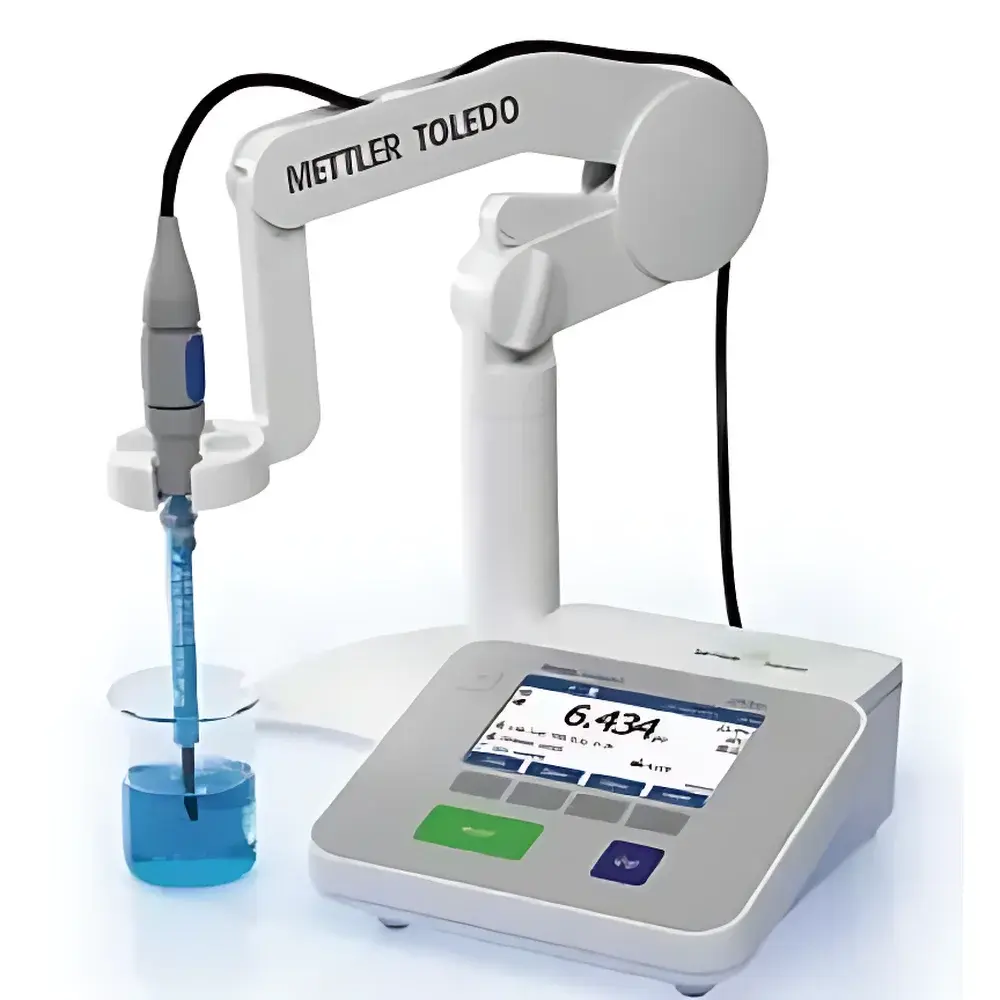
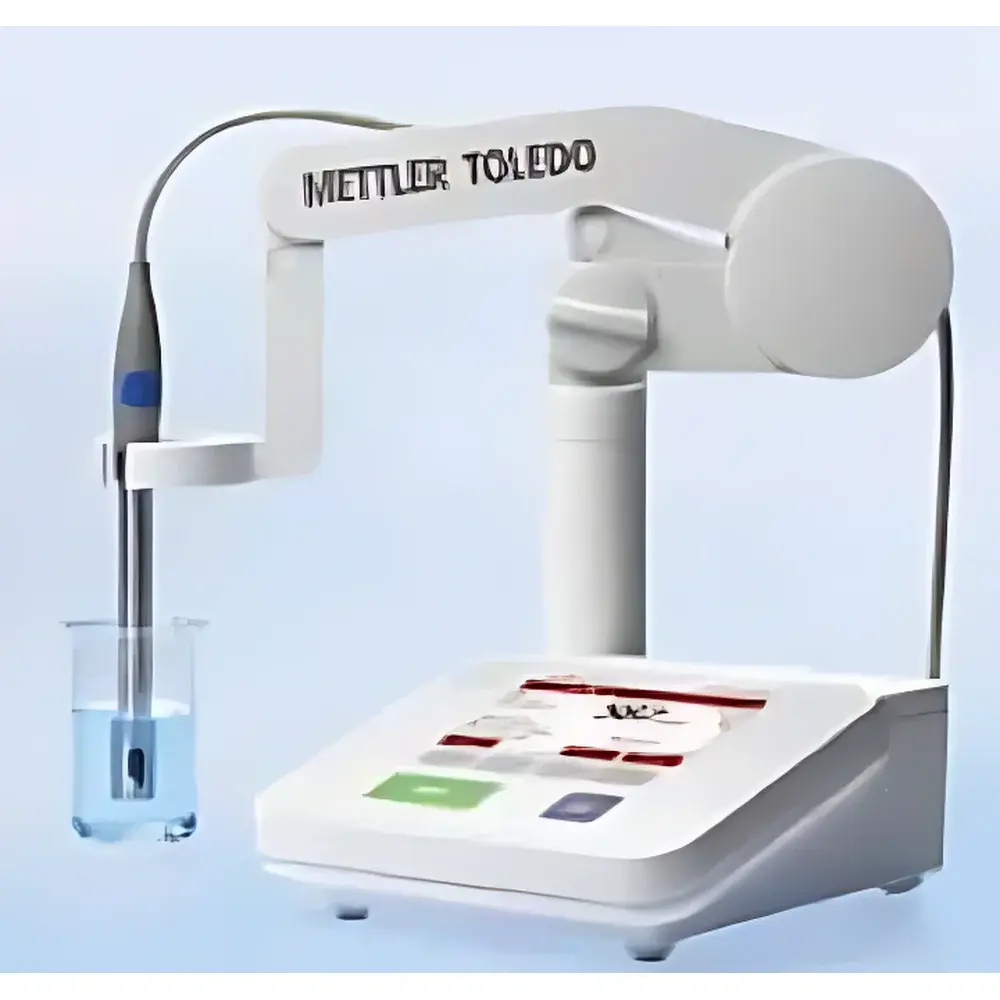
METTLER TOLEDO SevenCompact S220 pH/ION Meter and S230 Conductivity Meter
| Brand | METTLER TOLEDO |
|---|---|
| Origin | Switzerland |
| Model | S220 / S230 |
| Measurement Range | pH: –2.000 to 20.000 |
| mV/Rel.mV | –2000.0 to 2000.0 |
| Ion Concentration | 0.000–1000.0 %, 1.00E–9–9.99E+9 mmol/L, 1.00E–9–9.99E+9 mol/L, –2.000–20.000 pX |
| Conductivity | 0.001 µS/cm to 1000 mS/cm |
| TDS | 0.00 mg/L to 1000 g/L |
| Salinity | 0.00–80.00 psu, 0.000–10000.0 ppm |
| Resistivity | 0.00–100.0 MΩ·cm |
| Conductivity Ash | 0.000–2022 % |
| Temperature | –30.0 to 130.0 °C |
| Resolution | pH: 0.001/0.01/0.1 |
| Conductivity | 0.001–1 µS/cm |
| mV | 0.1/1 |
| TDS | 0.01–1 |
| Salinity/Resistivity | 0.00–1.0 |
| Ash | 0.001–1 |
| Temp | 0.1 °C |
| Accuracy | pH: ±0.002 |
| Conductivity | ±0.5% |
| mV | ±0.2 |
| TDS/Salinity/Resistivity/Ion Conc. | ±0.5% |
| Temp | ±0.1 °C |
| Calibration | Up to 5-point pH, 1-point conductivity |
| reference temp | 20 or 25 °C |
| endpoint | auto/manual/timed |
| stability modes | fast/standard/strict |
| GLP Compliance | Full audit trail, user/sample/electrode ID logging, password protection (startup/data/system), measurement limit alerts, calibration due reminders, electrode performance indicator, 1000-data storage, GLP-compliant print/export (USB drive, LabX direct pH software), RS232/USB-A/USB-B interfaces, IP54 rating, operating ambient: 5–40 °C, 5–80% RH non-condensing |
Overview
The METTLER TOLEDO SevenCompact S220 pH/ION Meter and S230 Conductivity Meter are modular, high-precision benchtop electrochemical analyzers engineered for regulated laboratory environments requiring traceable, repeatable, and compliant measurements. The S220 implements potentiometric principles to quantify hydrogen ion activity (pH), redox potential (ORP), and monovalent/multivalent ion concentrations (e.g., Na⁺, K⁺, Cl⁻, F⁻, NO₃⁻) via selective ion electrodes (ISEs). The S230 employs four-electrode AC conductivity measurement with automatic frequency selection to minimize polarization and electrode fouling effects—critical for low-conductivity ultrapure water and high-salt industrial samples. Both instruments share the same SevenCompact platform architecture, ensuring consistent GLP documentation, intuitive navigation, and interoperability across analytical workflows in pharmaceutical QC, biotechnology, food & beverage, and environmental testing laboratories.
Key Features
- Modular dual-instrument design: S220 dedicated to pH/ORP/ion analysis; S230 optimized for conductivity, salinity, TDS, resistivity, and conductivity ash—each with independent firmware and application-specific algorithms.
- SevenCompact platform advantages: 4.3-inch TFT color touchscreen with adjustable backlight (blue/red/green/gray), 10-language interface including Chinese, expert and standard operation modes, and full password protection for system configuration, data deletion, and startup access.
- Comprehensive calibration management: Up to five-point pH calibration with eight built-in IUPAC/NIST/USP/DIN buffer sets plus one customizable set; automatic buffer recognition; one-point conductivity calibration with thirteen preloaded standard solution sets (e.g., KCl 0.01 mol/L, NaCl 0.5% w/w) and user-defined entries.
- Regulatory-ready data integrity: Full GLP compliance with timestamped audit trails, electronic signatures, electrode status indicators (including last calibration performance), user/sample/electrode ID tagging (manual or via barcode scanner/USB keyboard), and configurable calibration due reminders.
- Robust connectivity and peripheral integration: Dual USB ports (Type-A for flash drives, Type-B for PC communication), RS232 serial interface, mini-DIN stirrer control, BNC (pH), mini-DIN (conductivity), 2-mm banana (reference), and Cinch/RCA or integrated mini-DIN (temperature) inputs; supports digital mini-LTW electrodes for plug-and-play recognition.
Sample Compatibility & Compliance
The S230 meets pharmacopeial requirements for purified water and water for injection (WFI) as specified in USP , EP 2.2.38, and ChP 0681, delivering validated conductivity measurements across all three operational ranges (0–2.0 µS/cm, 2.0–3.0 µS/cm, >3.0 µS/cm) with automatic temperature compensation per pharmacopeial algorithms. It further complies with ABNT NBR 10547:2006 for ethanol purity assessment and embeds ICUMSA GS2/3-17 and GS1/3/4/7/8-13 methods for conductivity ash determination in sugar refining—enabling single-button execution of industry-standard protocols without external calculation. Both instruments support ISO/IEC 17025 and FDA 21 CFR Part 11 readiness through LabX Direct pH software integration, IQ/OQ documentation packages, and secure data export in GLP-compliant report formats.
Software & Data Management
Data handling follows ALCOA+ principles (Attributable, Legible, Contemporaneous, Original, Accurate, Complete, Consistent, Enduring, Available). Each instrument stores up to 1000 fully annotated measurement records—including date/time, operator ID, sample ID, electrode SN, calibration history, and raw sensor values—with optional GLP printouts (simple, standard, or full-report mode) via RS232 or USB-connected printers. Export is supported to USB mass storage devices in CSV or PDF format. LabX Direct pH software enables remote instrument control, automated report generation, trend analysis, and centralized data archiving with role-based access control—facilitating audit preparation and long-term data retention in alignment with GxP and ISO 13485 requirements.
Applications
- Pharmaceutical quality control: WFI conductivity verification, buffer pH verification, dissolution media pH monitoring, and ion quantification in active pharmaceutical ingredients (APIs).
- Bioprocessing: Cell culture media pH and conductivity profiling, fermentation broth monitoring, and cleaning-in-place (CIP) rinse water validation.
- Foods & beverages: Salt content (NaCl) via conductivity ash, sugar syrup purity assessment, dairy product titratable acidity, and brewing wort conductivity.
- Environmental labs: Surface water salinity mapping, wastewater TDS compliance reporting, and soil extract conductivity for EC₅₀ estimation.
- Academic research: Teaching electrochemistry fundamentals, developing ISE calibration curves, and validating sensor response in non-aqueous or mixed-solvent systems.
FAQ
Does the S230 support automatic temperature compensation for conductivity measurements in pure water applications?
Yes—the S230 implements a dedicated non-linear (pure water) temperature compensation algorithm aligned with USP Annex, correcting for the anomalous conductivity–temperature relationship below 1 µS/cm.
Can the S220 perform simultaneous pH and ion concentration measurements on the same sample?
No—measurements are sequential but share the same sample chamber; pH must be measured first to avoid ISE interference from pH electrode conditioning solutions.
Is IQ/OQ documentation available for regulatory validation?
Yes—METTLER TOLEDO provides factory-verified Installation Qualification (IQ) and Operational Qualification (OQ) protocols, including test scripts, acceptance criteria, and blank execution forms, supporting GMP and ISO 17025 implementation.
What electrode types are compatible with the S220’s mini-LTW interface?
Only METTLER TOLEDO’s digital mini-LTW pH, ORP, and ISE electrodes—featuring embedded calibration memory, real-time diagnostics, and automatic parameter loading upon connection.
How does the S230 ensure measurement repeatability when switching between conductivity and resistivity modes?
The instrument applies identical raw conductance readings and applies mathematically reciprocal transformations internally—eliminating rounding errors and preserving six significant digits throughout computation.






