
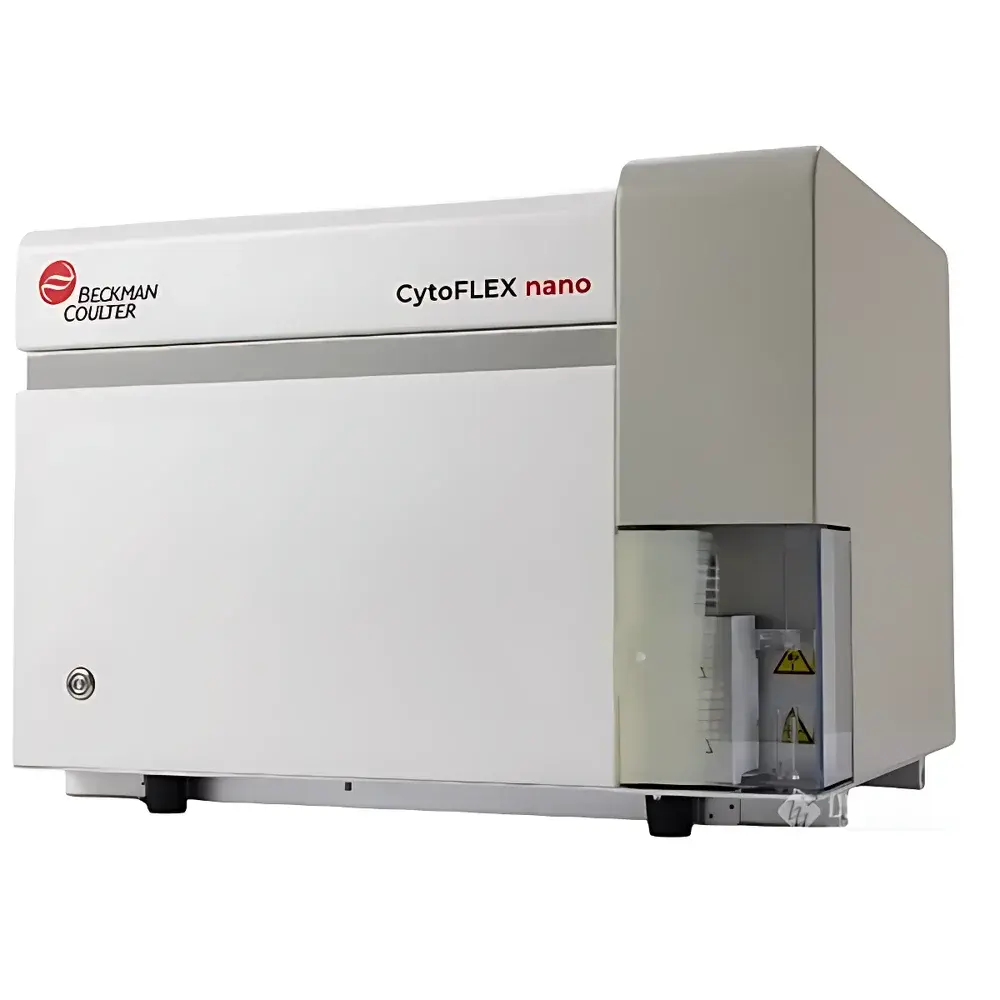
CytoFLEX nano Nanoscale Flow Cytometer
| Brand | Beckman Coulter |
|---|---|
| Origin | USA |
| Model | CytoFLEX nano |
| Particle Detection Range | 40 nm – 1 µm |
| Fluorescence Channels | 6 |
| Scatter Channels | 6 |
| Automated Sample Loading | Yes |
| Software | FCMpass (licensed) |
| Carryover Rate | <1% |
| Intended Use | Research-Grade Nanoparticle & Submicron Vesicle Analysis |
| Regulatory Context | Designed for GLP-compliant lab environments |
Overview
The CytoFLEX nano Nanoscale Flow Cytometer is a high-sensitivity, research-grade flow cytometry platform engineered by Beckman Coulter to extend conventional flow cytometric analysis into the sub-100 nm regime. Unlike traditional hydrodynamic focusing systems optimized for cells >500 nm, the CytoFLEX nano employs advanced optical alignment, low-noise avalanche photodiode (APD) detection, and enhanced signal-to-noise ratio (SNR) electronics to resolve biological nanoparticles—including exosomes, microvesicles, virus-like particles (VLPs), synthetic liposomes, and polymeric nanocarriers—within the 40 nm to 1 µm diameter range. Its core measurement principle relies on orthogonal light scattering (forward and side scatter) combined with multi-parameter fluorescence detection under laminar sheath flow conditions, enabling simultaneous sizing, counting, and phenotypic characterization of heterogeneous nanoscale populations in suspension. The instrument is calibrated using NIST-traceable silica and polystyrene nanoparticle standards, ensuring metrological traceability across laboratories.
Key Features
- Sub-100 nm sensitivity: Detects particles as small as 40 nm via optimized 405 nm violet laser excitation and high-gain APD detectors with adjustable voltage thresholds.
- Six-color fluorescence capability: Configurable filter sets support common fluorophores including FITC, PE, APC, BV421, CF647, and Alexa Fluor 700—enabling multivariate immunophenotyping of extracellular vesicles and engineered nanoparticles.
- Six-scatter channel architecture: Includes dual-angle forward scatter (FSC-A/FSC-H), side scatter (SSC), and three additional scatter channels (e.g., VSSC, SSC-W, FSC-W) for improved resolution of refractive index and structural heterogeneity.
- Integrated automated sample loading: Precision syringe pump-based autosampler with programmable aspiration volume (1–100 µL), wash cycle control, and barcode-compatible tube rack handling reduces manual intervention and operator variability.
- Low carryover performance: Fluidic path design and sequential high-efficiency rinse protocols achieve <1% carryover between samples—critical for serial analysis of low-abundance clinical or purified exosome preparations.
- Modular optical bench: Field-serviceable optics and user-replaceable filters allow reconfiguration for evolving assay needs without system downtime.
Sample Compatibility & Compliance
The CytoFLEX nano accommodates aqueous suspensions in standard 12×75 mm polystyrene or glass tubes, as well as 96-well microplates (with optional plate adapter). It supports both centrifugation-purified and size-exclusion chromatography (SEC)-fractionated samples, provided viscosity remains below 2 cP and particulate debris is minimized via 0.22 µm filtration. The platform meets ISO 13485-aligned design controls and complies with IEC 61010-1 safety standards for laboratory equipment. While not CE-marked as an IVD device, it is routinely deployed in academic and pharmaceutical research settings operating under Good Laboratory Practice (GLP) frameworks. Data integrity features—including electronic signatures, time-stamped audit logs, and password-protected method files—facilitate alignment with FDA 21 CFR Part 11 expectations when deployed within validated network environments.
Software & Data Management
FCMpass software (licensed included) provides acquisition, real-time visualization, and post-acquisition analysis tailored for nanoscale cytometry. It includes pre-configured templates for exosome gating (based on CD63/CD81/TSG101 staining), nanoparticle sizing calibration curves, and scatter-based population clustering algorithms. All raw FCS 3.1 files are stored with embedded metadata (instrument settings, date/time, operator ID, calibration status). Export options include CSV, PDF reports, and Cytobank-compatible .fcs archives. For enterprise integration, FCMpass supports DICOM-SR export and HL7 messaging via optional middleware modules—enabling interoperability with LIMS and ELN platforms in regulated biopharma labs.
Applications
- Extracellular vesicle (EV) phenotyping and quantification in biofluids (plasma, urine, CSF)
- Characterization of viral vector batches (AAV, lentivirus) during gene therapy process development
- Quality control of lipid nanoparticles (LNPs) used in mRNA delivery systems
- Monitoring aggregation states of therapeutic monoclonal antibodies and biosimilars
- Environmental nanoparticle monitoring (e.g., engineered nanomaterials in wastewater effluents)
- Single-particle tracking of fluorescently labeled synthetic nanocarriers in vitro
FAQ
What is the minimum detectable particle size under standard operating conditions?
The validated lower limit is 40 nm for polystyrene nanoparticles under optimal alignment and low-background buffer conditions (e.g., filtered PBS + 0.1% BSA). Biological vesicles may exhibit higher effective detection thresholds depending on refractive index and labeling efficiency.
Can the CytoFLEX nano be used for absolute counting without reference beads?
Yes—integrated volumetric sampling via calibrated syringe pump enables direct concentration calculation (particles/mL) without requiring internal bead standards, though bead-based calibration is recommended for inter-laboratory comparability.
Is the FCMpass software compatible with third-party analysis tools like FlowJo or Cytobank?
All acquired data are saved in standard FCS 3.1 format, fully importable into FlowJo v10.8+, Cytobank, and open-source alternatives such as FlowCore (R/Bioconductor).
Does the system support regulatory submission-ready documentation?
When deployed with validated IT infrastructure and documented SOPs, the platform supports creation of ALCOA+ compliant records—including raw data, processing history, and electronic signatures—as required for IND/IMPD filings.
How often does the fluidic system require maintenance?
Daily startup/shutdown routines include automated prime-and-rinse cycles. Quarterly preventive maintenance (PM) by certified Beckman Coulter field service engineers is recommended to ensure long-term optical alignment stability and pump calibration accuracy.





