
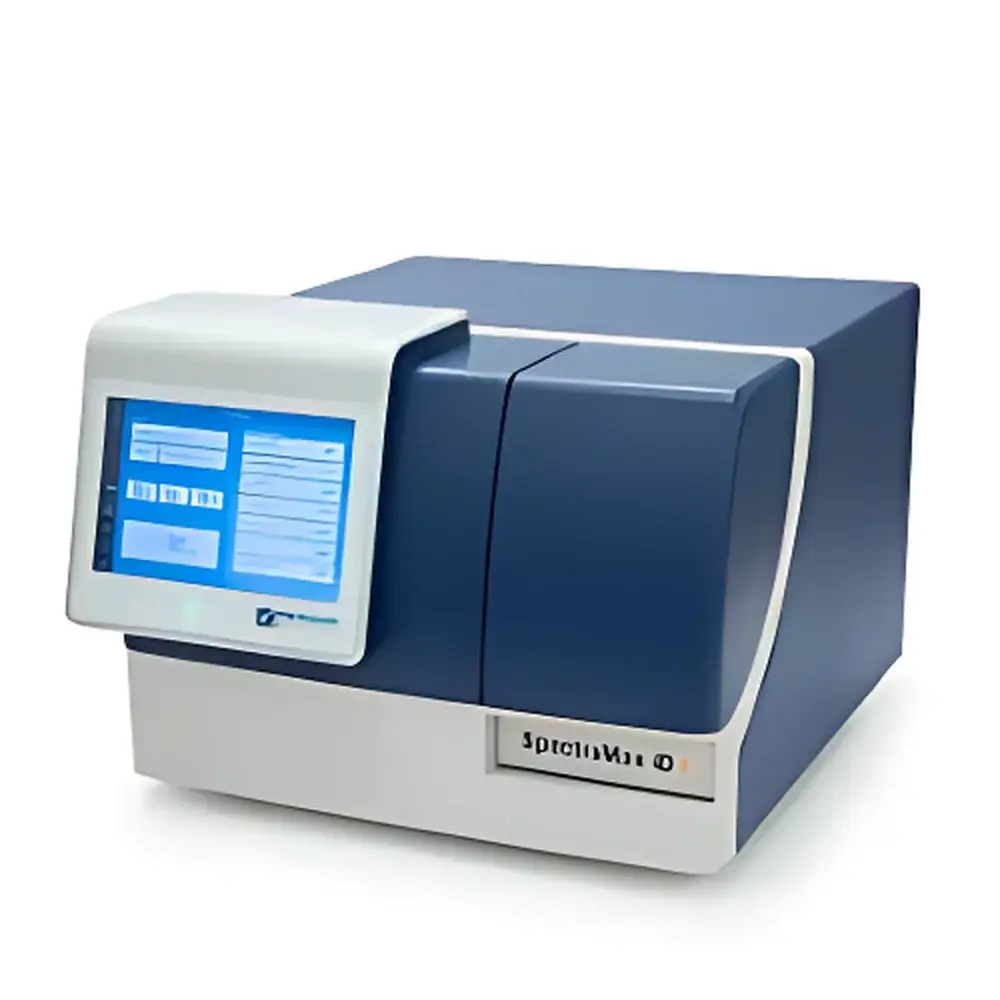
Molecular Devices SpectraMax iD3 Multimode Microplate Reader
| Brand | Molecular Devices |
|---|---|
| Origin | Shanghai, China |
| Manufacturer Type | Authorized Distributor |
| Product Origin | Domestic (China) |
| Model | SpectraMax iD3 |
| Function Type | Multimode |
| Automation Level | Fully Automated |
| Assay Modes | Endpoint, Kinetic, Scanning |
| Curve Fitting | SoftMax Pro Software-Based |
| Detector Type | PMT and Photodiode |
| Wavelength Range | Absorbance 230–1000 nm |
| Absorbance Range | 230–1000 nm |
| Absorbance Linearity | 0–2.0 OD |
| Absorbance Speed | 96-well plate in 25 sec |
| Accuracy | < ±0.010 OD |
Overview
The Molecular Devices SpectraMax iD3 Multimode Microplate Reader is a fully automated, benchtop microplate detection system engineered for precision, flexibility, and regulatory compliance in life science laboratories. It integrates absorbance, fluorescence intensity (FI), time-resolved fluorescence (TRF), fluorescence polarization (FP), and luminescence (including bioluminescence and chemiluminescence) detection modalities within a single platform. Its optical architecture employs a high-energy xenon flash lamp coupled with dual monochromators—enabling precise, tunable wavelength selection across broad spectral ranges—and a thermoelectrically cooled photomultiplier tube (PMT) operating at –5 °C to minimize dark current and enhance signal-to-noise ratio. This design supports quantitative assays requiring high dynamic range and low background, such as ATP quantification over five orders of magnitude (10–11 to 10–6 M) and nucleic acid quantitation from 2 to 1000 ng/μL in 4-μL volumes using SpectraDrop microplates.
Key Features
- Integrated 7-inch high-resolution capacitive touchscreen interface enabling method setup, real-time monitoring, and tutorial playback without external PC dependency
- NFC-enabled workflow personalization: tap an NFC tag to instantly load user-specific assay templates, instrument configurations, or calibration profiles
- Dual syringe-based SmartInject™ dispensing system compatible with all detection modes; features anti-drip, overflow prevention, and programmable injection timing for kinetic and stopped-flow applications
- Temperature control from ambient to 65 °C with ±0.5 °C uniformity across the microplate footprint, supporting enzyme kinetics, thermal shift assays, and cell-based functional studies
- Orbital or double-orbital shaking with adjustable speed (up to 1200 rpm) and amplitude for optimal reagent mixing prior to detection
- High-density scanning capability up to 20 × 20 well grids per plate, enabling spatial profiling of heterogeneous samples or colony-based assays
- Spectral scanning mode (absorbance and fluorescence) with 1-nm resolution for spectral deconvolution, peak identification, and excitation/emission matrix generation
Sample Compatibility & Compliance
The SpectraMax iD3 accommodates standard microplate formats from 6- to 384-well, including opaque, clear, and black plates, as well as specialized formats such as SpectraDrop ultra-low-volume plates (4–12 μL). Its modular optical path ensures consistent performance across diverse sample matrices—including cell lysates, serum, tissue homogenates, and purified biomolecules—without cross-talk or carryover. The system complies with international standards relevant to analytical instrumentation in regulated environments: ISO/IEC 17025 for testing laboratory competence, ASTM E2551–19 for microplate reader performance verification, and USP for bioassay validation. When operated with SoftMax Pro GxP software, it fulfills critical requirements of FDA 21 CFR Part 11, EU Annex 11, and GLP/GMP frameworks—including role-based user access control, electronic signatures, immutable audit trails, and full traceability of instrument parameters, raw data, and analysis steps.
Software & Data Management
SoftMax Pro 7 serves as the native acquisition and analysis engine, offering over 100 pre-validated assay templates optimized for commercial reagents (e.g., Promega Dual-Glo®, PerkinElmer ATPlite™, Thermo Fisher Pierce BCA). Advanced curve-fitting algorithms—including 4-parameter logistic (4PL), 5-parameter logistic (5PL), log-log, and spline interpolation—are embedded and independently verifiable. SoftMax Pro GxP extends this functionality with electronic record security features: hierarchical user permissions, session-based login tokens, timestamped audit logs capturing every parameter change and data export event, and support for electronic signatures compliant with ALCOA+ principles. Data synchronization occurs automatically over local Ethernet/Wi-Fi networks, enabling centralized management of multi-instrument workflows and seamless integration with LIMS or ELN systems via secure API endpoints.
Applications
The SpectraMax iD3 supports a wide spectrum of life science applications, including but not limited to: protein concentration determination (Bradford, BCA, Lowry), enzymatic activity profiling (kinase, phosphatase, protease assays), cell viability and cytotoxicity assessment (MTT, XTT, resazurin), reporter gene assays (luciferase, GFP), calcium flux and membrane potential measurements (FLIPR-compatible dyes), immunoassays (ELISA, AlphaScreen®), nucleic acid quantification and purity evaluation (A260/A280 ratios), and high-throughput screening (HTS) in drug discovery pipelines. Its ability to perform simultaneous dual-emission ratiometric measurements and temperature-controlled kinetic reads makes it particularly suitable for structure-function studies, thermal stability profiling (Tm analysis), and real-time monitoring of cellular responses under physiological conditions.
FAQ
Does the SpectraMax iD3 support GLP/GMP-compliant workflows?
Yes—when used with SoftMax Pro GxP software, the system provides full 21 CFR Part 11 compliance, including electronic signatures, audit trail logging, and user access controls required for regulated environments.
Can the instrument perform spectral scanning in both absorbance and fluorescence modes?
Yes—the dual monochromator design enables continuous spectral acquisition from 230–1000 nm (absorbance) and 250–850 nm (fluorescence) with 1-nm step resolution.
Is the temperature control uniform across all wells in a 384-well plate?
The system maintains ±0.5 °C uniformity across the entire plate surface at setpoints between ambient and 65 °C, verified per ASTM E2551 Annex A3.
What validation tools are included for IQ/OQ/PQ execution?
Molecular Devices provides a comprehensive Validation Toolkit including IQ/OQ test protocols, printable documentation templates, pre-loaded OQ test data sets, and verification scripts for 4PL/5PL curve fitting and plate uniformity assessment.
How does the SmartInject™ system improve reproducibility in kinetic assays?
SmartInject™ delivers precise, programmable reagent addition synchronized with measurement timing, minimizing pipetting variability and ensuring consistent mixing kinetics—critical for luciferase, ATP, and other rapid-luminescence assays.
Related Products



