
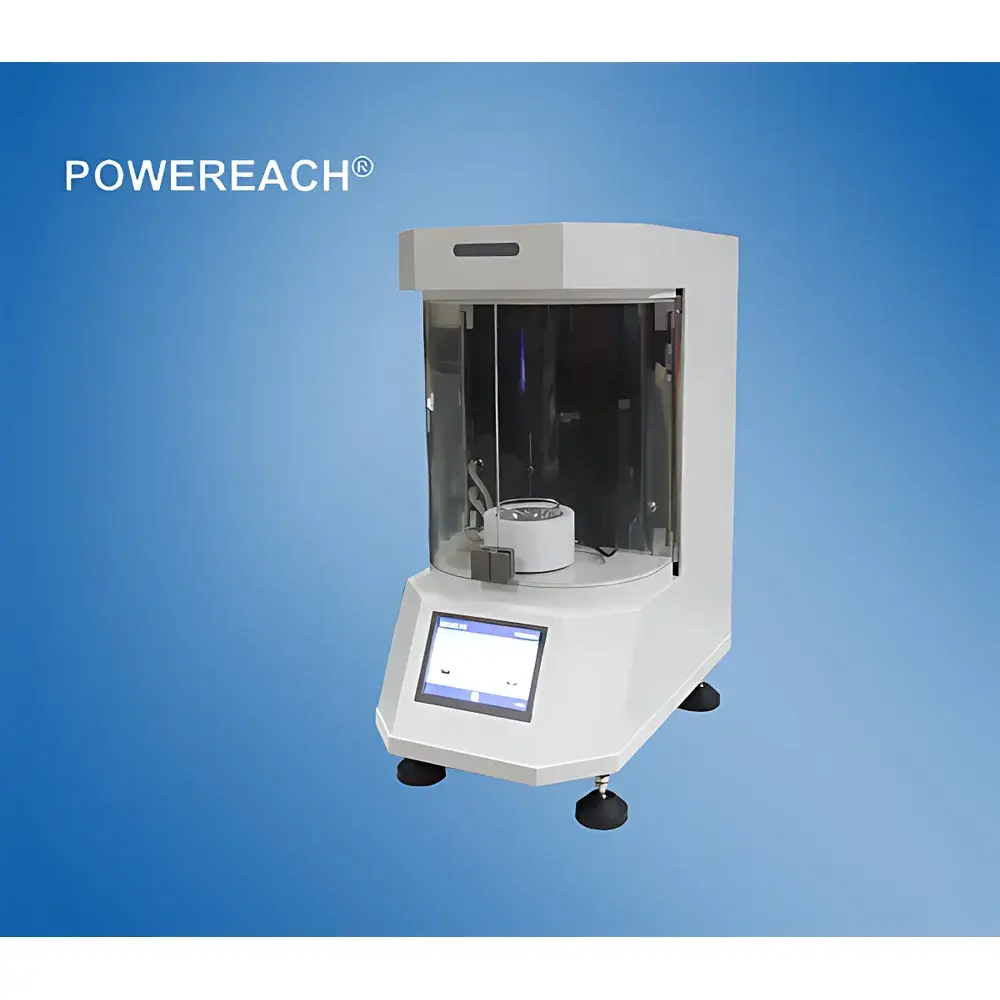
Interface JK99CN Fully Automated Surface and Interfacial Tensiometer
| [Brand | Interface |
|---|---|
| Origin | Beijing, China |
| Model | JK99CN |
| Measurement Range | 0–999.99 mN/m |
| Resolution | <0.05 mN/m |
| Methods | Du Noüy Ring Method & Wilhelmy Plate Method |
| Sampling Time | 1–5 s (plate), 20–150 s (ring) |
| Power Supply | AC 220 V, 50 Hz, <150 W |
| Operating Humidity | 30–85% RH |
| Compliance | SY/T 5370–1999] |
Overview
The Interface JK99CN Fully Automated Surface and Interfacial Tensiometer is a precision instrument engineered for the quantitative determination of surface tension (liquid–air interface) and interfacial tension (liquid–liquid interface) based on established physical measurement principles—primarily the Wilhelmy plate method and the Du Noüy ring method. These methods rely on direct force measurement of the interaction between a calibrated platinum probe and the liquid interface, governed by the Young–Laplace equation and corrected for buoyancy, wetting geometry, and dynamic meniscus effects. Designed for routine quality control, R&D screening, and regulatory-compliant testing, the JK99CN delivers high reproducibility in environments ranging from field-deployed industrial labs to university teaching laboratories. Its architecture supports both static equilibrium and quasi-dynamic measurements, enabling reliable characterization of surfactant solutions, crude oil–brine systems, polymer melts, and functional coatings under ambient or temperature-controlled conditions.
Key Features
- Fully automated operation with integrated high-precision stepper motor-driven vertical stage, ensuring stable, vibration-damped immersion and withdrawal cycles
- Dual-method capability: interchangeable platinum plate and platinum ring probes with dedicated calibration protocols and real-time method selection in software
- High-resolution load cell (resolution <0.05 mN/m) with low-drift thermal compensation, optimized for repeatable measurements across viscosity ranges (1–1000 mPa·s)
- 7-inch capacitive touchscreen HMI with intuitive workflow navigation; supports offline operation without PC connection
- Integrated data logging engine capable of continuous curve acquisition (force vs. time), with timestamped storage of raw sensor output and derived tension values
- Modular expansion support: optional Peltier-based thermostatic platform (±0.1 °C stability), fiber contact angle module, and magnetic stirrer integration for bulk-phase homogeneity
Sample Compatibility & Compliance
The JK99CN accommodates a broad spectrum of sample types—including aqueous surfactant solutions, hydrocarbon–water emulsions, silicone oils, molten polymers, and biological fluids—without requiring solvent-specific hardware modifications. All measurement protocols adhere to the methodology specified in SY/T 5370–1999, the People’s Republic of China petroleum industry standard for surface and interfacial tension determination. While not certified to ISO 1409 or ASTM D971, the instrument’s mechanical design, sensor traceability (via NIST-traceable calibration weights), and documented uncertainty budget align with GLP-aligned laboratory practices. Data export formats (CSV, TXT) are compatible with third-party statistical analysis tools used in FDA 21 CFR Part 11–compliant environments when paired with validated LIMS integration.
Software & Data Management
The system runs a Windows-based native application with full Chinese/English bilingual UI. The software implements automated baseline correction, dynamic meniscus height compensation, and method-specific algorithmic fitting (e.g., Huh–Mason correction for ring detachment, Zuidema–Waters for plate immersion depth). All measurement sessions include mandatory operator ID entry, audit trail logging (timestamp, method, probe ID, environmental conditions), and digital signature support for report finalization. Raw force-time datasets are stored with metadata tags (temperature, humidity, probe serial number), enabling retrospective reprocessing. Export options include PDF reports with embedded graphs, Excel-compatible tables, and ASCII-delimited files suitable for import into MATLAB, Python (Pandas), or JMP for multivariate trend analysis.
Applications
- Tertiary oil recovery research: quantification of ultra-low interfacial tension (0.001–10 mN/m) between enhanced oil recovery (EOR) formulations and reservoir brines
- Surfactant formulation development: critical micelle concentration (CMC) determination, adsorption kinetics modeling, and structure–property relationship studies
- Coating and ink R&D: evaluation of substrate wettability, leveling behavior, and defect formation thresholds via surface energy mapping
- Pharmaceutical excipient screening: interfacial stability assessment of nanoemulsions, liposomes, and microsuspensions
- Quality assurance in transformer oil monitoring: detection of oxidation byproducts and hydrophilic contaminants through deviations in interfacial tension trends
- Academic instruction: hands-on demonstration of capillary phenomena, Gibbs adsorption isotherms, and colloidal stabilization mechanisms
FAQ
What is the difference between surface tension and interfacial tension?
Surface tension refers specifically to the force per unit length at the interface between a liquid and its vapor phase (e.g., water–air). Interfacial tension describes the analogous property at the boundary between two immiscible liquids (e.g., oil–water), typically lower in magnitude due to partial molecular solvation.
Can the JK99CN measure ultra-low interfacial tensions below 1 mN/m?
Yes—when configured with the Wilhelmy plate method and operated under controlled humidity and vibration-isolated conditions, the instrument achieves reliable resolution down to 0.05 mN/m, suitable for screening EOR surfactants and microemulsion systems.
Is calibration traceable to international standards?
Calibration uses certified reference weights traceable to national metrology institutes; users may perform daily verification using pure water (72.75 mN/m at 20 °C) and diiodomethane (50.8 mN/m) as secondary standards.
Does the software support 21 CFR Part 11 compliance?
The base software provides electronic signatures, audit trails, and data integrity controls; full Part 11 compliance requires deployment within a validated IT infrastructure with role-based access and backup validation protocols.
What maintenance is required for long-term accuracy?
Platinum probes must be cleaned after each use with appropriate solvents (e.g., ethanol, piranha solution for organics), annealed periodically to restore surface homogeneity, and inspected for deformation or contamination under magnification. Load cell zero drift should be verified monthly using tare function.



