
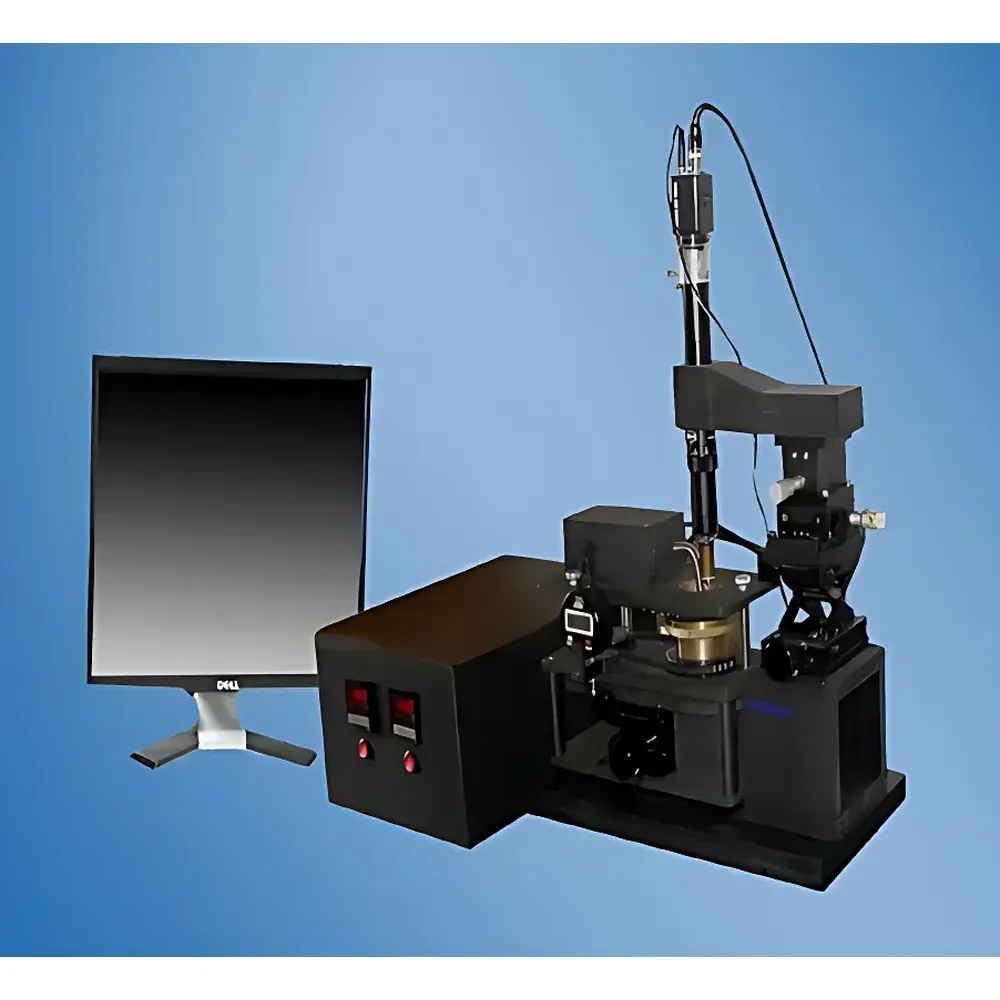
JOS06 Optical Shear Rheometer
| Origin | Beijing |
|---|---|
| Manufacturer Type | Distributor |
| Origin Category | Domestic (China) |
| Model | JOS06 |
| Price Range | USD 7,000–14,000 |
| Instrument Type | Interfacial Rheometer |
| Bearing Type | Mechanical Bearings |
| Minimum Rotational Speed | 10⁻⁴ rpm |
| Frequency Range | 10⁻³–628 rad/s |
| Maximum Rotational Speed | 3000 rpm |
| Maximum Torque | 200 mN·m |
| Torque Resolution | < 100 nN·m |
| Temperature Range | Ambient to 300 °C |
| Temperature Accuracy | ±1 °C (±0.1 °C within 100 °C) |
| Quartz Plate Spacing | 0.05–2 mm |
| Sample Area | Ø25 mm |
| Optical Resolution | 25 pixels/µm |
| Oscillation Frequency Range | 0.01–10 Hz |
| Steady-State Shear Rate Range | 0.001–500 rpm (controlled to ±0.01 rpm at low end) |
| Observation Port | Wide-field transmission & polarized light path |
| CCD System | Color, 3-axis motorized positioning |
| Objective Working Distance | 7 mm |
| Top & Bottom Quartz Plates | Independently motorized, heated via integrated heating plates, temperature monitored by Pt100 sensors |
| Removable Cover & Optional Quartz Plate Sets | Supported for rapid sample exchange and contamination control |
Overview
The JOS06 Optical Shear Rheometer is a high-precision, research-grade interfacial rheological instrument engineered for in situ structural and dynamic characterization of complex fluids under controlled shear, temperature, and optical observation conditions. Unlike conventional rotational rheometers, the JOS06 integrates a dual-axis, independently actuated quartz parallel-plate geometry with real-time optical microscopy—enabling simultaneous mechanical stimulation and microstructural interrogation. Its operational principle relies on Couette-type shear between two highly polished, thermally regulated quartz plates, while transmitted and polarized light paths allow quantitative analysis of birefringence, domain formation, particle alignment, and network evolution during deformation. Designed for applications spanning soft matter physics, colloid science, pharmaceutical formulation, and food rheology, the system supports both oscillatory and steady-state shear protocols across a broad frequency (10−3–628 rad/s) and torque (up to 200 mN·m) range, with sub-microradian angular resolution and torque sensitivity below 100 nN·m.
Key Features
- Dual independent quartz plate drive system: Top and bottom plates are separately motorized, enabling asymmetric shear profiles, counter-rotation, and precise gap control (0.05–2 mm adjustable).
- Integrated thermal management: Each quartz plate features embedded heating elements and Pt100 resistance thermometers, delivering temperature stability of ±0.1 °C within 0–100 °C and ±1 °C up to 300 °C.
- Optical compatibility: Wide-diameter observation port, transmission + polarized light pathways, and 25 px/µm resolution support high-fidelity imaging of anisotropic structures (e.g., liquid crystals, fibrillar gels, Pickering emulsions).
- Modular quartz plate sets: Interchangeable plates (optional multi-set configuration) minimize cross-contamination and enable rapid transition between hydrophilic/hydrophobic or chemically aggressive samples.
- 3-axis motorized CCD stage: Full XYZ positioning of the color imaging system ensures optimal focus, field-of-view centering, and z-stack acquisition without manual intervention.
- Low-speed precision architecture: Mechanical bearing design combined with closed-loop speed control achieves stable operation down to 10−4 rpm (0.0001 rpm), with calibrated accuracy maintained to ±0.01 rpm in the critical sub-1 rpm regime.
Sample Compatibility & Compliance
The JOS06 accommodates a wide spectrum of viscoelastic and interfacially active materials—including polymer melts, surfactant monolayers at air–water interfaces (via Langmuir trough integration), protein hydrogels, nanoparticle dispersions, and thermoresponsive micellar systems. Its Ø25 mm sample area and variable gap geometry permit testing of both bulk and thin-film configurations. The quartz cell construction ensures chemical inertness toward organic solvents, strong acids/bases, and high-salinity media. From a regulatory standpoint, the instrument’s deterministic motion control, timestamped data logging, and export-ready ASCII/CSV output align with GLP-compliant workflows. While not pre-certified for FDA 21 CFR Part 11, its software architecture supports user-defined audit trails, electronic signatures, and version-controlled method storage—facilitating validation in GMP environments per ICH Q5E and USP guidelines.
Software & Data Management
Control and analysis are executed via a dedicated Windows-based application supporting synchronized acquisition of torque, normal force, angular displacement, temperature, and time-resolved image sequences. All raw sensor data—including torque transients, phase lag, storage/loss moduli (G′/G″), and complex viscosity—are stored in hierarchical HDF5 format with embedded metadata (operator ID, method name, calibration ID, environmental timestamps). Export options include CSV for third-party analysis (e.g., MATLAB, Python pandas), TIFF stacks for image processing (ImageJ/Fiji), and PDF reports compliant with ISO 16769:2022 for rheological data presentation. The software implements ASTM D4440-20-compliant oscillatory test routines and allows custom script execution for multi-step protocols involving temperature ramps, amplitude sweeps, and frequency sweeps—all traceable via internal event logging.
Applications
- Time-resolved structural evolution of wormlike micelles under shear-induced scission/recombination.
- Yield stress quantification and fracture dynamics in colloidal glasses via step-strain imaging.
- Interfacial viscoelasticity of β-lactoglobulin films at oil–water interfaces during emulsification.
- Thermo-rheological behavior of polyethylene oxide melts across crystallization onset temperatures.
- Shear-banding visualization in entangled polymer solutions using flow-induced birefringence mapping.
- Particle jamming transitions in dense suspensions under controlled gap compression and oscillation.
FAQ
Is the JOS06 suitable for air–water interfacial measurements?
Yes—when coupled with a Langmuir trough accessory (sold separately), the top quartz plate can be replaced with a floating barrier-compatible interface plate, enabling direct measurement of interfacial shear modulus and dilatational response.
Can the system perform temperature ramp tests while acquiring images?
Yes—the heating plates and Pt100 sensors are fully integrated into the control loop; temperature ramps (e.g., 1 °C/min) are programmable alongside shear protocols, with synchronized image capture triggered at user-defined setpoints.
What is the minimum detectable structural change resolvable by the optical system?
At 25 px/µm resolution and with polarized contrast enhancement, the system reliably resolves birefringent domains ≥ 0.4 µm in lateral dimension and orientation shifts ≥ 0.5° under static or low-frequency oscillatory conditions.
Does the instrument support third-party rheology software integration?
Native API access (DLL-based) is provided for LabVIEW, Python (PySerial + NumPy), and MATLAB, enabling custom automation, real-time feedback control, and hybrid experimental designs.
Are calibration certificates traceable to national standards available?
Torque and temperature calibrations are performed using NIST-traceable reference standards (Fluke 729 for pressure-based torque simulators; Hart Scientific 1590 for Pt100 verification); full calibration reports are issued upon request.



