
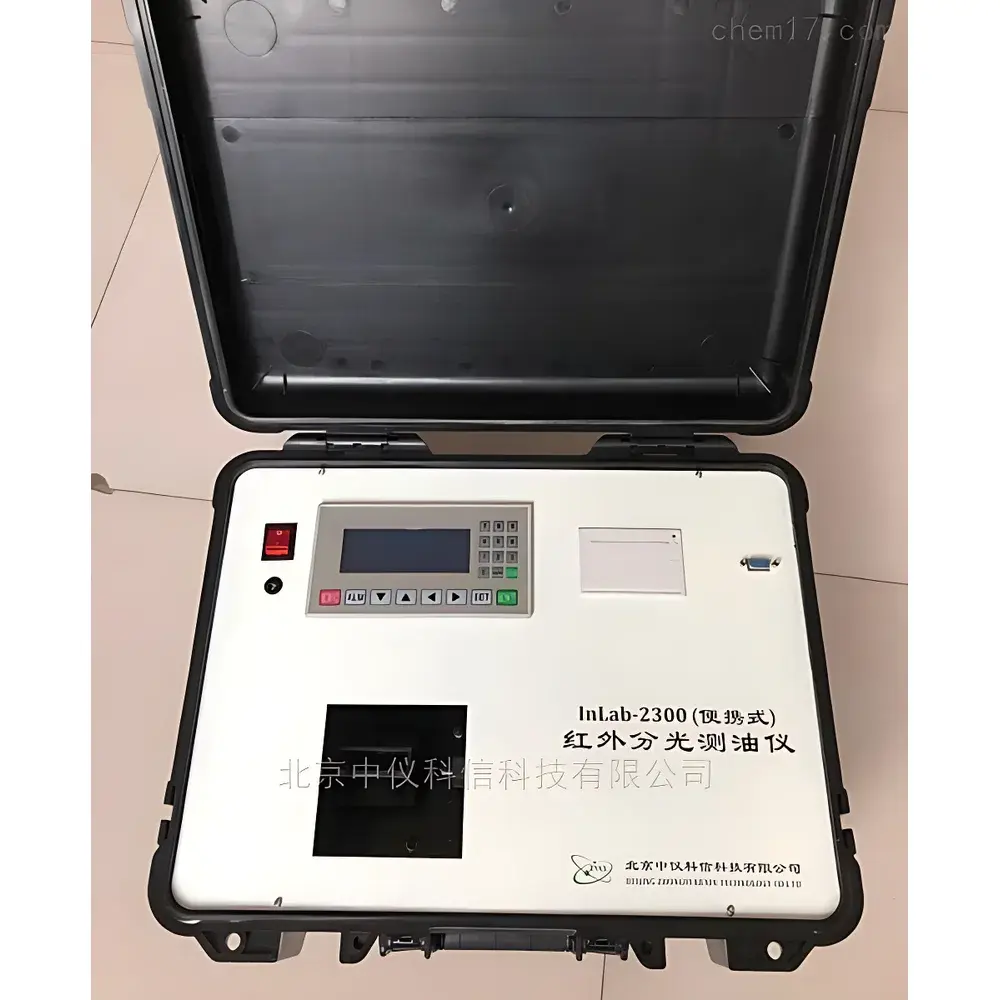
Zykx InLab-2300 Portable Infrared Oil Content Analyzer
| Brand | Zykx |
|---|---|
| Origin | Beijing, China |
| Manufacturer Type | Authorized Distributor |
| Country of Origin | China |
| Model | InLab-2300 |
| Instrument Type | Portable |
| Measurement Principle | Infrared Spectrophotometry (Dual-Wavelength & Full-Spectrum Scan) |
| Measurement Range | 0.00–100 mg/L (water sample, standard 4 cm quartz cuvette) |
| Detection Limit | <0.12 mg/L (CCl₄ extract) |
| <0.003 mg/L (water sample, 40 | 1 extraction ratio, 4 cm cuvette) |
| Accuracy | ±0.4 mg/L (C < 10 mg/L) |
| Repeatability | ≤1% (for 20 & 40 mg/L oil standards) |
| Resolution | 0.001 mg/L |
| Measurement Frequency | 5 samples/min |
| Wavenumber Range | 3400–2400 cm⁻¹ |
| Baseline Drift | <0.001 AU/60 min |
| Absorbance Range | 0.0000–3.000 AU |
| Linear Correlation Coefficient | R > 0.999 |
| Power Supply | 220 V ±22 V, 50 Hz ±1 Hz, 40 VA |
| Dimensions | 470 × 380 × 210 mm |
| Weight | ~12 kg |
| Operating Environment | 5–35 °C, 20–90% RH |
| Battery Life | ~8 h (integrated Li-ion) |
Overview
The Zykx InLab-2300 Portable Infrared Oil Content Analyzer is a field-deployable, laboratory-grade instrument engineered for quantitative determination of total petroleum hydrocarbons (TPH), animal and vegetable oils, and total oil content in aqueous matrices—including surface water, groundwater, seawater, wastewater, and leachates—according to internationally recognized infrared spectroscopic principles. It operates on the fundamental absorption characteristics of C–H stretching vibrations in the mid-infrared region (3400–2400 cm⁻¹), enabling selective quantification based on ASTM D7066-22, ISO 9377-2:2000, and Chinese national standards HJ 637-2012 and HJ 637-2018. Unlike non-dispersive methods, the InLab-2300 employs a true dispersive optical architecture with a fixed grating monochromator and thermoelectrically stabilized detector, delivering full-spectrum acquisition (scan time ≈120 s) alongside rapid single-point measurement (≤2 s per sample). Its dual-mode operation—supporting both infrared spectrophotometric analysis and non-dispersive quantification—ensures method flexibility without cross-interference, making it suitable for regulatory compliance, environmental field surveys, and routine QC in municipal and industrial labs.
Key Features
- Modular, detachable optical system: Pre-dispersive design (grating → detector) enhances spectral fidelity, thermal stability, and signal-to-noise ratio (SNR).
- Electronically modulated IR source: Eliminates mechanical chopper components, reducing thermal load and long-term drift while improving system reliability.
- Lock-in amplifier signal processing: Enables high-sensitivity detection at sub-ppb levels in extracted aqueous samples.
- Integrated spectral validation: Built-in absorbance curve display (5 cm⁻¹ resolution) allows real-time identification and assessment of interfering species (e.g., alcohols, ketones, chlorinated solvents).
- Universal cuvette compatibility: Accommodates path lengths from 0.5 cm to 5 cm—enabling dynamic range extension without hardware modification.
- Self-calibrating baseline correction: Real-time zero-point adjustment compensates for solvent absorption drift and cuvette imperfections.
- Dual operational modes: Standalone use via integrated LCD touchscreen (with battery-powered field operation) or PC-connected mode with dedicated analytical software.
- Extraction solvent verification protocol: Validates purity of CCl₄, C₂Cl₄, or alternative IR-transparent solvents prior to analysis—ensuring data integrity per EPA Method 1664B requirements.
- Compliance-ready data handling: Supports audit-trail generation, user access control, and electronic signature functionality aligned with FDA 21 CFR Part 11 and GLP/GMP documentation expectations.
Sample Compatibility & Compliance
The InLab-2300 is validated for direct analysis of liquid-phase extracts prepared using standardized liquid–liquid extraction protocols (e.g., EPA 1664A/B, HJ 637-2018). It accepts samples pre-extracted with tetrachloroethylene (C₂Cl₄), carbon tetrachloride (CCl₄), or other IR-transparent solvents meeting ASTM E2089-20 specifications. The instrument complies with performance criteria outlined in HJ 637-2018 for petroleum hydrocarbon quantification in environmental waters, including linearity (R > 0.999), repeatability (≤1% RSD), and detection limit verification (<0.003 mg/L in water matrix). Its optical configuration satisfies ISO/IEC 17025:2017 clause 5.9.1 for measurement traceability, and its firmware supports secure data export in CSV and XML formats compatible with LIMS integration.
Software & Data Management
The proprietary Zykx OilAnalysis Suite (v4.2+) provides full spectral acquisition, multi-point calibration (linear, quadratic, or custom polynomial), automatic peak integration at 2930 cm⁻¹ (CH₃), 2960 cm⁻¹ (CH₂), and 3030 cm⁻¹ (aromatic C–H), and interference correction algorithms. All measurements are timestamped, user-ID tagged, and stored with metadata (cuvette path length, solvent batch ID, extraction ratio). Software features include automated baseline subtraction, regression equation management, spectral overlay comparison, and PDF report generation with embedded spectra and uncertainty estimates. Data files adhere to ASTM E1382-21 structural conventions and support digital signature workflows compliant with 21 CFR Part 11 Annex 11 requirements.
Applications
- Regulatory monitoring of petroleum hydrocarbons in drinking water sources and effluent discharge points per HJ 637-2018 and EU Water Framework Directive Annex X parameters.
- Field-based assessment of oil contamination in soil pore water and sediment elutriates.
- Quantitative analysis of cooking oil emissions in food service exhaust ducts (in accordance with GB 18483-2001).
- QC/QA testing of organic solvent purity for laboratory use (e.g., verifying CCl₄ spectral transparency at 2930 cm⁻¹).
- Research applications involving C–H bond quantification in mixed organic matrices, including biodiesel blends and microplastic-associated hydrocarbons.
- Calibration verification of fixed-installation online oil-in-water monitors using reference standards traceable to NIST SRM 2781.
FAQ
Does the InLab-2300 require annual factory recalibration?
No—its thermoelectrically stabilized detector and electronic modulation eliminate the need for annual physical recalibration. Users perform daily verification using certified reference standards (e.g., Zykx OIL-STD-10); full performance validation per HJ 637-2018 Annex B is recommended every six months.
Can the instrument quantify individual hydrocarbon classes (e.g., aliphatics vs. aromatics)?
Yes—by applying the three-band algorithm (2930, 2960, 3030 cm⁻¹) defined in HJ 637-2018, the software calculates aliphatic, aromatic, and olefinic contributions independently, provided spectral resolution and signal-to-noise permit unambiguous peak deconvolution.
Is USB-C or Bluetooth connectivity supported?
The device includes USB 2.0 Type-B and RS-232 ports only; wireless interfaces are not implemented to maintain electromagnetic compatibility in field environments near variable-frequency drives or radio transmitters.
What is the expected lifetime of the IR source and detector?
The tungsten-halogen source has a rated service life of ≥5,000 hours; the thermoelectrically cooled MCT detector is rated for ≥10 years under normal operating conditions (≤35 °C ambient, <80% RH).
Does the software support multi-user role-based permissions?
Yes—administrator, analyst, and reviewer roles are configurable with password protection, session logging, and immutable audit trails for all critical actions (method edits, calibration updates, result deletions).
Related Products







