
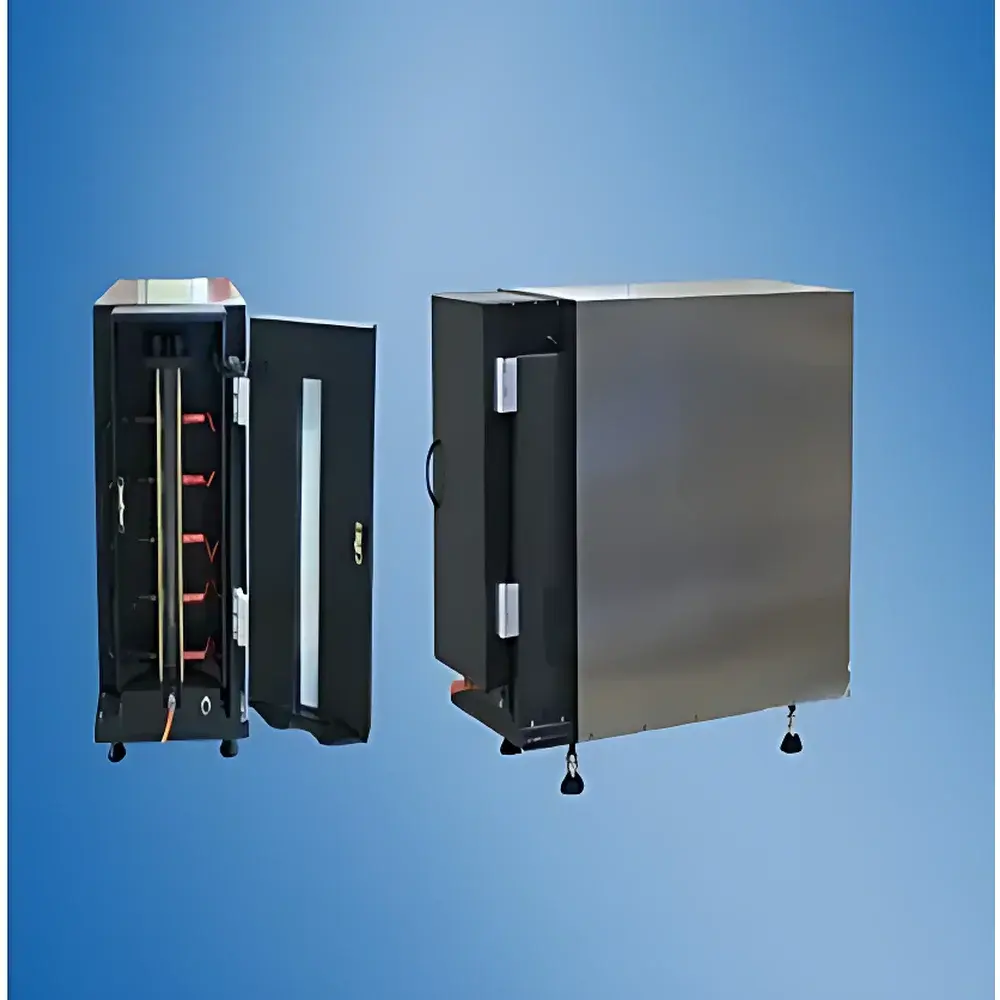
JPM2012A Foam Analyzer
| Origin | Beijing, China |
|---|---|
| Manufacturer Type | Distributor |
| Origin Category | Domestic |
| Model | JPM2012A |
| Price Range | USD 14,000 – 28,000 |
| Dimensions | 690 × 310 × 480 mm |
| Gas Flow Rate | 0–500 mL/min (±0.5% accuracy), Max Pressure: 1.5 MPa |
| Stirring Speed | Up to 5000 rpm (optional) |
| Foam Height Measurement Range | 0–300 mm (video-based) |
| Minimum Sample Volume | 20 mL |
| Conductivity Resolution | 0.01 µS/cm (5-electrode array along foam column) |
| Temperature Control | Ambient to 85 °C (heating rod, optional) |
| Foam Generator Pore Size Options | 1.0–1.6, 10–16, 16–40, 40–100, 100–160, 160–250, 250–500 µm |
| Imaging System | 8× telecentric lens, 1.3 MP digital camera, 25 fps |
| Measured Parameters | gas flow rate, foam volume, liquid drainage volume, foam conductivity, liquid fraction |
| Derived Metrics | foam density, Bikerman index, foam volume stability, liquid phase stability, expansion ratio, foaming capacity, head retention value |
| Power Supply | 220 V AC, 300 W |
| Control | Fully automated PC-based operation, no calibration factor required |
Overview
The JPM2012A Foam Analyzer is an advanced, fully automated instrument engineered for quantitative characterization of foam macrostructure and temporal evolution under controlled hydrodynamic and thermal conditions. Unlike conventional foam analyzers relying solely on electrical conductivity—whose validity is limited to aqueous systems—the JPM2012A integrates multi-modal sensing: high-resolution video imaging, distributed conductivity profiling, real-time gas flow monitoring, and optional temperature regulation. Its measurement principle is grounded in dynamic foam column analysis: gas is introduced into a defined liquid volume via calibrated orifice plates (with seven selectable pore size ranges), generating foam whose height, volume, drainage kinetics, and internal conductivity profile are continuously recorded. This enables rigorous determination of both foaming capacity (initial gas incorporation efficiency) and foam stability (quantified through liquid drainage rate, bubble coalescence onset, and structural collapse time). The system operates on the physical basis of foam rheology and interfacial drainage dynamics, making it suitable for non-aqueous media—including hydrocarbon solvents, silicone oils, and polymer melts—where traditional conductometric methods fail.
Key Features
- Non-contact, optical foam height measurement using a telecentric 8× lens and 1.3 MP high-speed camera (25 fps), eliminating probe interference and enabling precise tracking of foam front displacement and collapse morphology.
- Modular glass sample vessel design allows rapid disassembly, solvent-compatible cleaning, and full visual access—critical for residue-sensitive applications in pharmaceutical excipient development or food-grade surfactant screening.
- Integrated air compressor and dual foam generation modes: programmable gas sparging (0–500 mL/min, ±0.5% repeatability) and optional high-shear mechanical stirring (up to 5000 rpm) for comparative evaluation of shear-induced vs. gas-driven foam formation.
- Five-point axial conductivity sensor array embedded in the foam column delivers spatially resolved ionic transport data, supporting quantification of liquid fraction distribution and drainage heterogeneity—not merely bulk conductivity.
- Seven interchangeable sintered metal foam generators (pore sizes: 1.0–1.6 µm to 250–500 µm) permit systematic study of pore-scale effects on lamella formation, gas dispersion efficiency, and foam coarsening kinetics—aligned with ASTM D7490 and ISO 697 for foam generation standardization.
- Robust, vibration-damped mechanical architecture ensures measurement reproducibility across extended test sequences (>100 cycles), validated per GLP-compliant laboratory protocols.
Sample Compatibility & Compliance
The JPM2012A accommodates a broad spectrum of formulations without modification: low-surface-tension surfactant solutions, viscous polymer dispersions, emulsified oil systems, and even thermally sensitive biological foams (e.g., protein-based stabilizers). Its non-conductive measurement core eliminates electrolyte dependency, extending applicability beyond aqueous media to organic solvents and ionic liquids. All wetted components are borosilicate glass or chemically inert stainless steel (316L), compliant with USP and FDA extractables/leachables guidance. Optional temperature control (ambient to 85 °C) supports accelerated stability testing per ICH Q1A(R3). Data acquisition meets ALCOA+ principles: audit-trail-enabled software logs all parameter changes, operator IDs, timestamps, and raw sensor outputs—fully traceable for 21 CFR Part 11 compliance when configured with electronic signatures.
Software & Data Management
Control and analysis are executed via proprietary Windows-based software featuring intuitive workflow sequencing, real-time parameter overlay (foam height + conductivity + gas flow), and automated report generation in PDF/CSV formats. Raw image sequences are stored losslessly (TIFF) with metadata embedding. The software computes 13 primary metrics—including Bikerman index (β = hf/h0), foam expansion ratio (Vf/Vl), and head retention half-life—and exports derivative curves for statistical comparison (ANOVA, regression modeling). Batch processing mode enables unattended execution of up to 24 sequential tests with auto-archiving to network drives. Exported datasets conform to ASTM E1447 and ISO/IEC 17025 data integrity requirements, including checksum validation and version-controlled analysis scripts.
Applications
- Surfactant & Formulation Development: Quantitative ranking of anionic, cationic, nonionic, and zwitterionic surfactants by foaming capacity and drainage half-life; optimization of co-surfactant ratios in personal care foams (shampoos, cleansers).
- Oilfield Chemistry: Evaluation of foam quality and propagation resistance under reservoir-relevant salinity, temperature, and oil saturation—supporting design of CO2-foam EOR fluids per API RP 14E guidelines.
- Food & Beverage: Stability assessment of dairy-protein foams (whipped cream, meringue analogs) and plant-based alternatives (soy, pea protein), correlating liquid fraction decay with sensory texture metrics.
- Industrial Cleaning & Fire Suppression: Benchmarking of fluorosurfactant-containing AFFF (aqueous film-forming foams) against emerging PFAS-free alternatives under standardized drainage and burn-back test conditions.
- Pharmaceutical Aerosols: Characterization of propellant-free metered-dose foam vehicles (e.g., topical corticosteroids), where foam density and structural persistence directly impact dose uniformity and skin deposition.
FAQ
Does the JPM2012A require calibration with reference foams or standards?
No. The system employs absolute geometric referencing (pixel-to-mm mapping via stage micrometer), factory-trimmed flow sensors, and fixed-conductivity electrode geometry—eliminating routine calibration. Only annual verification per ISO/IEC 17025 is recommended.
Can it measure foam in highly viscous or particle-laden systems?
Yes. The video-based height detection and multi-pore generator options accommodate viscosities up to 10,000 mPa·s and suspended solids ≤5 wt%, provided particles remain below 50 µm to avoid orifice clogging.
Is remote operation and data export compatible with LIMS integration?
Yes. The software provides ODBC-compliant database connectivity and RESTful API endpoints for direct ingestion into LabWare LIMS or Thermo Fisher SampleManager, including structured metadata fields (sample ID, operator, SOP version, pass/fail flags).
What safety certifications does the instrument hold?
CE marked per EN 61010-1:2019 (electrical safety) and EN 61326-1:2013 (EMC); RoHS 2011/65/EU compliant; no hazardous substances used in construction.
How is thermal drift managed during extended temperature-controlled runs?
The heating rod is PID-regulated with dual RTD feedback (vessel wall + bulk liquid), maintaining ±0.3 °C stability over 8-hour tests—validated by NIST-traceable thermocouple logging.



