
English Product Name
| Origin | Taiwan |
|---|---|
| Manufacturer Type | Authorized Distributor |
| Domestic Production | Yes |
| Model | QC-603A / QC-603C |
| Pricing | Upon Request |
| Max Force | 900 kg (QC-603A) / 3000 kg (QC-603C) |
| Stroke | 100 mm (QC-603A) / 125 mm (QC-603C) |
| Upper Platen Diameter | 145 mm (round, optional square platen available) |
| Upper Platen Size | 350 × 160 mm |
| Lower Platen Size | 350 × 180 mm |
| Operating Pressure | 3–6 kg/cm² (compressed air required) |
| Dimensions (W×D×H) | 360 × 430 × 690 mm (QC-603A) / 400 × 380 × 1070 mm (QC-603C) |
| Weight | 55 kg (QC-603A) / 80 kg (QC-603C) |
Overview
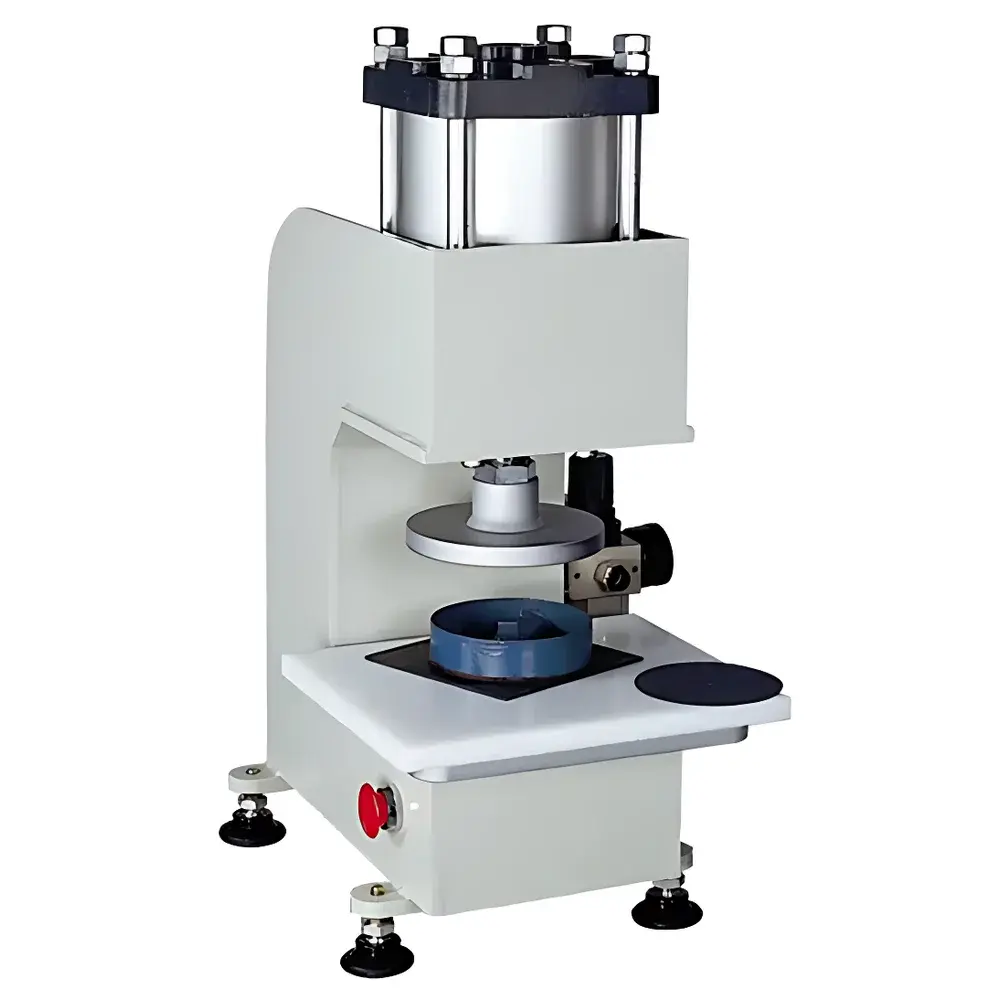
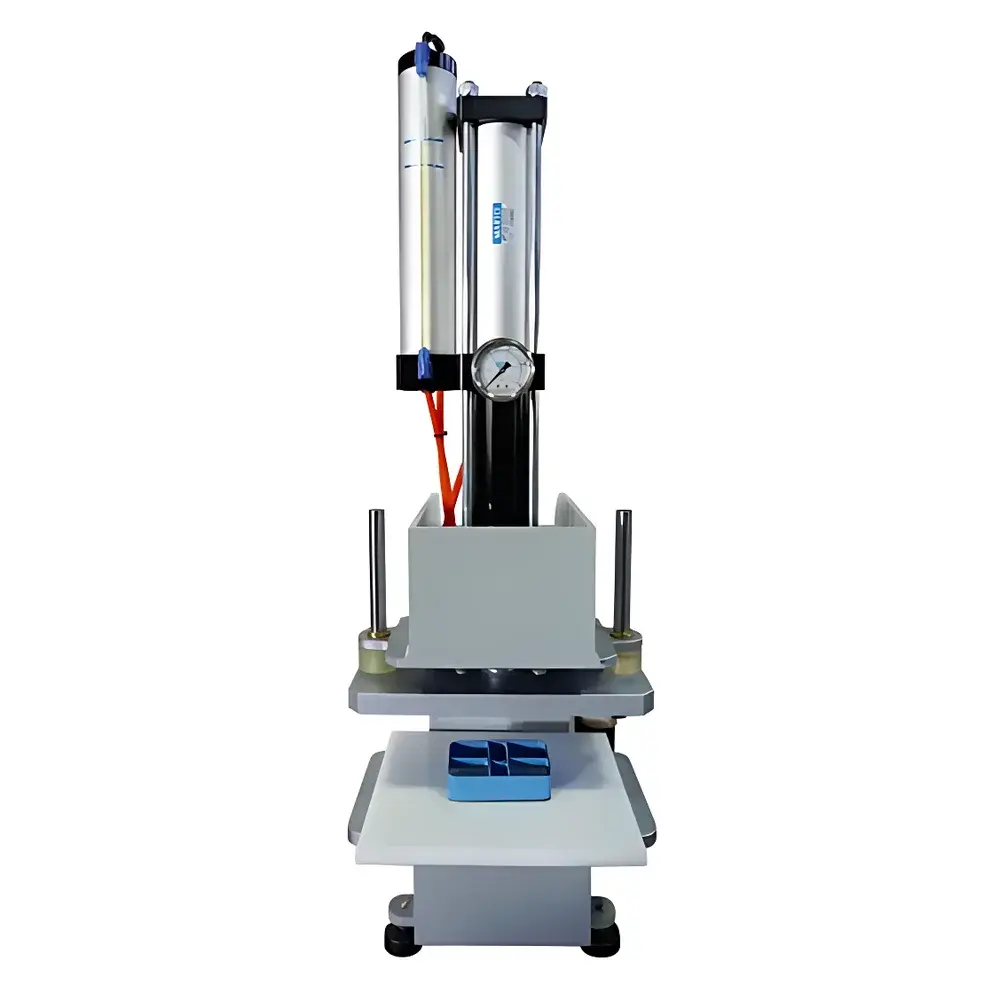
The QC-603A and QC-603C are precision-engineered pneumatic and pneumatic-hydraulic sample cutting presses designed specifically for standardized specimen preparation in rubber, plastic, textile, leather, and composite material testing laboratories. Both models operate on the principle of controlled pneumatic actuation—where compressed air drives a mechanical or air-oil intensification system to generate consistent, repeatable downward force on die-cutting tools. The QC-603A employs direct pneumatic force suitable for soft-to-moderate hardness materials (Shore A ≤ 90), while the QC-603C integrates an air-to-oil conversion mechanism to amplify output force up to 3000 kg, enabling clean, burr-free cutting of high-tensile, thick, or semi-rigid specimens—including reinforced polymers, woven fabrics, and rigid thermoplastics. Their compact footprint, modular platen configuration, and dual-safety switch architecture align with ISO 17025-compliant lab workflows and ASTM D3759, ISO 37, and GB/T 528 specimen geometry requirements.
Key Features
- Dual-hand safety interlock system compliant with ISO 13857:2019—requires simultaneous activation of two independent push-button switches to initiate stroke, eliminating single-point operator error.
- Adjustable stroke limit and pressure regulation (3–6 kg/cm² input) ensure reproducible cutting depth and force across batches.
- Modular platen design: QC-603A features a 145 mm round upper platen (with optional square variant); QC-603C uses a fixed 350 × 160 mm rectangular upper platen and 350 × 180 mm lower platen—optimized for large-format dies and multi-specimen nesting.
- Robust cast-iron frame with precision-ground guide columns ensures parallelism tolerance < 0.05 mm over full stroke—critical for uniform die penetration and edge quality.
- Integrated mounting interface for standard A-type, B-type, and custom precision dies (e.g., dumbbell, ring, strip, and circular geometries per ASTM D412, ISO 37, DIN 53504).
- Optional safety delay valve available—introduces programmable activation lag (adjustable 0.3–2.0 s) to enforce hand withdrawal before descent, satisfying OSHA 1910.212(a)(3)(ii) and EN 692 compliance for press-type equipment.
Sample Compatibility & Compliance
The QC-603 series accommodates a broad spectrum of sheet-form materials up to 12 mm thickness (QC-603C) or 8 mm (QC-603A), including natural/synthetic rubbers, TPEs, PVC, polyolefins, PU foams, nonwovens, coated textiles, and laminated composites. Its force profile supports both manual die-cutting and low-force compression bonding applications—such as layer adhesion pre-testing or specimen stacking prior to tensile or peel evaluation. All configurations meet CE marking directives (Machinery Directive 2006/42/EC), and the dual-switch control architecture satisfies functional safety requirements per IEC 62061 SIL 2 and ISO 13849-1 PL d. Documentation packages include traceable calibration certificates for force verification and dimensional inspection reports for platen flatness and parallelism.
Software & Data Management
While the QC-603A/C are standalone mechanical systems without embedded digital controllers, they integrate seamlessly into LIMS and ELN ecosystems via optional industrial I/O modules (e.g., 24 V DC dry-contact outputs for cycle counting, fault signaling, and timestamped operation logging). When paired with third-party PLC-based monitoring systems, full audit trails—including operator ID, date/time stamp, cycle count, and pressure setpoint—are exportable in CSV or XML format for GLP/GMP-aligned record retention. Optional RS-485 or Ethernet/IP interfaces support remote status polling and preventive maintenance scheduling based on cumulative actuation cycles.
Applications
- Preparation of standardized test specimens for tensile, tear, hardness, and elongation testing per ASTM D412, ISO 37, DIN 53504, and JIS K6251.
- Cutting of gasket, seal, and O-ring blanks from elastomeric sheets under controlled compression.
- Production of layered composite coupons for interfacial shear strength or delamination studies.
- Low-force lamination of multi-material stacks (e.g., rubber-metal bonds, fabric-reinforced elastomers) prior to adhesion testing.
- Routine QC sampling in tire compound development, conveyor belt manufacturing, and medical-grade polymer fabrication facilities.
FAQ
What compressed air specifications are required for stable operation?
A clean, dry, oil-free air supply at 3–6 kg/cm² (43–86 psi) with minimum flow rate of 120 L/min is recommended. An inline coalescing filter and refrigerated dryer are advised to prevent moisture-induced cylinder wear.
Can the QC-603C cut metal foil or thin sheet metal?
No—these presses are engineered exclusively for non-metallic, ductile, or viscoelastic sheet materials. Cutting metallic substrates requires dedicated hydraulic or mechanical punch presses with hardened tooling and structural reinforcement.
Is calibration traceable to national standards?
Yes—force calibration is performed using NIST-traceable load cells; dimensional verification follows ISO 17025-accredited procedures. Calibration certificates include uncertainty budgets and are valid for 12 months under normal usage.
Are replacement dies and platens available as spare parts?
All standard A/B-type dies, precision custom dies (CAD drawings accepted), round/square upper platens, and lower platen inserts are stocked and shipped globally within 5 business days.
Does the machine support integration with automated sample handling systems?
Yes—via optional photoelectric sensor triggers and programmable logic controller (PLC) interface kits, enabling synchronization with robotic arms, conveyor-fed die-loading stations, and barcode-triggered batch logging.




