
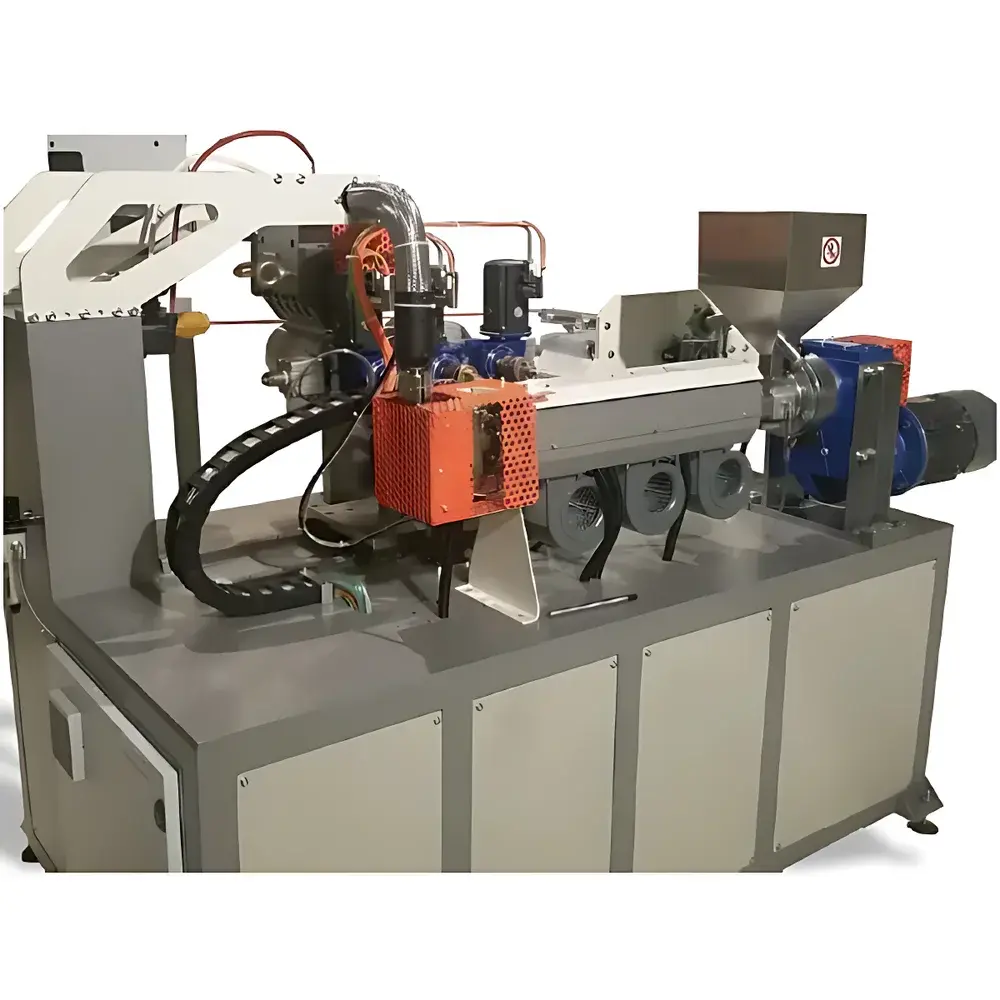
Eurotech D-20 Laboratory-Scale Cast Film Extrusion Line
| Brand | Eurotech |
|---|---|
| Origin | Italy |
| Model | D-20 |
| Screw Diameter | 20 mm |
| L/D Ratio | 30 |
| Max. Output | 15 kg/h (material-dependent) |
| Screw Speed Range | 0–180 rpm |
| Torque | 500 N·m |
| Motor Power | 3 kW |
| Die Width | 150 mm |
| Adjustable Die Gap | 1.5 mm |
| Chill Roll Surface Roughness | < 0.1 µm |
| Chill Roll Temperature Control Range | 20–180 °C |
| Temperature Stability | ±0.01 °C |
| Winding Speed | 0.1–10 m/min |
| Tension Control Range | up to 20 N |
| Overall Dimensions (Extruder) | 600 × 1200 × 450 mm |
| Weight (Extruder) | 300 kg |
| Dimensions (Chill & Winding Unit) | 720 × 450 × 860 mm |
| Weight (Chill & Winding Unit) | 480 kg |
| Chiller Capacity (at 0 °C) | 5 kW |
| Julabo Thermostat Temperature Range | –30 to +180 °C |
Overview
The Eurotech D-20 Laboratory-Scale Cast Film Extrusion Line is a compact, fully integrated cast film processing system engineered for R&D laboratories and pilot-scale formulation development in polymer science, packaging material engineering, and advanced film additive testing. It operates on the principle of melt extrusion followed by quenching via precision-controlled chill roll casting — a process critical for producing uniform, dimensionally stable thin films with controlled crystallinity, surface morphology, and mechanical anisotropy. Unlike blown film or calendering systems, cast film extrusion enables high-speed, low-stress solidification under controlled thermal gradients, making it ideal for evaluating shear-sensitive polymers (e.g., PLA, PHA, EVOH), multilayer coextrusions, and nanocomposite dispersions. The D-20 integrates a single-screw extruder, precision flat-film die, thermostatically regulated chill roll, and closed-loop tension-controlled winding station — all coordinated through a unified 5.7-inch TFT touchscreen interface with real-time data logging.
Key Features
- High-precision 20 mm L/D 30 single-screw extruder fabricated from nitrided LK3 alloy steel, optimized for thermal stability and wear resistance in abrasive or filled polymer systems.
- Electronically commutated servo drive with closed-loop torque feedback ensures consistent screw speed (0–180 rpm) and reproducible melt homogenization across viscosity ranges (MI 0.5–50 g/10 min).
- Three-zone barrel heating with Gneub J-type thermocouples and self-tuning PID controllers delivers ±0.5 °C zone temperature accuracy; combined with Asentec/KMK pressure transducers for inline melt pressure monitoring.
- 150 mm wide flat-film die featuring adjustable 1.5 mm gap and polished stainless-steel flow channels to minimize residence time and eliminate weld lines or flow instabilities.
- Chill roll assembly with electroplated chromium surface (Ra < 0.1 µm), height-adjustable mounting, and Julabo thermostatic circulation (–30 to +180 °C) enabling precise control of quench rate — essential for tailoring spherulite size and optical haze in semi-crystalline films.
- Integrated winding unit with pneumatic mandrel expansion (76 mm core), servo-controlled tension regulation (0–20 N), and linear speed adjustment (0.1–10 m/min), supporting consistent take-up of films as thin as 12 µm without edge curl or gauge banding.
Sample Compatibility & Compliance
The D-20 accommodates a broad spectrum of thermoplastic resins including polyolefins (LDPE, HDPE, PP), engineering thermoplastics (PC, PET, PA6), biopolymers (PLA, PBS), barrier polymers (EVOH, PVDC), and masterbatch-loaded formulations. Its modular architecture allows rapid die and roll configuration changes for thickness optimization (typically 25–250 µm) and substrate adaptation (e.g., release liners, metallized films). All electrical components comply with CE/EN 61000-6-2/6-4 EMC standards. Temperature controllers meet EN 60519-1 safety requirements for industrial heating equipment. While not certified for GMP production, the system supports GLP-compliant documentation workflows when paired with validated software logging (see Software & Data Management). It is routinely employed in ASTM D2838 (shrinkage), ASTM D882 (tensile properties), and ISO 1183 (density) pre-test sample preparation.
Software & Data Management
The embedded HMI runs on a deterministic real-time OS with non-volatile parameter storage and timestamped event logging (start/stop, temperature ramp, speed change, alarm triggers). All process variables — screw speed, zone temperatures, melt pressure, chill roll surface temperature, winding speed, and tension — are sampled at 1 Hz and exportable via USB to CSV or Excel-compatible formats. Optional Ethernet connectivity enables integration into LabVantage or Thermo Fisher SampleManager LIMS environments. Audit trail functionality satisfies FDA 21 CFR Part 11 requirements when deployed with user-access controls and electronic signature modules (available as add-on license). No cloud dependency: all data remains on-device unless explicitly exported.
Applications
- Rapid screening of polymer blends and compatibilizer efficacy via film clarity, haze, and peel strength analysis.
- Development of functional coatings — e.g., anti-fog, anti-static, or barrier layers — using solvent-free melt extrusion.
- Validation of rheological models by correlating extrudate swell, draw resonance onset, and chill roll adhesion behavior with capillary rheometry data.
- Preparation of standardized test specimens for ASTM D1709 (impact resistance), ASTM D1922 (tear propagation), and ISO 527-3 (tensile testing of films).
- Process mapping studies linking screw speed, melt temperature, and quench rate to final film crystallinity (DSC), orientation (WAXS), and oxygen transmission rate (OTR).
FAQ
What materials are incompatible with the D-20 extruder?
Thermosets (e.g., epoxies, phenolics), highly abrasive mineral-filled compounds (>40 wt% CaCO₃ or glass fiber), and reactive monomers requiring in-line polymerization are not supported due to residence time constraints and lack of venting capability.
Can the system produce multilayer films?
No — the standard D-20 is configured for monolayer extrusion only. Coextrusion capability requires retrofitting with a dual-feed manifold and auxiliary metering pump, available as a factory-engineered option (D-20-Coex variant).
Is calibration traceable to national standards?
Temperature sensors are calibrated against NIST-traceable references during factory acceptance testing; calibration certificates are provided. Users may perform field verification using portable dry-block calibrators per ISO/IEC 17025 guidelines.
What maintenance intervals are recommended?
Screw/barrel inspection every 500 operational hours; chill roll surface polishing every 2,000 hours; Julabo chiller coolant replacement annually or per manufacturer’s specification (Julabo Thermostat Maintenance Manual Rev. 4.2).
Does the system support automated recipe management?
Yes — up to 99 user-defined profiles can be stored onboard, each containing synchronized setpoints for all zones, screw speed, die gap, chill temperature, and winding parameters.






