
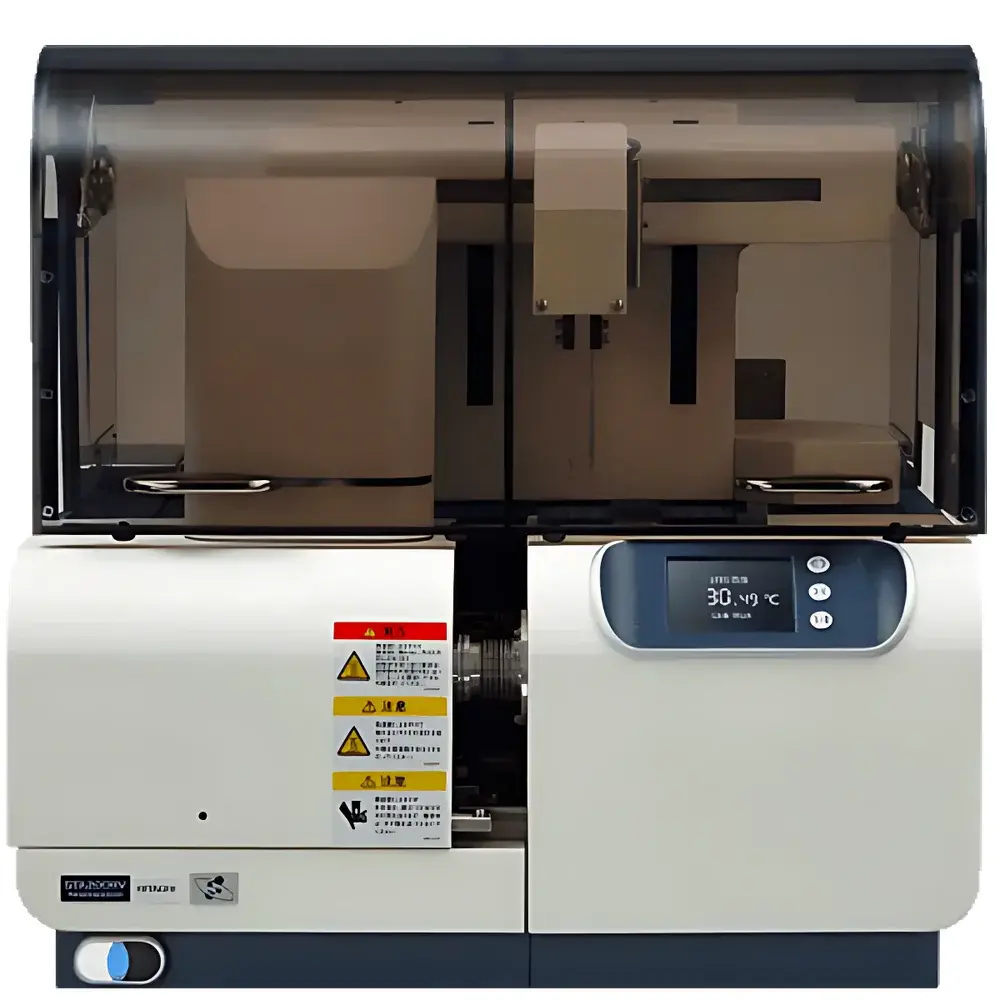
Hitachi New STA Series TG-DSC Simultaneous Thermal Analyzer
| Brand | Hitachi |
|---|---|
| Origin | Japan |
| Manufacturer | Hitachi High-Tech Corporation |
| Product Type | Imported Instrument |
| Model | STA300 |
| Temperature Range | Ambient to 1500 °C |
| Temperature Accuracy | ±0.2 K |
| Temperature Precision | ±0.07 °C |
| Heating/Cooling Rate | 0.01–150 K/min |
| Maximum Sample Mass | 0.2 g |
Overview
The Hitachi New STA Series TG-DSC Simultaneous Thermal Analyzer is an advanced, dual-signal thermal analysis platform engineered for precision measurement of mass change (thermogravimetry, TG) and heat flow (differential scanning calorimetry, DSC) under controlled temperature programs. Unlike legacy TG-DTA systems, the STA300 implements true simultaneous TG-DSC measurement using a single furnace and integrated high-stability microbalance—enabling direct correlation between mass loss events (e.g., decomposition, desorption, oxidation) and associated enthalpic transitions (e.g., melting, crystallization, glass transition, reaction enthalpy). Its design adheres to fundamental principles of thermodynamic equilibrium and heat transfer modeling, with calibration traceable to NIST-certified reference materials. The instrument is optimized for R&D laboratories, quality control environments, and failure analysis labs requiring quantitative, reproducible data across organic polymers, pharmaceuticals, composites, ceramics, and metallic alloys.
Key Features
- Digital Horizontal Differential Microbalance: A proprietary dual-pan, digitally resolved balance architecture with active thermal stabilization of the balance chamber—minimizing thermal drift induced by furnace temperature gradients. Baseline stability remains within ±10 µg over a 25–1000 °C ramp in zero-sample mode.
- True Simultaneous TG-DSC Measurement: Independent, real-time acquisition of both mass (µg resolution) and heat flow (µW sensitivity) signals from a single sample position—eliminating time-shift artifacts inherent in sequential or hybrid DTA-based systems.
- Enhanced Gas Management System: Redesigned laminar gas flow path with integrated mass flow controller (MFC) for precise, programmable atmosphere control (inert, oxidative, reducing, or reactive gases), including dynamic switching during a single run per ASTM E1131 and ISO 11357 standards.
- Real View® Sample Observation System (Optional, Upgraded): High-resolution digital optical module with motorized zoom, on-screen length calibration, RGB color analysis, and frame annotation—supporting visual correlation of morphological changes (e.g., swelling, cracking, phase separation) with thermal events.
- Thermal Control Architecture: Dual-zone furnace with independent PID regulation, enabling rapid heating/cooling rates (0.01–150 K/min) and exceptional temperature uniformity (<±0.5 K across 10 mm sample zone) compliant with USP <1225> and ICH Q5C guidelines for thermal stability assessment.
Sample Compatibility & Compliance
The STA300 accommodates solid powders, granules, thin films, fibers, and small-volume liquids (in hermetic pans) with nominal mass up to 0.2 g. It supports standard crucible types—including alumina, platinum, gold, and sealed stainless steel—and is compatible with high-pressure DSC pans (up to 10 MPa). The system meets critical regulatory requirements for GxP environments: full audit trail capability, electronic signature support, and 21 CFR Part 11–compliant software architecture (via optional ThermoSync™ Suite). All thermal calibrations follow ISO 11357-1 (DSC) and ISO 11358-1 (TG), with certified reference materials (e.g., indium, zinc, calcium oxalate monohydrate) included in the factory validation package.
Software & Data Management
Control and analysis are performed via ThermoSync™ Software—a Windows-based platform featuring method templating, multi-step temperature programming, automatic peak detection with deconvolution algorithms, and kinetic modeling (e.g., Ozawa-Flynn-Wall, Kissinger, ASTM E698). Raw data files are stored in vendor-neutral .tdf format (Time-Dependent Format), supporting third-party import into MATLAB, OriginLab, or Python-based analysis pipelines. The software includes GLP-compliant reporting modules with customizable templates aligned to ISO/IEC 17025 documentation requirements. Data integrity safeguards include write-protected archives, user-level access controls, and timestamped operation logs with operator ID tagging.
Applications
- Quantitative decomposition kinetics of polymer blends and flame-retardant additives
- Residual solvent determination and moisture content profiling in lyophilized pharmaceuticals (per USP <1225>)
- Oxidative induction time (OIT) and onset temperature evaluation of polyolefins per ASTM D3895
- Thermal stability screening of battery cathode materials (LiCoO₂, NMC) under air/N₂ atmospheres
- Phase transformation analysis in shape-memory alloys and ferroelectric ceramics
- Fusion enthalpy and crystallinity calculation in semi-crystalline biopolymers (PLA, PHA)
- Multi-step degradation profiling of carbon-fiber-reinforced composites in aerospace QA
FAQ
Does the STA300 support inert and oxidative atmospheres simultaneously within one experiment?
Yes—the integrated MFC enables automated, time-synchronized switching between up to three gas channels (e.g., N₂ → air → O₂) during a single thermal program, with flow rate accuracy ±1% FS.
Is baseline correction required before every measurement?
No—baseline stability is hardware-engineered; however, optional empty-pan baseline subtraction is available for ultra-high-precision applications requiring sub-µg mass resolution.
Can the Real View® system be used under reactive gas conditions?
Yes—the observation module features quartz viewport and purge-compatible housing, allowing real-time imaging under N₂, Ar, or forming gas without optical distortion.
What calibration standards are supplied with the instrument?
Factory-installed calibration includes indium (melting point 156.6 °C), zinc (419.5 °C), and calcium oxalate monohydrate (three-stage decomposition), all traceable to NIST SRMs.
Is remote monitoring supported?
Yes—ThermoSync™ supports secure remote access via TLS-encrypted VNC protocol, enabling real-time instrument status viewing and method queue management from authorized network endpoints.



