
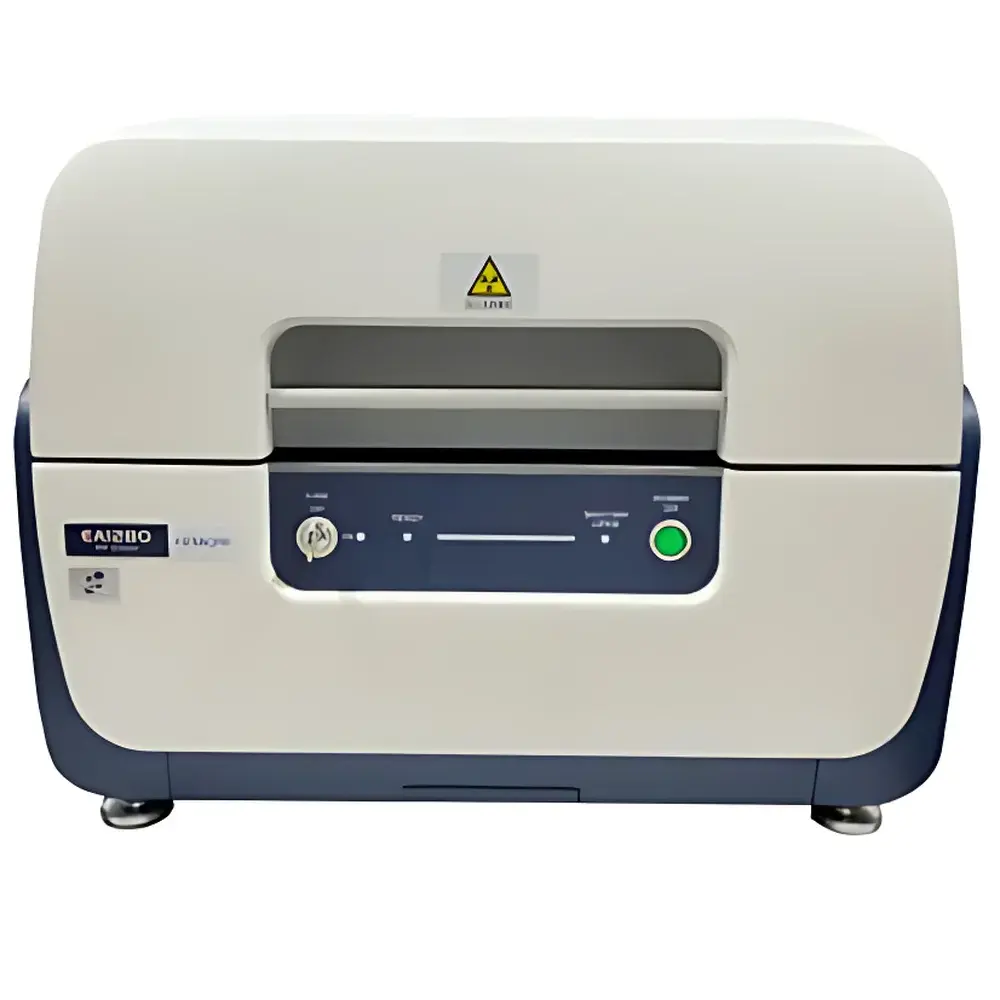
Hitachi EA1280 Benchtop Energy Dispersive X-Ray Fluorescence Spectrometer (RoHS-Compliant)
| Brand | Hitachi |
|---|---|
| Origin | Japan |
| Manufacturer Type | Original Equipment Manufacturer (OEM) |
| Origin Category | Imported |
| Model | EA1280 |
| Configuration | Benchtop |
| Instrument Type | Conventional ED-XRF |
| Application Scope | General-Purpose |
| Elemental Range | Al (Z=13) to U (Z=92) |
| Quantification Range | 1 ppm – 99.99 wt% |
| Energy Resolution | <150 eV (Mn Kα) |
| Detector | High-Performance Silicon Drift Detector (SDD) |
Overview
The Hitachi EA1280 is a benchtop energy dispersive X-ray fluorescence (ED-XRF) spectrometer engineered for regulatory compliance testing—specifically RoHS (Restriction of Hazardous Substances), ELV (End-of-Life Vehicles), EN71 (Toy Safety), and halogen-free standards. It operates on the fundamental principle of X-ray fluorescence: primary X-rays from a micro-focus tube excite inner-shell electrons in sample atoms; upon relaxation, characteristic secondary X-rays are emitted, with energies uniquely identifying elemental species and intensities correlating quantitatively with concentration. The EA1280 leverages a high-brightness X-ray source, precision collimation optics, and a high-resolution SDD detector to deliver reproducible, trace-level quantification across the full Al–U range—without vacuum or helium purge requirements, enabling robust air-path analysis for routine industrial QC.
Key Features
- Regulatory-optimized firmware: Pre-loaded RoHS/ELV/EN71/halogen screening methods compliant with IEC 62321-5:2013 and ASTM F2617-22 protocols.
- Enhanced light-element detection: Improved sensitivity for Cl (Z=17), Sb (Z=51), and Sn (Z=50) versus prior-generation instruments—critical for evolving RoHS Annex II updates.
- Automated multi-position analysis: 12-position programmable sample carousel supports unattended batch processing for high-throughput labs.
- Optical sample viewing: Integrated color CCD camera with 10× digital zoom enables precise positioning of measurement spots (standard 5 mm Ø, optional 1 mm and 3 mm Ø collimators).
- Intelligent acquisition logic: Real-time spectrum evaluation triggers automatic exposure termination once statistical confidence thresholds (e.g., ±10% RSD at 100 ppm) are met—reducing average analysis time to <35 s for polymers and <170 s for brass.
- Low operational overhead: No consumables beyond standard X-ray tube lifetime (≥20,000 h); optimized air-path geometry eliminates reliance on He gas, reducing cost-of-ownership by >40% vs. legacy purged systems.
Sample Compatibility & Compliance
The EA1280 accommodates solid, powder, and thin-film samples up to 304 mm (W) × 304 mm (D) × 110 mm (H) within its shielded chamber. Its open architecture supports custom fixtures for irregular geometries (e.g., PCBs, molded connectors, wire insulation). All RoHS screening workflows adhere to ISO/IEC 17025:2017 requirements for analytical competence, and method validation documentation aligns with EU Commission Decision 2011/65/EU and IEC TR 62321-1:2013 guidance. Optional GLP/GMP audit trail modules log user actions, parameter changes, and calibration events in accordance with FDA 21 CFR Part 11 requirements.
Software & Data Management
The proprietary EDS-Analyzer software provides intuitive workflow navigation, automated peak deconvolution (based on fundamental parameters and empirical library matching), and pass/fail reporting per substance-specific threshold (e.g., Cd ≤ 100 ppm, Pb ≤ 1000 ppm). Calibration models are field-upgradable via secure firmware patches—ensuring continued compliance as regulatory limits evolve. Data export supports CSV, PDF, and XML formats compatible with LIMS integration. Full spectral archives—including raw counts, background-subtracted spectra, and matrix correction logs—are retained with timestamped metadata for traceability.
Applications
- Routine RoHS/ELV pre-screening of electronic components, cables, and housings prior to final assembly.
- Halogen-free verification (Cl, Br) in flame-retardant plastics per IEC 61249-2-21.
- Thin-film thickness and composition analysis (e.g., Ni/Cu plating on PCB pads, SnAg solder layers).
- Positive material identification (PMI) for incoming raw materials including alloys, ceramics, and recycled feedstocks.
- Quantitative analysis of restricted substances in consumer goods (toys, packaging, textiles) per EN71-3 and CPSIA requirements.
FAQ
Does the EA1280 require vacuum or helium purging for light-element analysis?
No—it utilizes an optimized air-path configuration with enhanced low-energy X-ray transmission and SDD detector efficiency, enabling reliable Cl and S detection without gas consumption.
Can the instrument be upgraded to meet future RoHS revisions?
Yes—Hitachi provides validated software updates and recalibration kits aligned with new EU Commission delegated acts; hardware capabilities support all current and foreseeable RoHS substance expansions within the Al–U range.
Is operator training required to achieve ISO-compliant results?
Minimal training is needed: the interface guides users through sample loading, method selection, and report generation; however, ISO/IEC 17025-compliant operation requires documented competency assessment per laboratory SOPs.
What sample preparation is necessary for plastic RoHS screening?
Flat, homogeneous surfaces require no preparation; heterogeneous or layered samples benefit from cross-sectioning or pelletization with binder to ensure representative sampling and minimize matrix effects.
How does the EA1280 handle overlapping spectral peaks (e.g., Pb M-lines interfering with Sb L-lines)?
Its high-resolution SDD (<150 eV Mn Kα) combined with iterative fundamental parameter (FP) modeling and empirical interference corrections minimizes misidentification and improves accuracy for adjacent-Z elements in complex matrices.





