
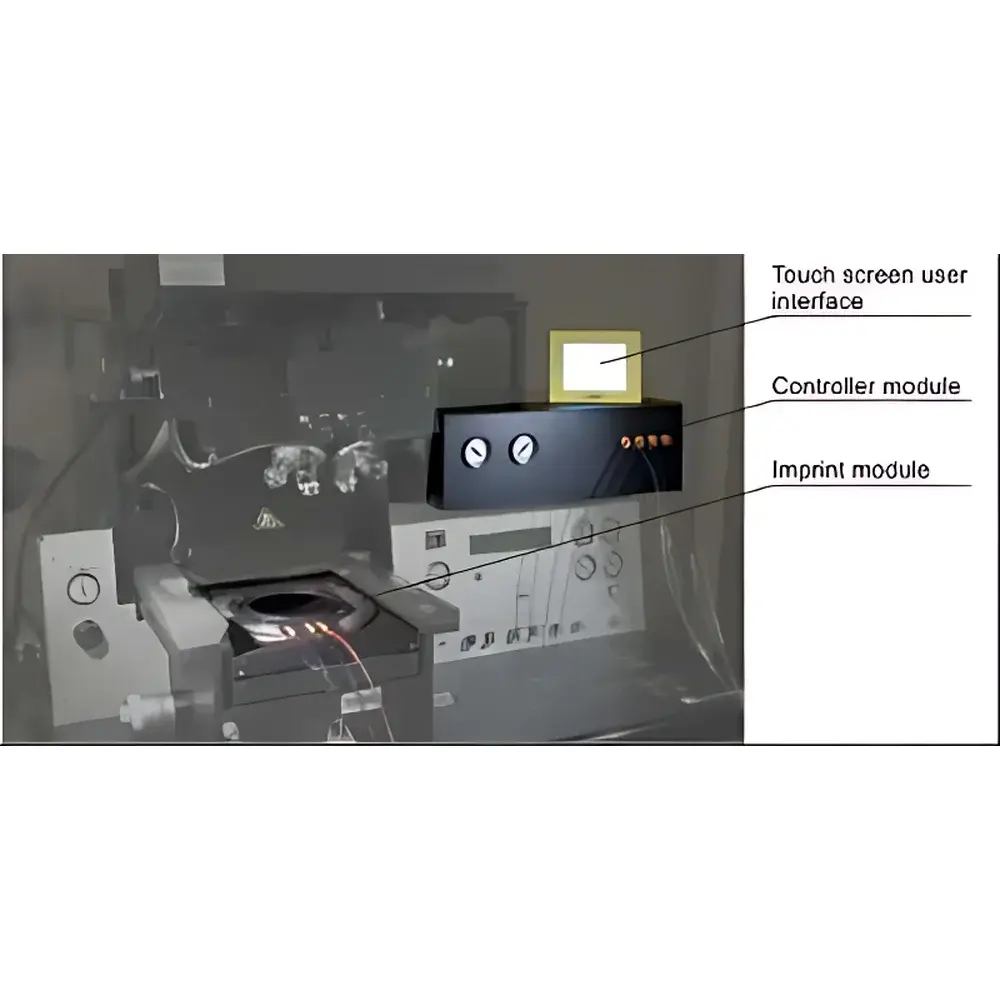
NIL Nanoimprint Template
| Brand | NIL |
|---|---|
| Origin | Denmark |
| Manufacturer Type | Authorized Distributor |
| Origin Category | Imported |
| Model | NIL |
| Pricing | Upon Request |
Overview
The NIL Nanoimprint Template is a high-precision master template engineered for thermal and ultraviolet (UV) nanoimprint lithography (NIL) processes. Designed and fabricated to meet stringent nanofabrication requirements, it operates on the principle of mechanical pattern transfer—where a rigid, topographically structured template is pressed into a thermoplastic or UV-curable resist layer under controlled temperature, pressure, or UV exposure. This enables deterministic replication of sub-50 nm features with exceptional fidelity and long-term dimensional stability. The template serves as the foundational element in advanced nanofabrication workflows, supporting research and production applications in photonics, metamaterials, biosensors, and semiconductor prototyping.
Key Features
- Sub-20 nm critical dimension (CD) accuracy across full template area, verified via calibrated scanning electron microscopy (SEM) and atomic force microscopy (AFM)
- Minimum structural period down to 40 nm, enabling high-resolution periodic and aperiodic pattern replication
- Optimized surface topology for uniform resist filling and low-defect imprinting—engineered to minimize residual layer variation (RLV)
- Thermally stable quartz or silicon substrate platform, compatible with both thermal NIL (T-NIL) and UV-NIL process conditions
- Customizable pattern design and layout based on customer-supplied CAD/GDSII files, with rapid turnaround for R&D-scale orders
- Surface functionalization options available—including anti-sticking monolayer coatings (e.g., perfluorodecyltrichlorosilane) to ensure clean demolding and extended template lifetime
Sample Compatibility & Compliance
The NIL Nanoimprint Template is fully compatible with industry-standard nanoimprint systems from EVG, Canon, Obducat (now part of Mycronic), and Suss MicroTec. It supports resist materials including PMMA, NOA series, OrmoStamp, and other commercially available UV-curable and thermoplastic polymers. All templates undergo rigorous metrological validation prior to shipment, including CD uniformity mapping and defect inspection per ISO/IEC 17025-accredited protocols. While not a standalone instrument subject to FDA or CE directives, the template complies with material safety and traceability requirements for use in ISO 14644-1 Class 5 cleanroom environments and GLP-compliant nanofabrication laboratories.
Software & Data Management
As a passive physical tool rather than an active instrumentation system, the NIL Nanoimprint Template does not incorporate embedded firmware or proprietary software. However, its integration into automated NIL platforms relies on standard alignment and overlay control systems—typically managed through vendor-specific host software (e.g., EVG’s SmartView or Canon’s NGL Control Suite). Pattern design data is delivered in GDSII or OASIS format, compatible with industry-standard mask data preparation (MDP) tools such as KLayout or Calibre. Traceability documentation—including coordinate metrology reports, surface roughness profiles (Ra < 0.3 nm), and coating verification certificates—is provided digitally in PDF and CSV formats, supporting audit readiness under ISO 9001 and internal quality management systems.
Applications
- High-throughput fabrication of plasmonic nanostructures for surface-enhanced Raman spectroscopy (SERS) substrates
- Replication of photonic crystal slabs and metasurface unit cells for visible and near-infrared optical devices
- Manufacturing of nanostructured electrodes for electrochemical biosensing and microfluidic cell culture interfaces
- Rapid prototyping of diffractive optical elements (DOEs) and anti-counterfeiting security features
- Process development and benchmarking for next-generation semiconductor patterning alternatives to EUV lithography
FAQ
What substrate materials are used for NIL Nanoimprint Templates?
Standard substrates include fused silica (quartz) and single-crystal silicon; alternative substrates (e.g., CaF₂, sapphire) are available upon request.
Can templates be reused, and what is their typical service life?
Yes—under proper cleaning (oxygen plasma, piranha solution, or UV-ozone) and handling protocols, templates sustain >500 imprint cycles without measurable CD drift or surface degradation.
Do you provide design support for custom patterns?
Yes—our engineering team offers layout review, proximity effect correction guidance, and manufacturability assessment for GDSII files prior to fabrication.
Are templates supplied with certification of conformity?
Each shipment includes a Certificate of Conformance listing dimensional specifications, metrology method, and batch-specific test data aligned with customer-defined acceptance criteria.
Is cross-platform compatibility guaranteed across different NIL equipment brands?
Templates are fabricated to mechanical interface standards (e.g., EVG 620 footprint, 100 mm diameter), ensuring physical fit; process optimization remains the responsibility of the end-user’s equipment operator.



