
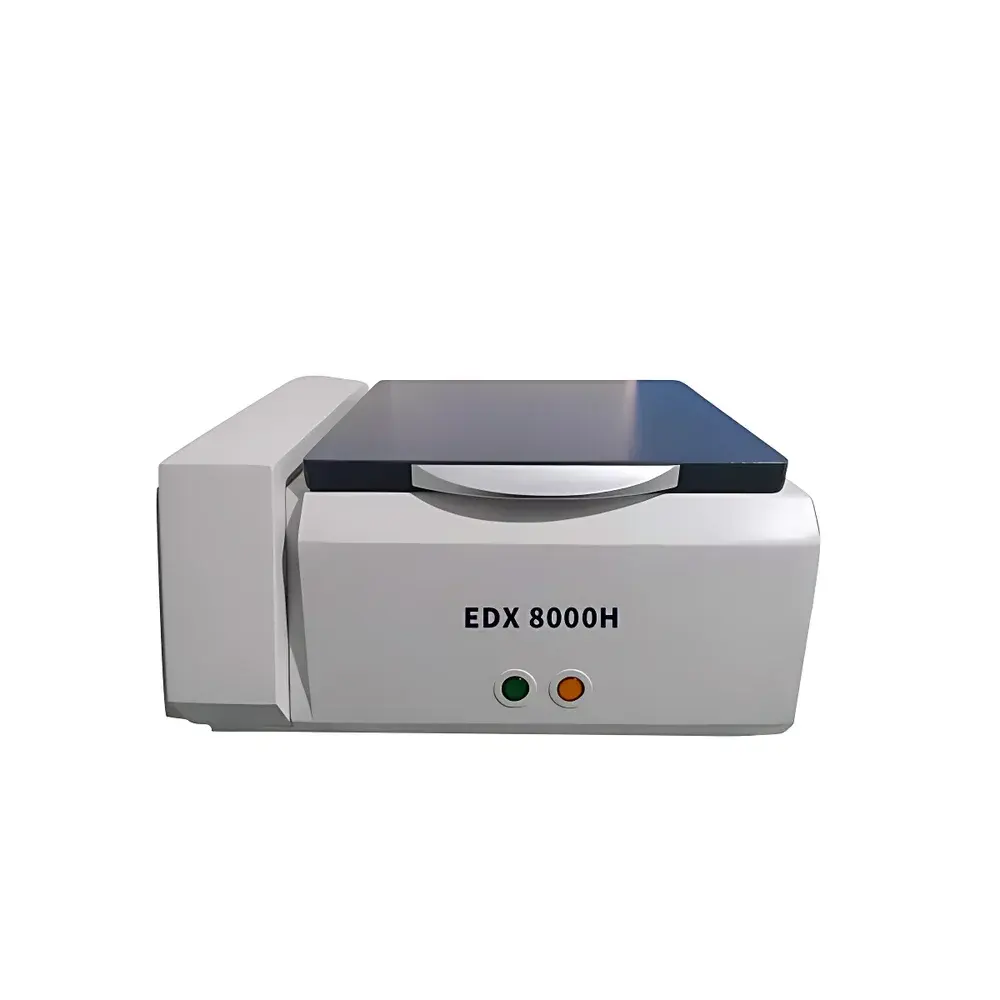
Beijing EDX 8000H Vacuum-Enabled Energy Dispersive X-Ray Fluorescence Spectrometer
| Origin | Beijing, China |
|---|---|
| Manufacturer Type | Authorized Distributor |
| Origin Category | Domestic (PRC) |
| Model | EDX 8000H |
| Configuration | Benchtop/Floor-Standing |
| Industry-Specific Use | Electronics & RoHS Compliance |
| Elemental Range | Na (11) to U (92) |
| Quantitative Range | 1 ppm to 99.99 wt% |
| Energy Resolution | 149 ± 5 eV (Mn Kα) |
| Repeatability | RSD ≤ 0.05% (at 100 s counting time, certified reference materials) |
| Operating Temperature | 15–30 °C |
| Relative Humidity | 40–70% RH |
| Power Supply | AC 220 V ± 5 V, 50 Hz |
Overview
The Beijing EDX 8000H is a vacuum-enabled energy dispersive X-ray fluorescence (EDXRF) spectrometer engineered for high-precision elemental analysis of solid, powdered, and thin-film samples across industrial quality control and regulatory compliance laboratories. Based on the fundamental principle of X-ray fluorescence—where primary X-rays excite atoms in a sample, inducing emission of characteristic secondary X-rays—the EDX 8000H detects and quantifies emitted photons using a silicon drift detector (SDD) with digital pulse processing. Its integrated vacuum chamber eliminates atmospheric absorption of low-energy X-rays, significantly enhancing sensitivity for light elements (Na–F), making it particularly suited for RoHS-compliant screening of Cd, Pb, Cr, Hg, Br, and Cl at detection limits down to 1 ppm, as well as for alloy grade identification, plating composition verification, and geological matrix characterization.
Key Features
- Vacuum-compatible sample chamber (ultimate pressure: 6.7 × 10⁻² Pa) with rapid evacuation (<20 s), enabling reliable detection of elements from sodium (Na) through uranium (U) without liquid nitrogen cooling.
- Silicon drift detector (SDD) with Peltier-based thermoelectric cooling, delivering 149 ± 5 eV energy resolution at Mn Kα (5.89 keV) and stable long-term performance (>5000 h X-ray tube lifetime).
- Digital multi-channel analyzer (4096 channels) with SES signal enhancement algorithm, improving peak-to-background ratio and quantitative accuracy for complex matrices.
- Automated collimator and filter selection system: seven fixed apertures (2–8 mm) and five interchangeable filters support optimized excitation conditions across diverse sample types and thicknesses.
- Intelligent calibration curve auto-selection engine, eliminating manual curve assignment and reducing operator-induced error in routine QA/QC workflows.
- Real-time vacuum status monitoring, X-ray tube temperature tracking, and hardware interlock safeguards—including radiation-shielded enclosure, automatic vacuum release upon chamber opening, and overvoltage/overcurrent protection in the 0–50 kV high-voltage generator.
- USB 2.0 interface for deterministic data transfer, compatible with Windows-based laboratory networks and LIMS integration via standardized ASCII or CSV export formats.
Sample Compatibility & Compliance
The EDX 8000H accommodates both open (610 × 320 × 100 mm) and semi-closed vacuum-compatible (Φ100 × 75 mm) sample chambers, supporting irregular, large-area, or coated substrates without destructive preparation. It meets international regulatory requirements for restricted substance screening per EU RoHS Directive 2011/65/EU, Packaging Directive 94/62/EC, and toy safety standard EN71-3. While not certified to ISO/IEC 17025 for accredited testing, its measurement reproducibility (RSD ≤ 0.05%) and traceable calibration against NIST-traceable reference materials align with GLP-aligned internal QA protocols. The instrument supports ASTM E1621 (standard test method for elemental analysis by EDXRF) and IEC 62321-5 (RoHS screening using XRF), and its software audit trail functionality—including user login logs, parameter change history, and result timestamps—facilitates 21 CFR Part 11 readiness when deployed with validated electronic signature modules.
Software & Data Management
The dedicated Windows-based acquisition and analysis software features dual-language UI (English/Chinese, with optional third-language localization), real-time spectral visualization, and automated qualitative phase identification to prevent misassignment of calibration curves. It includes embedded vacuum control logic, live display of tube temperature, high-voltage settings, count rates, and vacuum level. Quantitative analysis employs fundamental parameter (FP) and empirical calibration methods, with support for up to 20 custom working curves. Reports are exportable in PDF, Excel, or XML formats; spectral overlays allow comparative analysis of multiple measurements. All instrument parameters, acquisition metadata, and raw spectra are stored in structured binary files with checksum validation, ensuring data integrity during archival or transfer. Software updates are provided free of charge for the instrument’s operational lifetime.
Applications
The EDX 8000H is routinely deployed in electronics manufacturing for incoming material verification and final product screening; in metallurgy labs for rapid alloy grade confirmation (e.g., stainless steel, Zn–Al die-castings, Cu–Ni brazing alloys); in surface engineering for plating composition and thickness estimation (via FP modeling); in mining and geochemistry for bulk ore assay screening; and in packaging and consumer goods testing for halogen-free compliance (Cl, Br). Its vacuum capability ensures robust quantification of Mg, Al, Si, P, S, and Cl in polymers, ceramics, and glass—elements otherwise attenuated under ambient conditions.
FAQ
Does the EDX 8000H require liquid nitrogen cooling?
No. It uses a thermoelectrically cooled SDD detector, eliminating cryogenic handling and associated operational downtime.
Can the instrument analyze liquids or powders?
Yes—powders may be pressed into pellets or loaded in sample cups; liquids require containment in X-ray transparent films (e.g., polypropylene) and are analyzed in the open chamber configuration.
Is vacuum operation mandatory for all measurements?
No. The software allows toggling between air and vacuum modes; vacuum is recommended only for elements below calcium (Z < 20) to minimize absorption losses.
What maintenance is required for the vacuum pump?
The oil-free diaphragm pump requires no routine oil changes; periodic inspection of intake filters and replacement every 12–18 months under continuous use is advised.
How is calibration verified and maintained?
Calibration is verified using certified reference materials (e.g., Ag foil for energy calibration); daily system checks include tube stability and detector resolution monitoring via built-in diagnostic routines.
Related Products





