
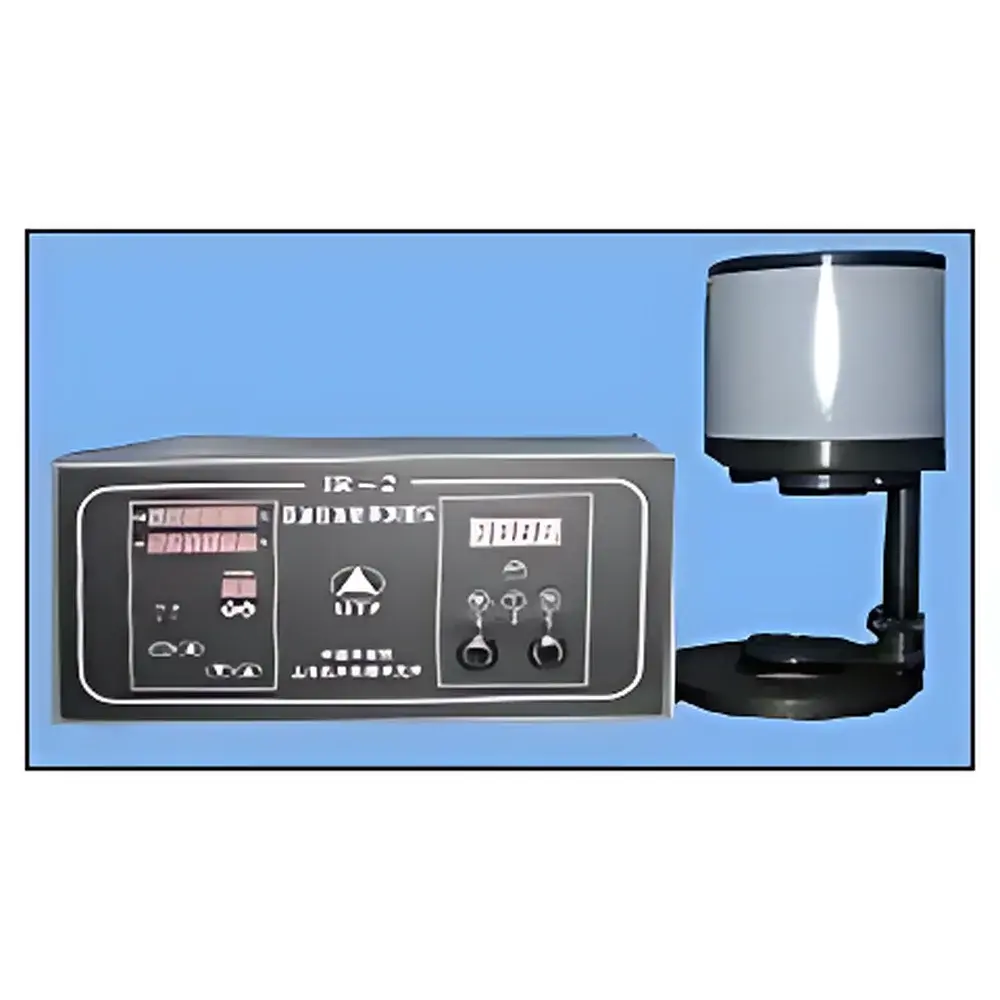
IR-2 Dual-Band Emissivity Tester for Mid- and Long-Wave Infrared
| Key | Origin: Beijing, China |
|---|---|
| Manufacturer Type | Authorized Distributor |
| Origin Category | Domestic (PRC) |
| Model | IR-2 |
| Pricing | Available Upon Request |
| Measurement Bands | 3–5 µm, 8–14 µm, 1–22 µm |
| Emissivity Range | 0.100–0.990 |
| NEΔε (Noise-Equivalent Emissivity Change) | 0.001 |
| Accuracy | ±0.02 (for ε > 0.50) |
| Repeatability | ±0.01 |
| Sample Temp. Range | Ambient to 300 °C (optional heated stage) |
| Max. Sample Diameter | 50 mm |
| Measurement Time | < 3 s after trigger |
| Display Resolution | 0.001 (LED) |
| Power Supply | AC 220 V, 50 Hz |
| Interface | RS-232 serial port |
| Optical Method | Normal-incidence reflectance-based emissivity derivation using calibrated blackbody source |
Overview
The IR-2 Dual-Band Emissivity Tester is a precision optical instrument engineered for the non-contact, quantitative determination of normal spectral emissivity (εn) of solid materials in the mid-wave infrared (MWIR: 3–5 µm) and long-wave infrared (LWIR: 8–14 µm) atmospheric transmission windows—plus an extended broadband range (1–22 µm) for comprehensive spectral characterization. It operates on the fundamental principle of Kirchhoff’s law of thermal radiation: under thermodynamic equilibrium, the spectral directional emissivity of an opaque surface equals its spectral directional reflectance at the same wavelength and temperature. The IR-2 implements this via a calibrated, actively controlled miniature blackbody radiation source (operable up to 600 K with ±1 mK temperature stability), enabling high-fidelity measurement of normal reflectance (ρn) across user-selectable spectral bands. Emissivity is then derived as εn = 1 − ρn, assuming negligible transmittance—a valid assumption for most engineering solids including metals, ceramics, polymers, and composites.
Key Features
- Integrated high-stability blackbody source with six-digit microprocessor temperature controller (resolution: 1 mK), ensuring reproducible radiometric calibration traceable to ITS-90 standards;
- Dual-channel optical detection architecture: a primary mirror-reflection (MR) channel for specular component capture, plus a dedicated diffuse-reflection (DR) compensation channel to correct for surface scattering effects—critical for matte, textured, or low-gloss samples;
- Optical modulation technique eliminates interference from ambient thermal background and self-emission of the sample during measurement, enabling reliable operation in unshielded laboratory environments;
- Lock-in amplifier signal processing combined with low-noise microelectronic circuitry achieves a noise-equivalent emissivity change (NEΔε) of 0.001, supporting high-resolution comparative studies;
- Modular filter wheel design allows rapid interchange of bandpass interference filters; standard configuration covers 3–5 µm, 8–14 µm, and 1–22 µm, with custom spectral bands available upon request;
- Non-destructive, contactless measurement—no surface preparation, coating, or thermal loading beyond optional heating stage requirements;
- RS-232 serial interface enables integration into automated test benches or data acquisition systems compliant with IEEE 488.2 or SCPI command sets;
- LED digital display with 0.001 resolution provides immediate readout post-trigger (measurement completes within 3 seconds); front-panel RST key supports hardware-level system reset for GLP-aligned operational integrity.
Sample Compatibility & Compliance
The IR-2 accommodates flat, opaque, non-transmissive samples up to 50 mm in diameter and ≤25 mm in thickness. Surface roughness, oxidation state, and coating uniformity directly influence measurement uncertainty—users are advised to follow ASTM E1933-19 (“Standard Test Methods for Measuring and Compensating for Emissivity Using Infrared Imaging Radiometers”) for best-practice sample handling. For elevated-temperature measurements (ambient to 300 °C), a thermostatically controlled sample stage with PID feedback and NIST-traceable thermocouple monitoring is available as an accessory. The instrument’s design aligns with ISO 18434-1:2008 (Condition monitoring and diagnostics of machines — Thermography — Part 1: General procedures) for emissivity-dependent thermal imaging calibration, and supports audit-ready documentation workflows required under FDA 21 CFR Part 11 when paired with compliant data logging software.
Software & Data Management
While the IR-2 operates as a standalone benchtop unit, its RS-232 interface permits bidirectional communication with host PCs running custom or third-party acquisition software. ASCII-formatted output includes timestamped εn values, band identifier, sample temperature (if external sensor connected), and instrument status flags. Raw data export supports CSV and tab-delimited formats compatible with MATLAB, Python (NumPy/Pandas), and Excel for statistical analysis, trend tracking, and emissivity vs. temperature modeling. Optional firmware upgrade enables automatic averaging over multiple acquisitions and GLP-compliant electronic signature logging—meeting core requirements for ISO/IEC 17025-accredited testing laboratories.
Applications
- Infrared signature management: evaluation of low-emissivity coatings, stealth material stacks, and multispectral camouflage systems for defense platforms;
- Thermal process validation: emissivity profiling of ceramic kiln linings, aerospace composite layups, and infrared drying substrates (e.g., paper, textiles, thin-film coatings);
- Building physics research: quantification of radiative heat transfer coefficients for low-e glazing, radiant barrier membranes, and insulating foams;
- Materials science: correlation of microstructure (grain size, porosity, phase distribution) with spectral emissivity behavior in sintered oxides and refractory metals;
- Calibration traceability: reference-grade emissivity verification for infrared thermometers, thermal imagers, and radiometric sensors used in industrial predictive maintenance programs.
FAQ
How does the IR-2 ensure accuracy when measuring highly reflective or oxidized surfaces?
The dual-channel MR/DR detection scheme isolates specular and diffuse reflection components independently, allowing algorithmic correction for surface scattering—an essential capability for polished metals or thermally grown oxide layers.
Can the IR-2 measure emissivity of curved or irregularly shaped samples?
No—it requires optically flat, planar samples centered under the collimated beam; curvature introduces angular deviation from normal incidence, violating Kirchhoff’s law assumptions.
Is the blackbody source NIST-traceably calibrated?
Yes—each unit ships with a calibration certificate referencing NIST Standard Reference Material (SRM) 1971 or equivalent, with annual recalibration recommended per ISO/IEC 17025 Clause 6.5.
What environmental conditions affect measurement repeatability?
Ambient temperature fluctuations > ±2 °C/hour or air currents > 0.5 m/s near the optical path may induce drift; operation in climate-controlled labs (23 ±1 °C, RH < 60%) is strongly advised.
Does the IR-2 comply with military specification MIL-STD-45662A for calibration systems?
The instrument meets functional requirements for emissivity measurement per MIL-HDBK-338B Annex D, though full compliance requires documented metrology chain implementation by the end-user’s calibration laboratory.



