
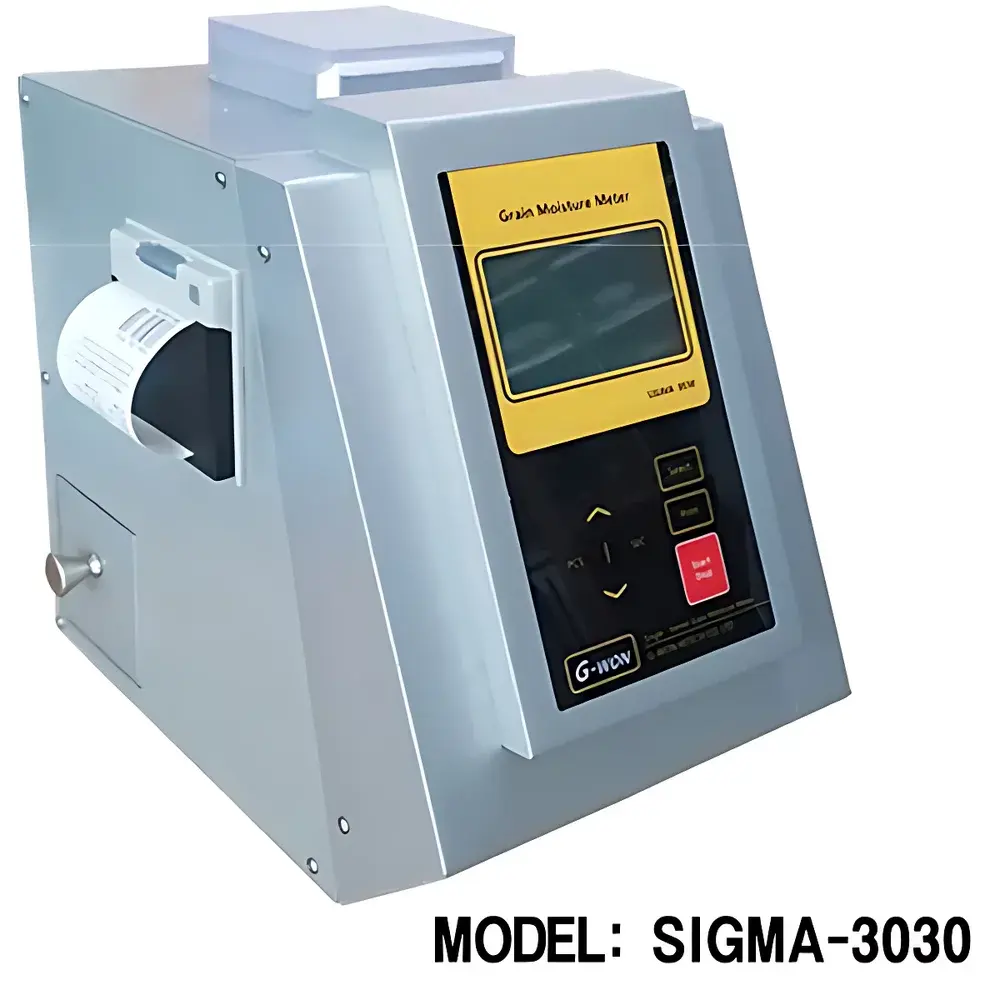
G-WON SIGMA-3030 Single-Kernel Grain Moisture Analyzer
| Brand | G-WON |
|---|---|
| Origin | South Korea |
| Model | SIGMA-3030 |
| Measurement Principle | Electrical Resistance Method |
| Grain Types Supported | Paddy, Barley, Naked Barley, Brown Rice, Rice, Wheat |
| Moisture Range | 11.0–40.0% (varies by grain type) |
| Accuracy | ±0.5% (for moisture <20%) |
| Resolution | 0.1% |
| Throughput | 60 kernels/min |
| Measurement Modes | By Kernel Count (10–180 pcs) or Time Duration (20–60 sec) |
| Temperature Compensation | Automatic |
| Operating Temp | 5–50 °C |
| Interface | RS-232C |
| Power | AC 100–240 V, 50/60 Hz |
| Dimensions | 295 × 193 × 281 mm |
| Weight | ~8 kg |
Overview
The G-WON SIGMA-3030 Single-Kernel Grain Moisture Analyzer is an industrial-grade, portable capacitance-resistance hybrid instrument engineered for rapid, non-destructive moisture and temperature assessment of individual cereal grains. Unlike bulk-sampling moisture meters that report averaged values, the SIGMA-3030 implements a discrete kernel-by-kernel measurement strategy grounded in electrical resistance methodology—where grain dielectric properties (influenced by water content and density) are correlated to calibrated moisture reference standards per species. This approach enables high-resolution profiling of moisture heterogeneity within a batch, supporting critical quality control decisions in grain drying, storage, trading, and milling operations. Designed for field-deployable robustness and laboratory-grade repeatability, the analyzer meets the functional demands of grain inspection stations, agricultural cooperatives, commodity traders, and QA/QC labs operating under ISO 712, ISO 6540, and ASTM D4940-compliant workflows.
Key Features
- Single-kernel analysis mode: Measures moisture and temperature for each individual grain (10–180 kernels per test), enabling statistical evaluation of moisture distribution rather than bulk averaging.
- Dual-mode operation: Select between count-based measurement (e.g., 50 kernels) or time-based acquisition (20–60 seconds), optimizing throughput versus representativeness based on workflow requirements.
- Multi-grain calibration library: Preloaded algorithms for six major cereals—paddy rice, barley, naked barley, brown rice, milled rice, and wheat—with species-specific resistance-to-moisture regression models validated against oven-dry reference methods.
- Integrated environmental compensation: Automatic temperature correction across 5–50 °C ensures stable readings under variable ambient conditions, eliminating manual offset adjustments.
- High-stability electromechanical design: Brushless DC motor drive ensures low vibration, minimal acoustic noise, and extended service life—critical for repeated field use without recalibration drift.
- On-device data visualization: Backlit LCD displays real-time kernel count, elapsed measurement time, running average, power status, and ambient temperature—enabling immediate operational feedback without external software.
- Portable architecture: Compact footprint (295 × 193 × 281 mm) and lightweight chassis (~8 kg) facilitate transport to silos, harvest sites, elevators, or mobile inspection units.
Sample Compatibility & Compliance
The SIGMA-3030 is validated for intact, unbroken kernels of paddy, barley, naked barley, brown rice, milled rice, and wheat. It excludes cracked, damaged, or highly heterogeneous samples (e.g., mixed-species batches) unless re-calibrated using user-defined reference curves. All factory calibrations are traceable to NIST-traceable gravimetric standards and conform to ISO 712:2017 (cereal and cereal products — determination of moisture content — reference method) and AOAC Official Method 992.13. The instrument supports GLP-aligned documentation when paired with optional thermal mini-printer (RS-232C output) and complies with IEC 61000-4 electromagnetic compatibility standards for industrial environments.
Software & Data Management
Data export is supported via RS-232C serial interface for integration into LIMS or custom QC databases. While the device operates autonomously without PC dependency, raw measurement logs—including timestamp, grain type, kernel count, individual moisture values, mean, SD, and ambient temperature—can be streamed in ASCII format for post-hoc statistical analysis (e.g., histogram generation, outlier detection, moisture variability index calculation). Firmware updates are performed via secure serial protocol; no cloud connectivity or proprietary software installation is required. Audit trails (if enabled via external logging systems) satisfy FDA 21 CFR Part 11 requirements when combined with appropriate procedural controls.
Applications
- Grain drying optimization: Identify under-dried or over-dried sub-batches before storage to prevent mold growth or fissuring.
- Harvest-time field screening: Rapid on-site assessment to guide combine settings or segregation decisions at the farm gate.
- Commodity grading and trade settlement: Provide auditable, kernel-level moisture evidence for contractual compliance with national grain standards (e.g., USDA FGIS, GAFTA, or KOSHAL).
- Mill feedstock qualification: Ensure incoming wheat or rice lots meet moisture thresholds for optimal milling yield and flour stability.
- Research applications: Support agronomic studies on genotype-by-environment moisture response, post-harvest physiology, or drying kinetics modeling.
FAQ
Does the SIGMA-3030 require daily calibration verification?
No—factory calibrations remain stable for ≥6 months under normal use. However, users must perform a two-point verification (dry and mid-range reference kernels) before each shift if used in regulated environments (e.g., certified grain inspection).
Can it measure broken or dehydrated grains?
Not reliably. The resistance method assumes intact endosperm structure. Severely cracked, shriveled, or freeze-dried samples fall outside the validated range and require alternative methods (e.g., Karl Fischer titration).
Is temperature compensation active during kernel counting?
Yes—ambient temperature is continuously monitored and applied to all resistance calculations, regardless of measurement mode or duration.
What is the minimum sample size for statistically representative results?
For routine QC, ≥50 kernels are recommended; for research-grade variance analysis, ≥100 kernels per subsample is advised per ISO 6540 guidance.
Does the unit support multi-language UI or custom grain profiles?
The firmware interface is English-only. Custom calibration curves may be loaded via RS-232 using G-WON’s authorized configuration utility—subject to technical support approval and validation documentation.




