
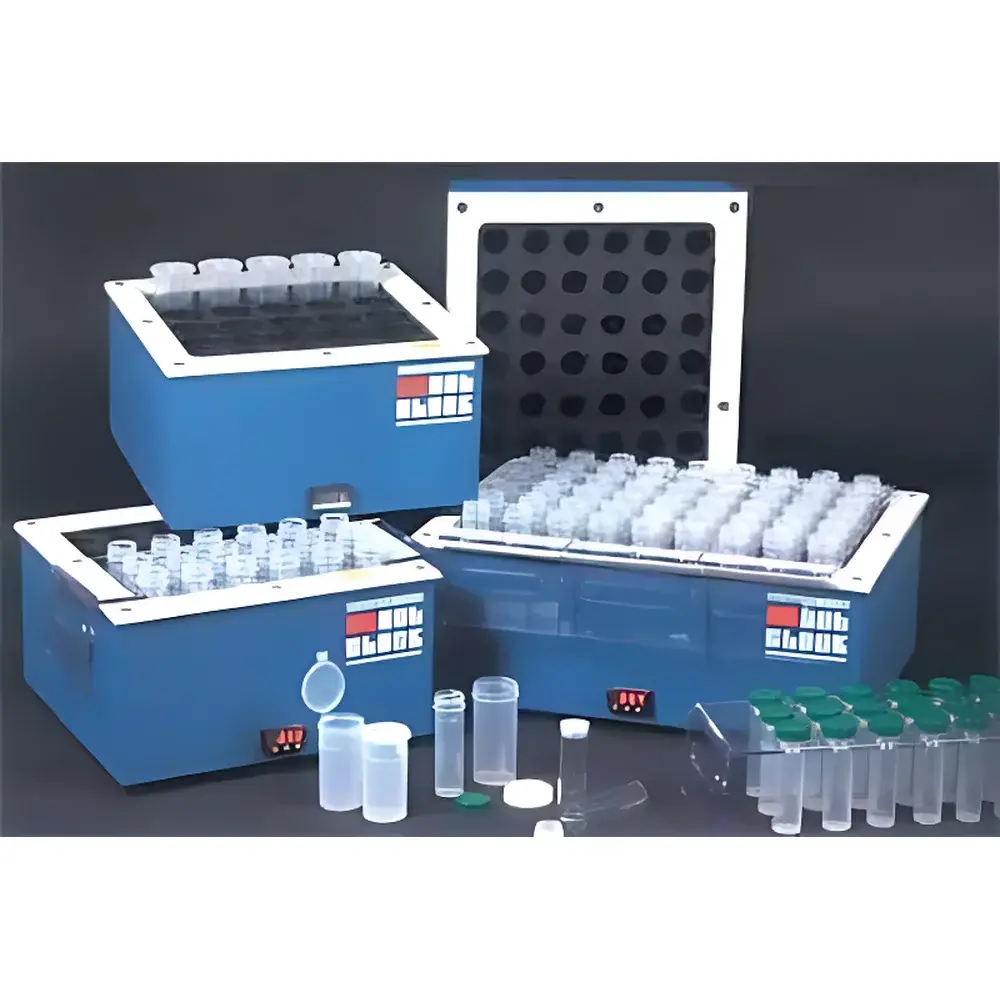
EHD36 Intelligent Electric Heating Digestion System
| Origin | USA |
|---|---|
| Manufacturer Type | Authorized Distributor |
| Origin Category | Imported |
| Model | EHD36 |
| Pricing | Available Upon Request |
Overview
The EHD36 Intelligent Electric Heating Digestion System is a precision-engineered, benchtop thermal digestion instrument designed for reproducible, trace-metal-clean sample preparation in regulated analytical laboratories. It operates on the principle of controlled conductive heating—utilizing high-thermal-conductivity graphite blocks with embedded resistance heaters—to deliver uniform, programmable temperature profiles across up to 36 sample positions simultaneously. Unlike open-loop heating devices (e.g., hot plates or heating mantles), the EHD36 employs closed-loop PID feedback control with real-time thermocouple monitoring at the block surface and optional internal probe integration, enabling accurate thermal management from ambient to 450 °C. Its architecture meets the fundamental thermal performance criteria required for EPA Method-compliant digestion protocols—including Methods 3010B, 3050B, 3051A, and 3052—and serves as a validated alternative to microwave-assisted digestion for acid leaching, residual acid removal (“赶酸”, i.e., post-digestion evaporation), and pre-treatment prior to ICP-OES, ICP-MS, AAS, and HG-AFS analysis.
Key Features
- High-power 2800 W heating system with optimized thermal mass distribution ensures rapid ramp rates and stable dwell performance across the full 25–450 °C operating range.
- PID temperature control with ±1 °C accuracy (typical) and ±1.5 °C inter-hole uniformity (25–210 °C), verified per ASTM E220-22 calibration practices.
- Digital front-panel interface with real-time setpoint/actual temperature display, programmable multi-step heating sequences, adjustable ramp rates, hold times, and dual-stage over-temperature safety cutoff.
- RS-232/USB digital serial interface enables bidirectional communication with host PCs; supports time-stamped temperature logging, curve visualization, LIMS integration (via ASTM E1578-compliant drivers), and remote operation under GLP/GMP audit-trail requirements (21 CFR Part 11-ready when paired with compliant software).
- Corrosion-resistant construction: upper heating block and platform fabricated from high-purity, isotropic graphite with >99.9% carbon content; surface-coated with PTFE (Teflon™) for low-background metal leaching and chemical inertness against HNO₃, HCl, HF, and aqua regia.
- Modular, tool-free accessory compatibility—including PFA-lined, PP, borosilicate glass, and quartz digestion tubes—ensures method flexibility without cross-contamination risk.
Sample Compatibility & Compliance
The EHD36 accommodates standard 16–55 mm OD digestion vessels (e.g., 50 mL calibrated borosilicate glass tubes, 100 mL PFA vials, and 15 mL PP microtubes) with precise well geometry (36 × Ø28 mm). Its thermal uniformity profile satisfies ISO/IEC 17025:2017 clause 5.4.2 for equipment suitability verification and aligns with USP , EPA SW-846 Chapter 3, and CLSI EP21-A guidelines for digestion consistency. All materials contacting samples comply with ASTM D5127 (low-metal-grade polymers) and ASTM C1377 (high-purity graphite). The system has undergone third-party validation for EPA Method 3051A equivalence by an ILAC-accredited environmental testing laboratory.
Software & Data Management
The EHD36 communicates via ASCII-based serial protocol supporting ASCII log export (.csv) and SCPI command sets. Optional companion software provides: (i) graphical real-time temperature overlay across all zones; (ii) automated method storage (up to 99 programs); (iii) electronic signature-enabled audit trails; (iv) automatic report generation compliant with ISO/IEC 17025 documentation requirements; and (v) configurable alarm notifications (email/SNMP) for deviation events. When deployed with validated LIMS middleware, it fulfills FDA 21 CFR Part 11 requirements for electronic records and signatures through role-based access control and immutable data archiving.
Applications
The EHD36 is routinely deployed in environmental labs for soil, sediment, sludge, and wastewater digestions prior to heavy metal quantification (Pb, Cd, As, Cr, Hg); in pharmaceutical QC for residual catalyst analysis in APIs; in food safety testing for mineral profiling (Ca, Mg, Zn, Se); and in geochemical research for silicate rock dissolution. It is also widely used for post-microwave “acid fuming” steps, blank minimization in ultratrace analysis, and certified reference material (CRM) homogenization studies where batch-wise thermal consistency is critical.
FAQ
Is the EHD36 compatible with hydrofluoric acid (HF) digestion procedures?
Yes—when used with PFA-lined digestion tubes and graphite blocks rated for HF exposure, the system supports EPA Method 3052 and similar fluoroboric acid protocols.
Does the instrument support GLP-compliant data integrity?
Yes—when operated with validated software and configured for electronic signatures, audit logs, and secure user authentication, it meets core GLP data handling expectations per OECD Principles of Good Laboratory Practice.
What is the maximum recommended operating temperature for polypropylene (PP) digestion tubes?
130 °C, as specified by the tube manufacturer’s thermal stability rating; exceeding this may compromise dimensional stability and introduce organic leachables.
Can the EHD36 be integrated into an automated sample preparation line?
Yes—its serial interface and discrete I/O signals (optional relay module) allow synchronization with robotic liquid handlers and autosamplers per ASTM E2655-20 interoperability standards.
How often should temperature uniformity be verified?
Per ISO/IEC 17025, initial verification is required upon installation; subsequent checks are recommended quarterly or after any maintenance affecting thermal components.
Related Products



