
FD125 Radon and Thoron Analyzer
| Origin | Beijing, China |
|---|---|
| Manufacturer Type | Authorized Distributor |
| Origin Category | Domestic (China) |
| Model | FD125 |
| Price Range | USD 7,000–14,000 (FOB) |
| Sampling Method | Passive Collection |
| Measurement Range | 0–10 Bq/m³ |
| Minimum Detectable Concentration | 0.01 Bq/m³ |
| Response Time | 300 s |
| Detector Background | ≤100 counts/s |
| Sensitivity Accuracy | ±10% |
| Operating Temperature | 0–45 °C |
| Relative Humidity Limit | ≤95% RH |
| Power Supply | +9–10 V DC for amplifier |
| Weight | 16 kg (excluding scaler unit) |
Overview
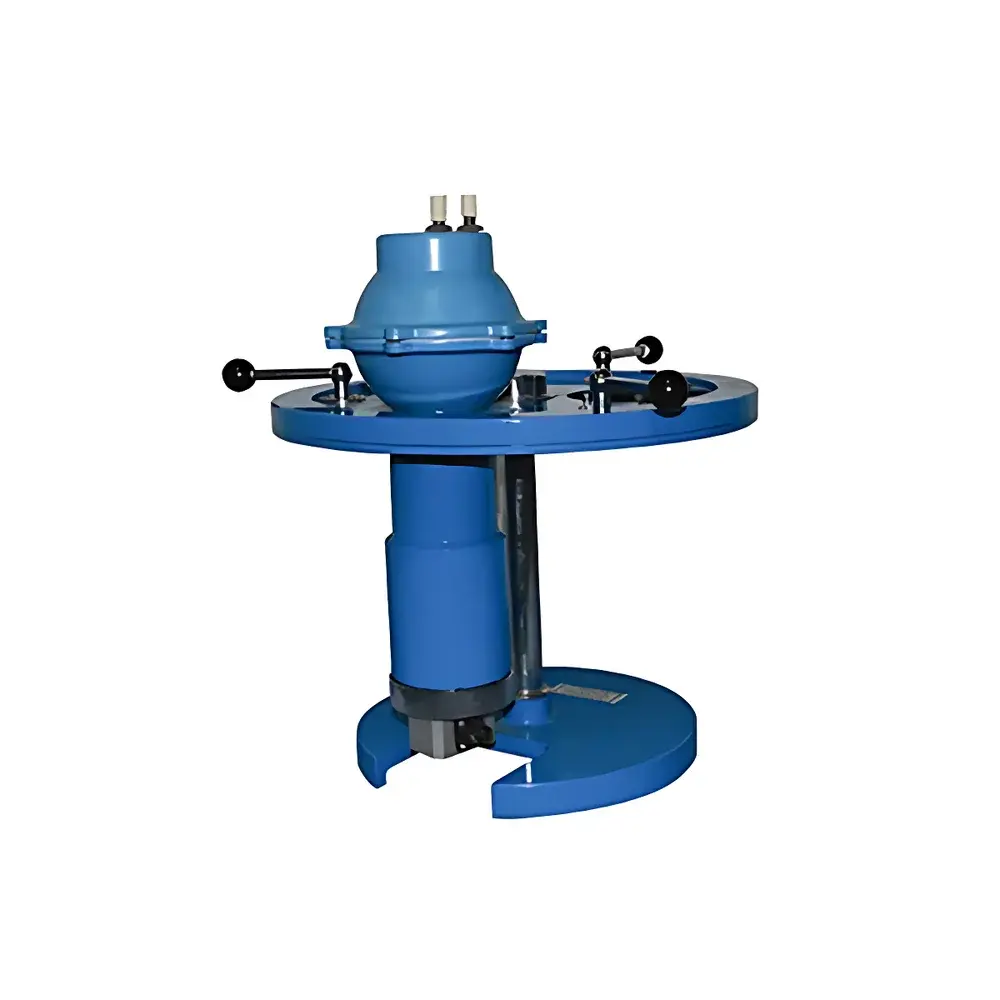
The FD125 Radon and Thoron Analyzer is a scintillation-based passive radon/thoron detection instrument engineered for precise, low-level measurement of 222Rn and 220Rn (thoron) in air, water, and geological samples. It operates on the principle of alpha-particle-induced scintillation in ZnS(Ag)-coated organic glass hemispheres. When radon or thoron decay products deposit within the sealed scintillation chamber, emitted alpha particles excite the phosphor layer, generating light pulses detected by a photomultiplier tube (PMT). The system’s dual-chamber carousel design enables sequential, uninterrupted sample analysis—critical for field-deployed environmental monitoring where continuous operation and minimal downtime are essential. Unlike active-flow instruments, the FD125 relies on passive diffusion and equilibrium accumulation, making it suitable for long-term unattended deployment in indoor air quality studies, uranium/thorium ore assay, mine ventilation assessment, and groundwater radon profiling.
Key Features
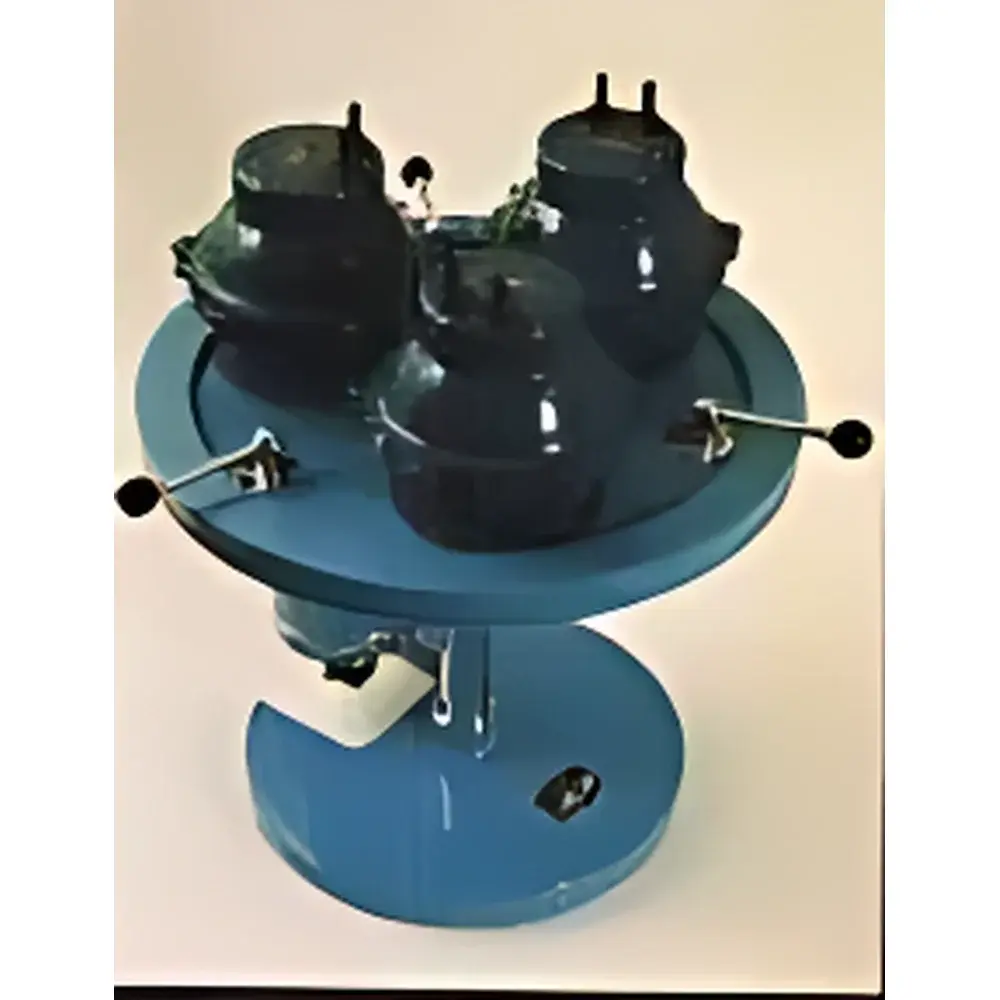
- Triple-position rotating scintillation chamber carousel: One chamber actively measured under PMT; two others shielded and staged for rapid exchange—no instrument shutdown required between samples.
- ZnS(Ag)-coated acrylic hemispherical chambers: Optimized geometry and reflective coating ensure high light collection efficiency and consistent pulse amplitude response.
- Low-background design: Intrinsic detector background ≤100 counts/s, verified under vacuum-sealed conditions (residual pressure 1.33 × 10⁴ Pa), with leak rate ≤1.33 × 10³ Pa/10 min.
- Stable high-voltage PMT supply: Adjustable 0–1500 V negative DC output with fine-tuned regulation to maintain gain consistency across ambient temperature fluctuations.
- Robust thermal and humidity tolerance: Validated performance within 0–45 °C and up to 95% RH (non-condensing); ±10% measurement deviation maintained at 35 ± 2 °C / 95 ± 3% RH.
- Reproducibility-optimized electronics: Amplifier powered by regulated +9–10 V DC; preheating time ≤30 min ensures ≤±10% drift over 8-hour continuous operation.
Sample Compatibility & Compliance
The FD125 supports direct measurement of gaseous radon/thoron in ambient air and mine shafts, as well as indirect quantification in aqueous and solid matrices via emanation techniques. For water samples, radon is extracted using aeration or liquid scintillation transfer prior to introduction into the chamber. Uranium-bearing rock or soil samples are sealed in gas-tight containers and allowed to equilibrate; emanated radon is then transferred to the scintillation cell. The instrument meets functional requirements aligned with ISO 11665-2:2019 (Measurement of radon-222 in air — Part 2: Integrated measurement method for determining average activity concentration), and its passive sampling protocol conforms to ASTM D6909-22 (Standard Practice for Radon Testing in Homes). While not inherently 21 CFR Part 11 compliant (as it lacks embedded audit trail or electronic signature functionality), raw count data output is compatible with externally validated LIMS platforms supporting GLP/GMP workflows.
Software & Data Management
The FD125 operates in conjunction with an external scaler unit (sold separately), which digitizes PMT pulses and transmits count-rate data via RS-232 or USB interface to host software. Standard acquisition software provides real-time count visualization, background subtraction, decay-corrected activity calculation (using 222Rn t1/2 = 3.82 d and 220Rn t1/2 = 55.6 s), and export of ASCII-formatted datasets (.csv, .txt). Calibration coefficients—including chamber-specific sensitivity (e.g., ~1.4 × 10⁻¹³ g Ra per count for radium assays) and thoron correction factors for depressurization protocols—are user-configurable. All raw spectra and timestamps are retained for retrospective reprocessing. Data files include metadata fields for operator ID, sample ID, chamber position, integration time, ambient T/RH, and PMT voltage—enabling full traceability per ISO/IEC 17025:2017 documentation requirements.
Applications
- Indoor radon screening in residential and institutional buildings per national action levels (e.g., WHO 100 Bq/m³ reference level).
- Geological prospecting for uranium and thorium deposits via soil-gas radon mapping and ore-sample emanation assays.
- Occupational health monitoring in underground mines, caves, and radon spa facilities.
- Hydrogeological studies: Radon-in-water surveys for identifying fault zones, aquifer recharge pathways, and groundwater–surface water interaction.
- Calibration verification of continuous radon monitors using standardized reference chambers.
- Educational use in nuclear physics and environmental radiochemistry laboratories.
FAQ
What is the minimum detectable activity concentration for radon using the FD125?
The instrument achieves a minimum detectable concentration of 0.01 Bq/m³ under standard 300-second counting conditions, assuming optimal background suppression and chamber sealing integrity.
Can the FD125 distinguish between radon (222Rn) and thoron (220Rn) without spectral discrimination?
No. The FD125 measures total alpha activity from both isotopes. Discrimination requires temporal deconvolution using their distinct half-lives—typically implemented via sequential short/long counting intervals in post-processing software.
Is the scaler unit included with the FD125 analyzer?
No. The scaler is a separate component and must be ordered independently. Compatible models include standard NIM-bin-based scalers with programmable gate timing and dead-time correction.
What maintenance is required for long-term operational reliability?
Annual verification of chamber vacuum integrity and PMT gain stability is recommended. ZnS(Ag) coating degradation is negligible under normal use; however, chambers should be stored in light-tight, low-humidity environments when not in service.
Does the FD125 comply with international radiation safety standards for field deployment?
Yes. Its passive design eliminates moving parts and high-flow pumps, resulting in Class II low-risk classification per IAEA SSG-22. No radioactive sources are integrated; all measurements rely solely on naturally occurring environmental radionuclides.
Related Products







