
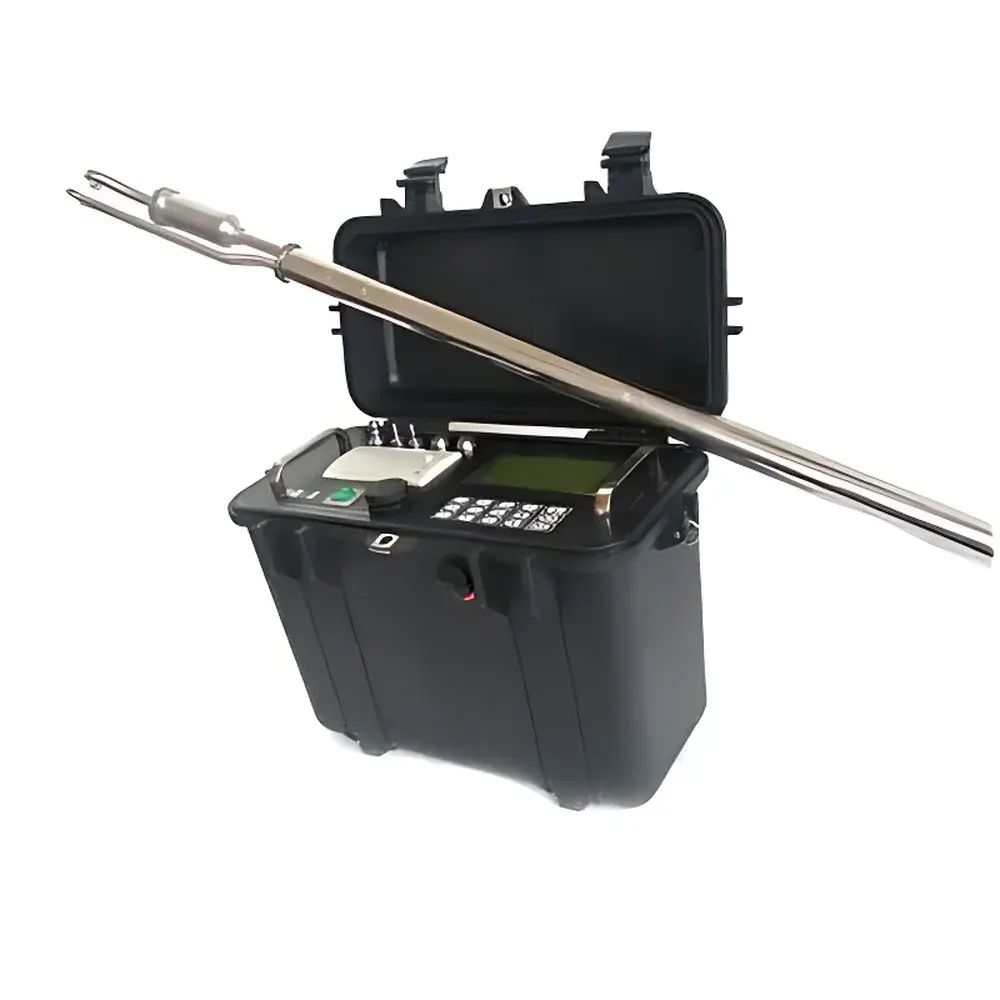
YQ3000C Fully Automated Stack Emission Analyzer for Particulate Matter and Gaseous Pollutants
| Origin | Shandong, China |
|---|---|
| Manufacturer Type | Authorized Distributor |
| Origin Category | Domestic (PRC) |
| Model | YQ3000C |
| Price Range | USD 7,000 – 14,000 |
| Instrument Type | Portable Flue Gas & Particulate Emission Analyzer |
| Sampling Principle | Isokinetic Pitot Tube Sampling + Gravimetric Collection + Potentiostatic Electrolytic Gas Sensing |
| Compliance | HJ/T 48–1999, JJG 968–2002, JJG 680–2007 |
Overview
The YQ3000C Fully Automated Stack Emission Analyzer is an integrated, field-deployable instrument engineered for simultaneous measurement of particulate matter (PM) and gaseous pollutants in industrial flue gas streams. It operates on two fundamental analytical principles: isokinetic sampling via Pitot tube—ensuring representative particulate capture under dynamic flow conditions—followed by gravimetric quantification of total suspended particulates (TSP) or PM10/PM2.5 (with optional cyclone modules); and potentiostatic electrolytic detection for real-time, selective quantification of key combustion-related gases including O2, SO2, NO, NO2, CO, CO2, and H2S. Designed for compliance-driven environmental monitoring, the YQ3000C delivers standardized, stack-integrated data aligned with Chinese national emission standards (HJ/T 48–1999, JJG 968–2002, JJG 680–2007), supporting regulatory reporting, process optimization, and pollution control efficiency evaluation—including dust collector and desulfurization unit performance assessment.
Key Features
- Integrated dual-mode operation: simultaneous particulate mass concentration (mg/m³ at standard conditions) and multi-gas analysis in a single field-deployable platform
- Intelligent isokinetic flow control: automatic adjustment of sampling velocity to match flue gas velocity (5–45 m/s range) with ≤±5% deviation, ensuring regulatory-compliant particulate collection per HJ/T 48–1999
- Robust electrochemical sensor architecture: factory-calibrated, temperature- and pressure-compensated gas sensors with built-in NO2 negative interference correction for low-SO2 environments
- High-vacuum sampling system: long-life diaphragm pump delivering ≥50 L/min at 20 kPa backpressure and peak negative pressure up to 60 kPa—capable of penetrating high-resistance ducts and filter media
- Real-time thermobaric normalization: automatic conversion of raw volumetric flow, temperature, and pressure readings to standard conditions (101.325 kPa, 273.15 K) with dedicated pre-metering pressure/temperature sensors
- Electrostatic immunity: opto-isolated signal paths and shielded internal circuitry mitigate electromagnetic interference common in industrial boiler rooms and power plant peripheries
- Uninterruptible operation: auto-resume functionality restores sampling sequence and timestamped data logging following AC power loss
- Ruggedized IP54-rated enclosure: aluminum-magnesium alloy chassis with reinforced impact-resistant housing rated for continuous operation in ambient temperatures from −20 °C to 50 °C and relative humidity up to 90% non-condensing
Sample Compatibility & Compliance
The YQ3000C supports sampling from rectangular and circular ducts with diameters ≥100 mm, accommodating standard EPA Method 5 and ISO 9096-compatible probe configurations. It complies with HJ/T 48–1999 (specifying isokinetic sampling accuracy, leak rate <0.5% of full-scale flow, and filter holder thermal stability), JJG 968–2002 (defining gas analyzer linearity, zero drift <2% FS/24 h, span drift <3% FS/24 h), and JJG 680–2007 (mandating flowmeter calibration traceability to national metrological standards). While not certified to EN 15267 or US EPA PS-1/PS-2, its measurement uncertainty profiles meet typical requirements for routine CEMS verification, stack testing audits, and periodic emissions inventory submissions under provincial ecological environment bureaus. All stored datasets include mandatory metadata: sampling location ID, operator code, calibration certificate IDs, and timestamped environmental parameters—supporting GLP-aligned record retention.
Software & Data Management
Data acquisition and reporting are managed via embedded ARM-based firmware with a 5.7-inch resistive touchscreen interface. Raw measurements—including differential pressure (±2000 Pa), static pressure (±30 kPa), flue gas temperature (0–600 °C), and humidity (0–60% RH)—are logged at 1 Hz resolution. The device stores up to 1000 complete test records internally, each containing >30 parametric fields with audit-trail timestamps. Export is supported via USB 2.0 to CSV or proprietary .YQD format; no cloud connectivity or remote telemetry is implemented. Firmware supports user-defined report templates compliant with local environmental monitoring forms (e.g., Form HJ-201, HJ-202). Calibration logs—including zero/span gas concentrations, date, technician ID, and post-calibration verification results—are cryptographically signed and immutable within device memory.
Applications
- Regulatory stack testing for coal-fired boilers, biomass furnaces, waste incinerators, and cement kilns
- Performance evaluation of electrostatic precipitators (ESPs), fabric filters, wet scrubbers, and FGD systems
- Source apportionment studies requiring synchronized PM and SO2/NOx emission ratios
- Occupational health and safety assessments in confined combustion zones (e.g., refinery heaters, marine auxiliary boilers)
- Educational laboratory instruction in environmental engineering curricula covering emission characterization and control technology validation
- Pre-commissioning verification of abatement equipment prior to formal CEMS installation
FAQ
What standards does the YQ3000C comply with?
It conforms to HJ/T 48–1999 (particulate samplers), JJG 968–2002 (gas analyzers), and JJG 680–2007 (sampling system metrology), as mandated for use in PRC environmental monitoring programs.
Can the YQ3000C measure PM2.5 or PM10 directly?
No—it performs total suspended particulate (TSP) gravimetric analysis by default; PM2.5/PM10 fractionation requires optional inertial impactor modules installed upstream of the filter holder.
How is sensor cross-sensitivity addressed, particularly for NO2 in SO2-rich streams?
The firmware applies empirically derived compensation algorithms based on concurrent O2 and humidity readings, and includes a dedicated NO2 negative interference correction mode activated during low-concentration SO2 measurement.
Is the instrument suitable for continuous emissions monitoring (CEMS) duty?
No—it is designed for periodic grab sampling and manual stack surveys, not unattended 24/7 operation; it lacks redundant sensors, automated calibration gas delivery, or 4–20 mA analog outputs required for CEMS integration.
What maintenance intervals are recommended for field operation?
Filter cartridges must be replaced before each sampling run; electrochemical sensors require zero/span verification every 72 operating hours or prior to critical measurements; pump diaphragms should be inspected every 500 hours of cumulative runtime.







