
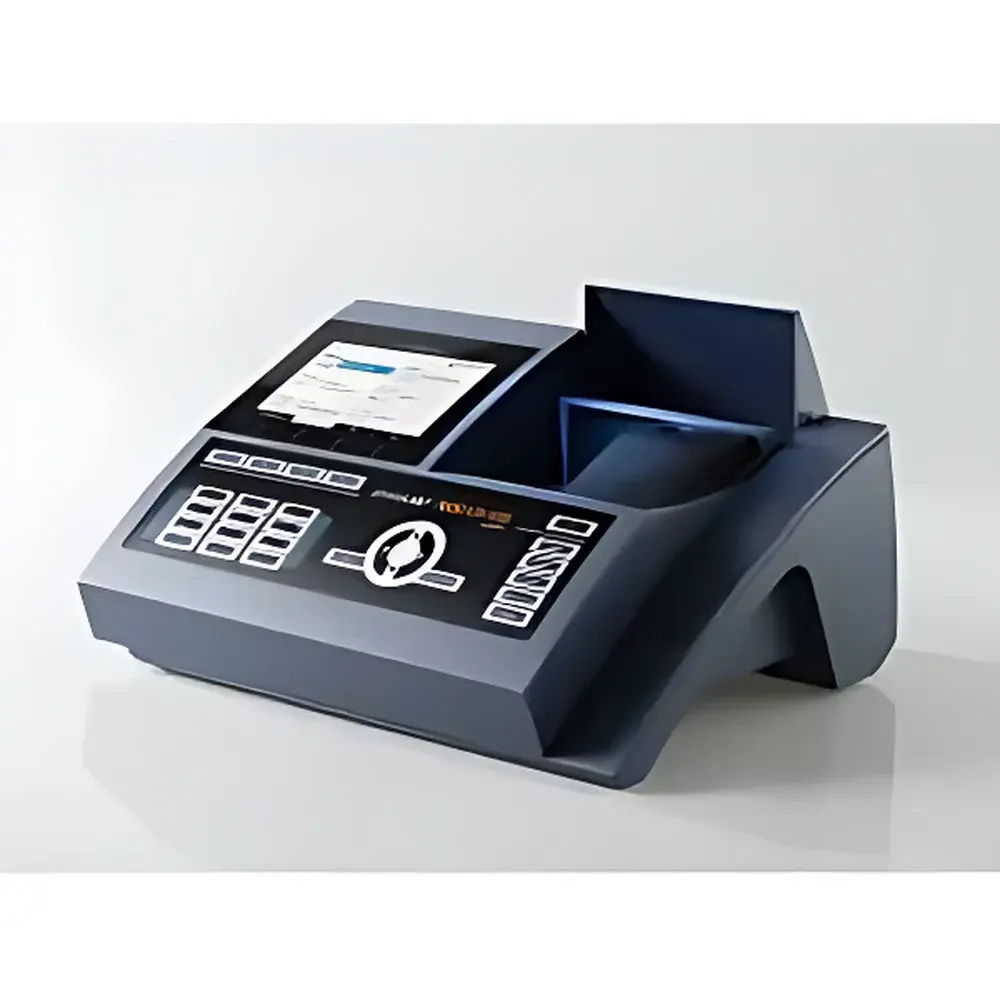
WTW photoLab® 7600 UV-VIS Spectrophotometer
| [Origin | Germany |
|---|---|
| Type | Double-beam UV-VIS spectrophotometer |
| Detector | Photodiode array |
| Wavelength range | 190–1100 nm |
| Spectral bandwidth | 4 nm |
| Wavelength accuracy | ±1 nm |
| Stray light | <0.01% T |
| Auto-wavelength selection | Yes |
| Cuvette auto-recognition | 10 mm, 20 mm, 50 mm rectangular and 16 mm round |
| Display | 7" backlit color touchscreen |
| Data storage | 5000 measurements, 500 spectra, 400 kinetic curves |
| Interfaces | 1× USB-A, 1× USB-B, 1× Ethernet |
| Compliance | ASTM E275, ISO 6059, USP <857>, DIN EN ISO/IEC 17025] |
Overview
The WTW photoLab® 7600 UV-VIS Spectrophotometer is a high-precision, double-beam laboratory spectrophotometer engineered for routine and advanced quantitative analysis in environmental, industrial, and academic laboratories. Based on monochromator-based UV-VIS absorption spectroscopy with a stepper-motor-driven grating and integrated reference beam path, the instrument delivers high photometric stability and measurement reproducibility across its full spectral range of 190–1100 nm. Its core architecture incorporates a xenon lamp source for deep-UV performance and a photodiode array detector enabling rapid spectral acquisition without mechanical scanning delays. Designed as the successor to the photoLab® 6600 series, the 7600 introduces enhanced optical path integrity through real-time reference beam monitoring, improved wavelength calibration traceability, and expanded method flexibility—particularly for regulatory-compliant water quality testing.
Key Features
- Double-beam optical design with dynamic reference channel compensation for drift correction during extended measurements
- Photodiode array detection enabling full-spectrum acquisition in under 1 second, supporting kinetic profiling and spectral derivative analysis
- Automatic cuvette recognition for standard 10 mm, 20 mm, 50 mm rectangular, and 16 mm round cells—including quartz and PMMA variants
- Barcode-assisted method selection: pre-programmed assays auto-load upon scanning reagent kit barcodes, minimizing operator error
- OptRF (Optical Reagent-Free) measurement mode for direct quantification of COD, nitrate-N, and nitrite-N in wastewater matrices using UV absorbance (200–390 nm), eliminating hazardous digestion steps
- 7-inch capacitive color touchscreen with multilingual UI (including Simplified and Traditional Chinese), intuitive workflow navigation, and context-sensitive help
- Integrated AQA (Analytical Quality Assurance) tools compliant with ISO/IEC 17025 requirements, including calibration verification, blank tracking, and audit trail logging
Sample Compatibility & Compliance
The photoLab® 7600 supports aqueous, mildly acidic, and buffered liquid samples in standard spectrophotometric cuvettes. It accommodates sample volumes from 0.5 mL (in semi-micro 50 mm pathlength cells) to 10 mL (in standard 10 mm cells), with automatic pathlength correction applied during concentration calculation. The instrument meets key international standards for photometric instrumentation: ASTM E275 (description of spectrophotometric techniques), ISO 6059 (water quality — determination of chemical oxygen demand), and USP (spectrophotometry). For regulated environments, firmware supports 21 CFR Part 11–compliant user access control, electronic signatures, and immutable audit trails when used with photoLab® Data spectral software. All built-in methods are validated against DIN 38405 and EPA 410.4 protocols where applicable.
Software & Data Management
The photoLab® 7600 operates standalone or integrates seamlessly with photoLab® Data spectral PC software (Order No. 902 761), a GLP/GMP-ready application enabling centralized method deployment, instrument calibration management, and structured data archiving. The software provides spectral database import/export (JWS, CSV, ASCII), customizable report templates aligned with ISO 17025 documentation requirements, and batch processing for multi-sample kinetics. Optional photoLab® color+Data spectral package extends functionality to CIE L*a*b*, ΔE, and Yellowness Index calculations per ASTM D1209 and ISO 11477. Firmware updates are performed via USB stick or network push, ensuring continuous alignment with evolving regulatory guidance and method revisions.
Applications
This spectrophotometer serves as a primary analytical platform in municipal wastewater treatment plants for rapid, reagent-free monitoring of COD, NO₃⁻-N, and NO₂⁻-N—reducing turnaround time from hours to seconds while eliminating Cr(VI) and Ag⁺ waste streams. In industrial QC labs, it performs standardized assays for total hardness (EDTA complexometry), phosphate (molybdenum blue), ammonia (salicylate), and heavy metals (e.g., Cr, Cd, Cu, Pb) per APHA 3111 and ISO 11908. Research applications include enzyme kinetics (e.g., glucose oxidase), chlorophyll-a quantification (EPA 445.0), and spectral characterization of nanomaterials. With optional IQ-LabLink® connectivity, it interfaces with IQ Sensor Net probes for hybrid lab-field workflows, such as correlating real-time DO/pH sensor data with lab-based nutrient assays.
FAQ
Does the photoLab® 7600 support GLP-compliant data integrity?
Yes—when paired with photoLab® Data spectral software, it enforces role-based access control, electronic signatures, and tamper-evident audit logs meeting 21 CFR Part 11 and ISO/IEC 17025 requirements.
Can I use quartz cuvettes for UV measurements below 220 nm?
Yes—the instrument is fully compatible with quartz cuvettes (e.g., REK 10 Quarz, Order No. 250 606) for high-transmission performance down to 190 nm.
Is OptRF measurement validated against standard digestion methods?
OptRF has been cross-validated per DIN 38405-46 against dichromate reflux (DIN 38409-H41) for COD and cadmium reduction (DIN 38405-D9) for nitrate, demonstrating R² > 0.98 in municipal wastewater matrices.
What is the maximum scan speed for full-spectrum acquisition?
Full 190–1100 nm scans complete in ≤2.5 seconds at 1 nm resolution; step-scan modes support selectable increments of 1, 2, 5, or 10 nm.
How is wavelength accuracy maintained over time?
The system performs automatic internal wavelength calibration using holmium oxide and didymium filters prior to each startup and after every 8 hours of operation, traceable to NIST SRM 2034.




