
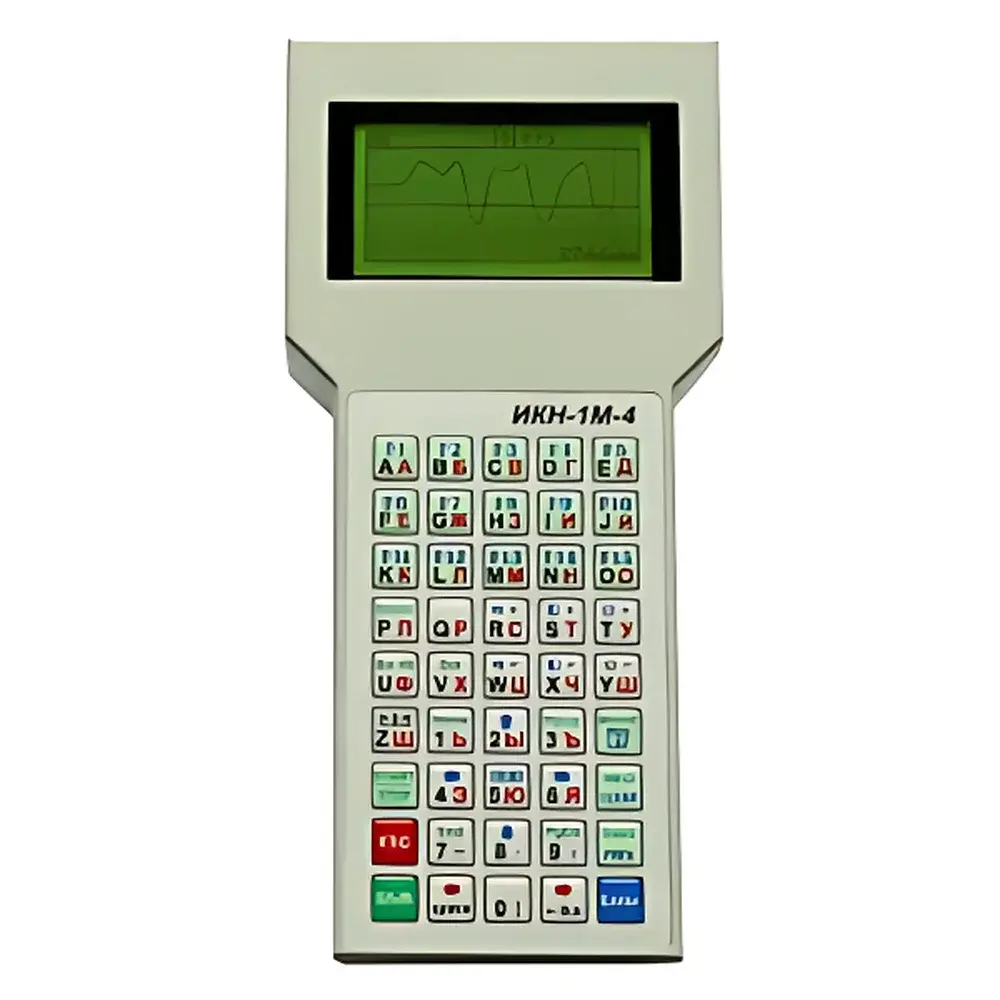
TSC-1M-4 Metal Magnetic Memory (MMM) Stress Concentration Detector
| Origin | Russia |
|---|---|
| Manufacturer Type | Authorized Distributor |
| Origin Category | Imported |
| Model | TSC-1M-4 |
| Price | Upon Request |
| Hp Measurement Range | ±2000 A/m |
| Number of Measurement Channels | 2–4 (configurable per probe) |
| Minimum Step Size | 1 mm |
| Maximum Step Size | 128 mm |
| Max Scanning Speed (at 1 mm step) | 0.2–0.5 m/s |
| Basic Relative Error per Channel (Hp) | ±5% |
| Length Measurement Relative Error | <5% |
| Microprocessor | 8-bit |
| RAM Capacity | 128 kB |
| Flash Memory | 4 MB |
| Display | 128×64-pixel monochrome LCD with real-time waveform plotting |
| Data Transfer Interface | RS-232 @ 115 kbps |
| Keypad | 45-key bilingual (English/Russian) tactile keyboard |
| Power Supply | 4×AA NiMH (1.2 V) or alkaline (1.5 V) batteries |
| Power Consumption | 0.8–3.0 V·A |
| Operating Temperature | −15 °C to +55 °C |
| Relative Humidity | 45–85 % RH |
| Dimensions | 230 × 105 × 40 mm |
| Weight | 0.5 kg |
| Probe Types | Type 1 (4-channel wheeled cart, integrated length encoder), Type 2 (2-channel single-wheel probe for small components), Type 3 (2-channel dual-wheel probe for complex geometries and small-diameter pipes), Type 4 (2-channel contact probe without encoder, for confined-access areas) |
| Auto-calibration | Yes, sensor-level real-time compensation |
Overview
The TSC-1M-4 Metal Magnetic Memory (MMM) Stress Concentration Detector is a field-deployable, non-destructive evaluation (NDE) instrument engineered for early-stage structural integrity assessment of ferromagnetic materials in service. Unlike conventional NDT methods requiring external magnetization or surface preparation, the TSC-1M-4 operates on the principle of Metal Magnetic Memory—a passive electromagnetic technique that detects self-magnetization anomalies induced by irreversible plastic deformation and residual stress accumulation. It measures the tangential component of the magnetic field (Hp) along the surface of inspected components, where local maxima and gradient inflections correlate directly with stress concentration zones (SCZs), microstructural degradation, and incipient fatigue damage. Developed by Diagnostics Power Ltd. (Russia), the system complies with Russian Federation State Mining Technical Supervision regulations and is registered in the Unified Register of Measuring Instruments of the Russian Federation (Gosreestr No. 49766-14). Its physics-based detection paradigm enables predictive diagnostics prior to crack initiation—making it particularly valuable for life extension assessments of pressure vessels, pipelines, turbine blades, welded joints, and aging infrastructure.
Key Features
- Passive, zero-prep inspection: Requires no external magnetization, surface cleaning, couplant, or coating removal—operates using naturally occurring residual magnetic fields generated during operational loading.
- Multi-channel real-time acquisition: Supports 2–4 simultaneous measurement channels depending on probe configuration; each channel independently records Hp magnitude and position data at up to 0.5 m/s scanning speed (1 mm step resolution).
- Onboard signal processing: Integrated 8-bit microcontroller performs real-time differentiation, gradient analysis, and SCZ localization; graphical results displayed live on the 128×64-pixel LCD with waveform overlay.
- Intelligent probe ecosystem: Four interchangeable probe types (Type 1–4) enable application-specific adaptation—from wide weld seams on storage tanks (Type 1 cart probe with dual encoders) to confined-access turbine blade roots (Type 4 contact probe).
- Self-calibrating architecture: Automatic sensor offset compensation and gain normalization ensure measurement stability across temperature fluctuations (−15 °C to +55 °C) and battery voltage drift.
- Field-portable design: Compact form factor (230 × 105 × 40 mm), 0.5 kg weight, and AA-battery operation support extended battery life (>8 h typical usage) without AC dependency.
Sample Compatibility & Compliance
The TSC-1M-4 is validated for use on carbon steels, low-alloy steels, and other ferromagnetic structural alloys commonly found in power generation, oil & gas transmission, rail transport, and heavy machinery. It does not require material-specific calibration curves due to its reliance on relative field gradient analysis rather than absolute permeability values. The instrument conforms to GOST R ISO/IEC 17025:2019 (general requirements for competence of testing and calibration laboratories) as implemented in Russian metrological practice. While not certified to ASTM E1444 or ISO 9934, its methodology aligns with principles outlined in RIMAP (Risk-Based Inspection and Maintenance Assessment Procedure) guidelines for residual stress mapping. Data acquisition meets traceability requirements for GLP-compliant reporting when used with MM-System software’s audit trail functionality.
Software & Data Management
Raw Hp(x) profiles and positional metadata are stored in proprietary binary format on the device’s 4 MB flash memory (capacity for >10,000 m of scanned data). Data export occurs via RS-232 serial interface (115 kbps) to Windows-based MM-System software—a dedicated analytical platform supporting spectral filtering, derivative mapping, SCZ probability indexing, and comparative multi-scan overlay. MM-System generates ISO/IEC 17025-aligned PDF reports containing raw waveforms, gradient heatmaps, annotated SCZ coordinates, and statistical summaries (e.g., maximum gradient magnitude, spatial dispersion index). The software implements user-access controls, electronic signatures, and change logs compliant with FDA 21 CFR Part 11 for regulated environments.
Applications
- Predictive maintenance of steam generator tubes and boiler drums in thermal power plants
- In-service inspection of girth welds on cross-country pipelines without excavation or shutdown
- Early fatigue assessment of aircraft landing gear components and helicopter rotor hubs
- Residual stress mapping of repaired welds in offshore platform structural nodes
- Quality verification of additive-manufactured steel parts post-heat treatment
- Monitoring stress redistribution during hydrostatic testing of pressure vessels
FAQ
Does the TSC-1M-4 require magnetization of the test object?
No. It detects naturally occurring magnetic leakage fields resulting from dislocation pile-ups and domain wall pinning at stress concentrators.
Can it detect subsurface defects?
It identifies stress-induced magnetic anomalies originating from near-surface plastic zones (typically < 1–3 mm depth); it is not a volumetric flaw detector like UT or RT.
Is calibration traceable to national standards?
Yes—each unit ships with a factory calibration certificate referencing GOST 8.751-2011 (magnetic field strength measurement standards) and includes onboard reference coil verification.
What environmental conditions affect measurement accuracy?
Strong external DC fields (>50 A/m) or high-frequency EMI may interfere; however, all probes incorporate active shielding and differential sensing to suppress geomagnetic noise.
How is probe selection determined for a given application?
Type 1 is optimal for flat or gently curved surfaces ≥50 mm width; Type 2 suits small rotating components; Type 3 handles tight-radius bends and small-diameter tubing; Type 4 is reserved for inaccessible weld toes or bolted flange interfaces.



