
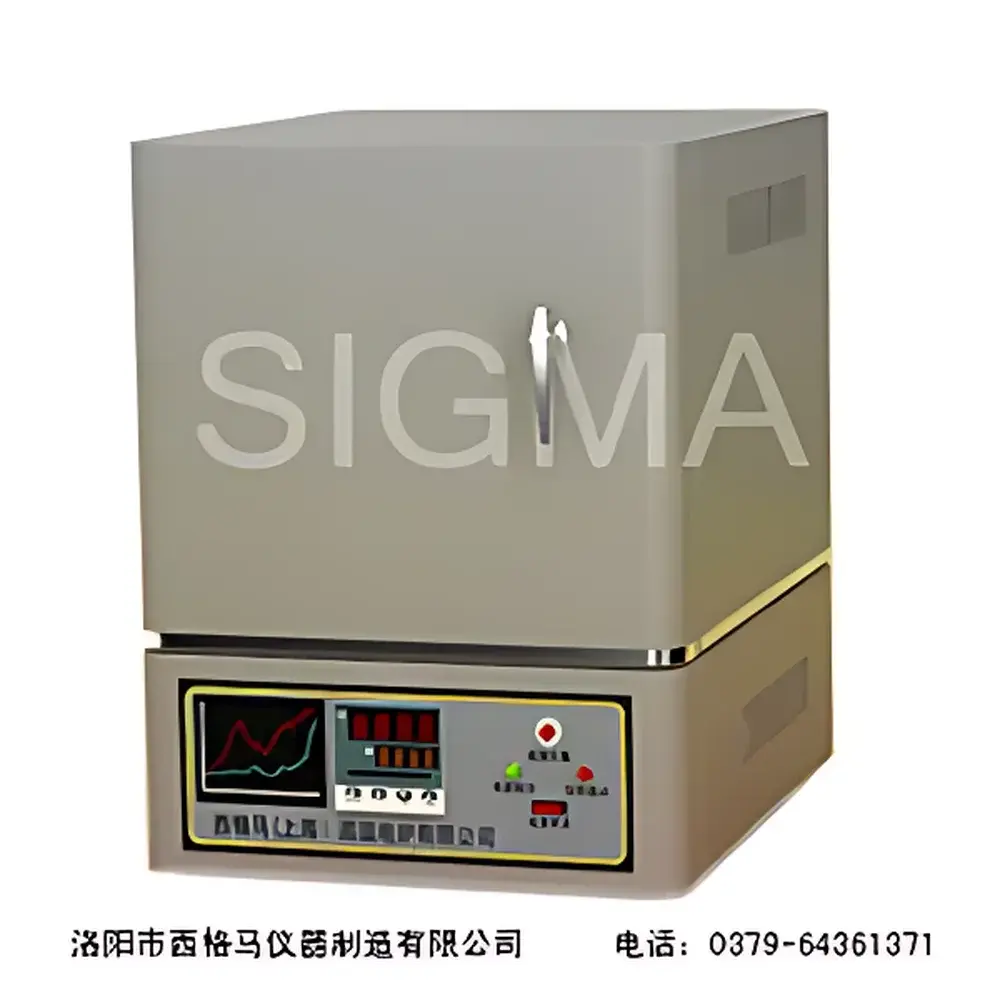
SGM M1000–1200°C Box-Type Resistance Furnace
| Origin | Henan, China |
|---|---|
| Manufacturer Type | Authorized Distributor |
| Product Origin | Domestic (PRC) |
| Model | M1000–1200°C |
| Pricing | Available Upon Request |
| Heating Element | Kanthal A1 Resistance Wire |
| Thermocouple Types | K-type (≤1000°C), S-type (up to 1200°C) |
| Temperature Uniformity | ±2.9°C (at 1000°C, per SGM2825 configuration) |
| Control System | 30-Stage Programmable PID Controller with Auto-Tuning, Manual/Auto Seamless Switching, Over-Temperature Alarm, and Temperature Compensation/Calibration Functions |
| Display Accuracy | ±1°C |
| Ramp Rate | Adjustable |
| Thermal Insulation | Full-Ceramic Fiber Chamber (Low Thermal Mass, <30% Energy Consumption vs. Refractory Brick Furnaces) |
| Structural Design | Integrated “Full-Door” Enclosure with Ergonomic Handle and Safety Interlock |
Overview
The SGM M1000–1200°C Box-Type Resistance Furnace is a precision-engineered laboratory muffle furnace designed for high-reliability thermal processing in academic research, materials science laboratories, and small-scale production environments. It operates on resistive heating principles, utilizing high-purity Kanthal A1 alloy heating elements embedded within a fully ceramic fiber-insulated chamber. This architecture enables rapid thermal response, exceptional energy efficiency (>70% reduction in no-load power consumption compared to conventional refractory brick furnaces), and stable temperature maintenance across extended dwell periods. The furnace supports two maximum operating temperatures—1000°C and 1200°C—selected at time of order, with corresponding thermocouple configurations (K-type for ≤1000°C; S-type for up to 1200°C) ensuring metrological traceability per IEC 60584-2 and ASTM E230 standards. Its design prioritizes thermal uniformity, mechanical robustness, and operational safety—critical requirements for sintering, annealing, ashing, calcination, and thermal expansion testing of advanced ceramics, metallic alloys, and refractory composites.
Key Features
- Full-ceramic fiber insulation chamber: Low thermal mass, minimal heat storage, and reduced standby losses—validated for >70% energy savings versus traditional muffle furnaces.
- Programmable 30-segment temperature profile controller with auto-tuned PID algorithm, enabling precise ramp-hold-cool sequences without manual intervention.
- Temperature uniformity of ±2.9°C at 1000°C (measured per ISO 9001-compliant internal verification protocol), significantly exceeding national standard Class A (±15°C) and Class C (±6°C) specifications for box-type electric furnaces.
- High-accuracy digital display with ±1°C resolution and integrated temperature compensation and calibration offset functions for long-term measurement stability.
- Adjustable heating rate: Achieves ambient-to-1000°C in 15–30 minutes, supporting time-sensitive experimental protocols such as rapid thermal annealing or kinetic studies.
- Full-door structural integration with reinforced stainless steel frame, ergonomic handle, and door-mounted safety interlock switch compliant with EN 61000-6-4 electromagnetic compatibility and EN 61000-6-2 immunity requirements.
Sample Compatibility & Compliance
The furnace accommodates a wide range of crucible-compatible samples—including alumina, quartz, silicon carbide, and graphite crucibles—within volumetric options ranging from 6 L to 30 L. Its uniform heating zone ensures reproducible thermal exposure for ASTM C20 (Apparent Porosity and Bulk Density of Refractories), ASTM C373 (Water Absorption, Bulk Density, Apparent Porosity, and Voids in Fired Whiteware), and ISO 5068 (Determination of Linear Thermal Expansion of Ceramics) test methods. All models are CE-marked and conform to IEC 61000-3-2 (harmonic current emissions) and IEC 61000-3-3 (voltage fluctuations). Optional documentation packages support GLP/GMP audit readiness, including factory calibration certificates traceable to NIM (National Institute of Metrology, China) and optional 21 CFR Part 11–compliant software audit trails when paired with SGM’s certified data acquisition module.
Software & Data Management
While the base unit features an embedded 30-stage programmable controller with local display and keypad interface, optional RS485 Modbus RTU connectivity enables integration into centralized lab management systems (LIMS) or SCADA platforms. SGM’s optional FurnaceLink™ software (Windows-based, USB/RS485 interface) provides real-time temperature logging, profile editing, export to CSV/PDF, and electronic signature-enabled report generation. All data files include timestamps, operator ID fields, and automatic event tagging (e.g., “Ramp Start”, “Hold Reached”, “Overtemp Alarm”). Audit trail functionality complies with FDA 21 CFR Part 11 requirements when configured with user authentication and electronic signature modules.
Applications
- Sintering of oxide and non-oxide ceramics (Al₂O₃, ZrO₂, SiC, Si₃N₄)
- Heat treatment of single crystals (e.g., LiNbO₃, YAG) and metallic alloys (Ti-6Al-4V, Inconel 718)
- High-temperature dimensional stability testing per ASTM C830 (Hot Crushing Strength of Refractories) and ISO 5068
- Ash content determination in pharmaceutical excipients (USP <281>) and environmental samples (EPA Method 3010A)
- Thermal gravimetric pre-conditioning prior to DSC/TGA analysis
- Small-batch annealing of thin-film substrates and MEMS components
FAQ
What thermocouple types are used—and how are they selected?
K-type thermocouples (Chromel-Alumel) are standard for models rated to 1000°C; S-type (Platinum-10% Rhodium / Platinum) thermocouples are installed for 1200°C-rated units to ensure long-term stability and oxidation resistance above 1000°C.
Is temperature uniformity validated across the entire working volume?
Yes—uniformity is verified at nine standardized points (center + eight corners) per ISO/IEC 17025-aligned internal procedure; reported value (±2.9°C) reflects worst-case deviation at 1000°C under steady-state conditions.
Can the furnace be integrated into automated lab workflows?
Yes—RS485 Modbus RTU interface supports bidirectional communication with PLCs, LIMS, or custom Python/Node-RED control scripts; optional FurnaceLink™ software adds full audit-trail capability.
Does the furnace meet international electrical safety standards?
All units comply with IEC 61010-1 (Safety Requirements for Electrical Equipment for Measurement, Control, and Laboratory Use) and carry CE marking for EMC and Low Voltage Directive conformity.
What maintenance is required to sustain calibration integrity?
Annual verification using NIST-traceable reference thermocouples is recommended; ceramic fiber insulation requires no scheduled replacement under normal use but should be inspected for physical damage after repeated thermal cycling above 1100°C.
Related Products



