
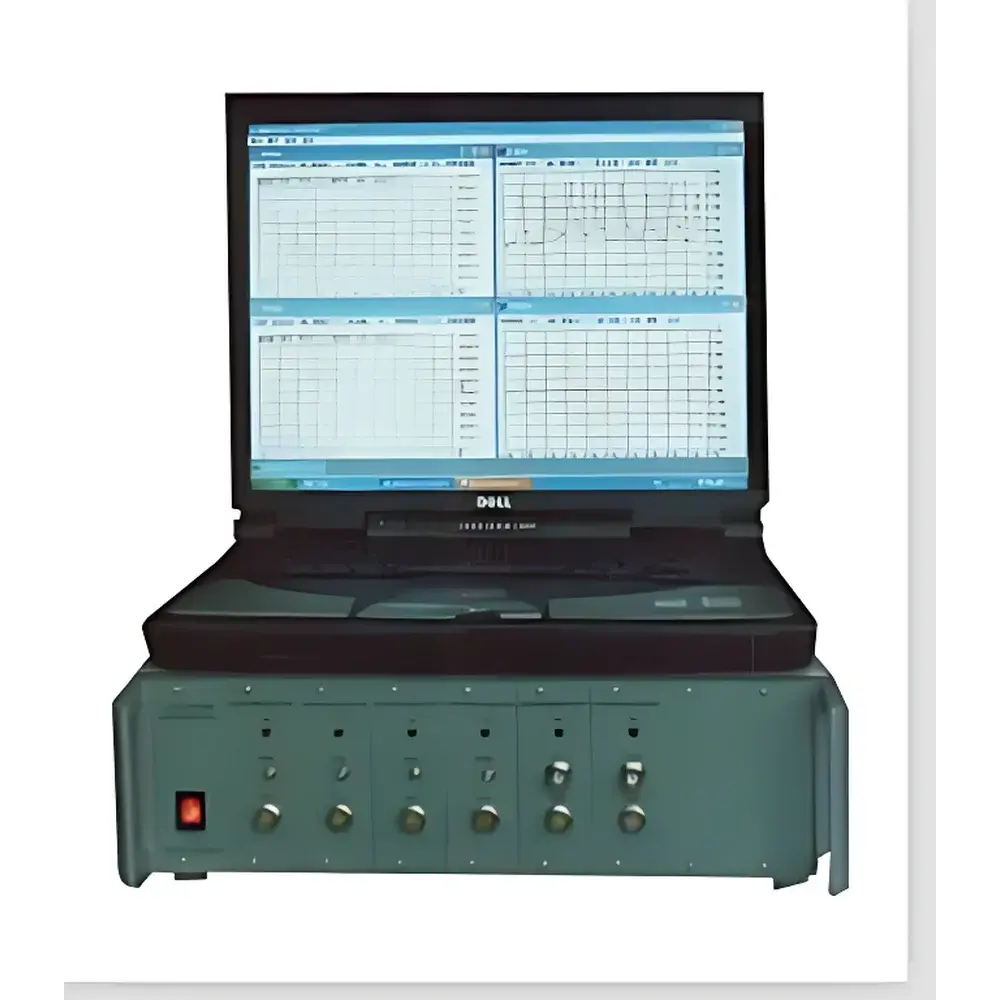
AWA6290A Multi-Channel Noise and Vibration Analyzer
| Origin | Beijing, China |
|---|---|
| Manufacturer Type | Authorized Distributor |
| Origin Category | Domestic (China) |
| Model | AWA6290A |
| Pricing | Available Upon Request |
Overview
The AWA6290A Multi-Channel Noise and Vibration Analyzer is a modular, high-fidelity signal acquisition and spectral analysis platform engineered for simultaneous broadband measurement of airborne sound pressure and mechanical vibration. It operates on dual independent analog signal paths—acoustic and inertial—each conditioned by dedicated, metrologically traceable front-end amplifiers (AWA5811A for noise, AWA5812 for vibration) compliant with international standards for precision environmental and industrial diagnostics. The system implements real-time digital signal processing (DSP) using high-speed 24-bit A/D conversion at selectable sampling rates up to 100 kHz, enabling both time-domain waveform capture and frequency-domain decomposition via Fast Fourier Transform (FFT) or fractional-octave band analysis. Its architecture supports arbitrary channel pairing—e.g., 2-channel noise + 2-channel vibration, or 4-channel vibration-only configurations—making it suitable for rotating machinery health monitoring, structural dynamic testing, product noise certification, and acoustic emission source localization.
Key Features
- Dual-path signal conditioning: Integrated Class 1-compliant acoustic channel (IEC 61672-1:2013) and charge-mode vibration input with programmable gain and anti-alias filtering
- Real-time spectral analysis: FFT resolution options up to 8192 lines; 1/3-octave band analysis conforming to IEC 61260-1:2014 Class 1 requirements
- Intelligent threshold-triggered data capture: User-definable amplitude limits per frequency band; automatic spectrum logging to standard ASCII .txt files upon exceedance
- High-dynamic-range acquisition: ≥80 dB effective dynamic range with low-noise preamplification and selectable anti-alias filter cutoffs (1–30 kHz for vibration; 25 kHz fixed for acoustic)
- Modular sensor interface: Supports industry-standard 1/2″ pre-polarized condenser microphones (30 mV/Pa sensitivity) and IEPE-compatible or charge-output accelerometers (1–10 kHz flat response)
- Flexible display and visualization: Simultaneous real-time rendering of overall sound pressure level (SPL), RMS acceleration, time waveforms, and overlaid spectral plots on external PC monitor
Sample Compatibility & Compliance
The AWA6290A accommodates a wide range of transducers used in industrial acoustics and mechanical vibration metrology. Acoustic measurements utilize 12.7 mm (1/2″) pre-polarized condenser microphones meeting IEC 61094-4 specifications, with linear frequency response from 20 Hz to 20 kHz and A-, C-, and Z-frequency weightings certified to IEC 61672-1:2013 Class 1 accuracy. Vibration inputs accept piezoelectric accelerometers with charge sensitivities between 1.00–10.99 pC/(m·s²), supporting full-scale acceleration ranges from 0.1 to 1000 m/s² across 1 Hz–10 kHz bandwidth. Optional accessories—including magnetic bases, low-noise coaxial cables, and portable anechoic enclosures (≥30 dB insertion loss, α > 0.8 average absorption coefficient)—extend field deployability while preserving measurement integrity. All hardware and firmware design align with ISO 2631-1 (human vibration), ISO 5349 (hand-arm vibration), and ISO 3744/3746 (acoustic power determination) test methodologies.
Software & Data Management
Data acquisition, configuration, and post-processing are performed via Windows-based host software running on user-supplied PCs or laptops. The application provides intuitive GUI-driven setup of sampling parameters, weighting filters, FFT resolution, and alarm thresholds. Raw time-series data and spectral results are exported in plain-text (.txt) format compatible with MATLAB, Python (NumPy/Pandas), LabVIEW, and statistical analysis platforms—ensuring full traceability and interoperability within regulated QA/QC workflows. Audit-ready metadata—including timestamp, sensor ID, calibration date, operator ID, and environmental conditions—is embedded in each saved file. While the base system does not include FDA 21 CFR Part 11-compliant electronic signature or audit trail functionality, its open data architecture allows integration with validated LIMS or ELN systems under GLP/GMP environments when deployed with appropriate procedural controls.
Applications
- Machinery condition monitoring: Detection of bearing faults, gear mesh anomalies, and imbalance through synchronous order tracking and envelope spectrum analysis
- Noise source identification: Beamforming-ready multi-microphone array support (with optional synchronization module) for spatial mapping of dominant contributors in HVAC, automotive, or manufacturing settings
- Product compliance testing: Verification against regulatory limits (e.g., EU Directive 2000/14/EC for outdoor equipment noise, ISO 3745 for laboratory acoustic power measurement)
- Structural dynamics characterization: Modal analysis of lightweight panels, enclosures, and mounting subsystems using impact hammer or shaker excitation
- Environmental noise assessment: Long-term unattended monitoring of community noise exposure (Lden, Lnight) when paired with weatherproof housing and GPS-synchronized logging
- Research-grade vibro-acoustic coupling studies: Correlation of structural vibration modes with radiated sound fields in electromechanical devices
FAQ
What calibration standards does the AWA6290A comply with for acoustic measurements?
It meets IEC 61672-1:2013 Class 1 requirements for sound level meters, including frequency weighting accuracy, linearity, and temperature stability specifications.
Can the system perform real-time octave band analysis alongside FFT?
Yes—simultaneous parallel processing enables concurrent 1/3-octave band filtering (per IEC 61260-1:2014 Class 1) and high-resolution FFT analysis without computational trade-offs.
Is external power required for the microphone preamplifiers?
No—the AWA5811A amplifier supplies constant-current powering (2–10 mA, 24 VDC) to standard pre-polarized 1/2″ microphones, eliminating need for external phantom power units.
How is synchronization handled across multiple vibration channels?
All analog inputs share a common master clock derived from the internal 100 kHz sampling oscillator, ensuring sub-sample phase coherence essential for modal analysis and cross-channel coherence estimation.
Does the analyzer support third-party transducer databases or TEDS?
Not natively—sensor sensitivity and calibration factors must be entered manually; however, the ASCII export format facilitates automated ingestion into TEDS-enabled platforms via custom scripting.
Related Products







