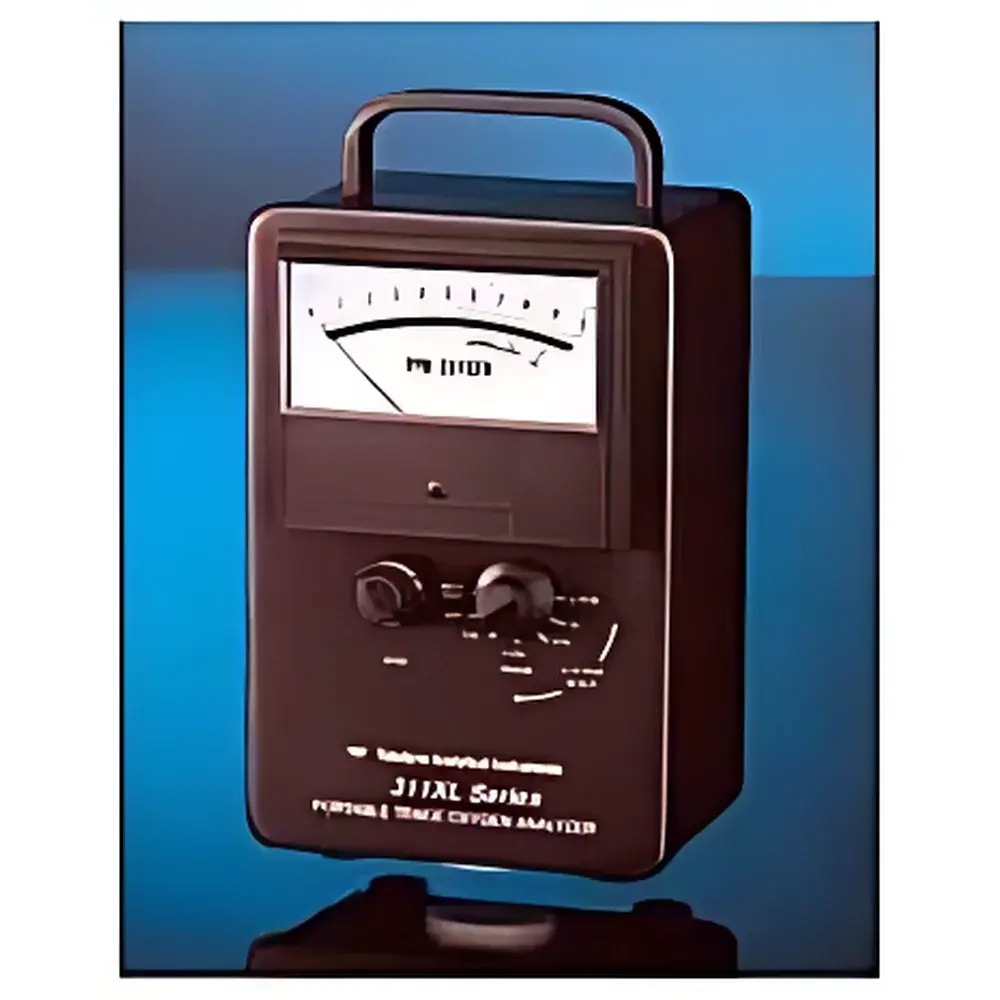
Teledyne 311 Series Portable Trace Oxygen Analyzer
| Origin | USA |
|---|---|
| Manufacturer Type | Authorized Distributor |
| Origin Category | Imported |
| Model | Teledyne 311 |
| Pricing | Upon Request |
Overview
The Teledyne 311 Series Portable Trace Oxygen Analyzer is a field-deployable electrochemical micro-fuel cell instrument engineered for high-precision, real-time measurement of trace oxygen concentrations in inert and reactive gas matrices. Utilizing proprietary B-2C, B-2CXL, or S-2 micro-fuel cell sensors—each operating on the principle of oxygen-specific electrochemical reduction—the analyzer delivers linear current output proportional to O₂ partial pressure. This galvanic cell architecture ensures inherent selectivity for molecular oxygen without cross-sensitivity to reducing gases (e.g., H₂, CO, CH₄, C₂H₄) or hydrocarbon-rich backgrounds (up to 100% vol), eliminating the need for catalytic scrubbers or complex gas conditioning. Designed for demanding industrial environments—from semiconductor fab purge lines to nuclear fuel handling gloveboxes—the 311 Series meets rigorous requirements for stability, zero-drift immunity, and operational simplicity under variable ambient conditions (0–50 °C). Its fundamental measurement physics aligns with ASTM D6894 (Standard Practice for Calibration of Trace Oxygen Analyzers) and supports compliance with ISO 8573-1 (compressed air purity) and USP (water and gas quality for pharmaceutical manufacturing).
Key Features
- True zero-based calibration: Micro-fuel cell sensors provide absolute zero reference; no zero-gas cylinder required.
- Economical air calibration: Dedicated span range enables accurate two-point calibration using ambient air (20.9% O₂), eliminating dependence on certified standard gases.
- Extended battery autonomy: Rechargeable NiCd battery pack delivers up to 30 days of continuous operation per full charge; overnight recharging supports multi-year service life.
- Multi-range flexibility: Configurable models cover 0–2 ppm to 0–25% O₂, including auto-ranging (3110) and fixed-range variants (311XL, TURBO2) optimized for specific process tiers.
- Hazardous area certification: FM Class I Div 1 Groups A–D (311XL, 311) and BASEEFA EEx ib IIC T4 (311TC, 311PC) approvals enable safe deployment in flammable atmospheres.
- Robust mechanical design: IP54-rated enclosure, stainless-steel sample fittings (optional), and shock-absorbing molded carry case (3110) ensure field durability.
Sample Compatibility & Compliance
The 311 Series is validated for use with high-purity inert gases (N₂, Ar, He, H₂), hydrocarbon streams (C₂H₂, C₂H₄, C₄H₆, CₙHₘ), CO₂, SF₆, and mixed process gases. Sensor chemistry remains stable in non-corrosive, non-condensing sample streams with dew point ≤ −40 °C and particulate loading < 0.3 µm. Instrumentation complies with IEC 61000-4 electromagnetic compatibility standards and meets functional safety requirements per IEC 61508 SIL 2 for critical monitoring applications. Data integrity protocols support audit-ready operation under FDA 21 CFR Part 11 when paired with optional digital logging (3110 model). All units are manufactured in accordance with ISO 9001:2015 and undergo factory verification per NIST-traceable procedures.
Software & Data Management
While analog-display models (311, 311XL, TURBO2) operate as standalone instruments with minimal configuration, the 3110 digital variant integrates RS-232/RS-485 serial interface and optional real-time data logging (up to 10,000 records). Logged parameters include timestamped O₂ concentration, sensor temperature, battery voltage, and alarm status. Firmware supports user-defined alarm thresholds (high/low), configurable averaging windows (1–60 sec), and automatic range switching. Exported CSV files are compatible with LIMS platforms and comply with GLP/GMP electronic record retention guidelines. No proprietary software installation is required—basic configuration uses ASCII command set; advanced diagnostics require Teledyne’s OEM service utility.
Applications
- Air separation unit (ASU) product purity verification and cryogenic liquid transfer monitoring
- Hydrogen and helium pipeline integrity testing via residual O₂ leak detection
- Semiconductor process gas cabinets (PGCs) and bulk gas delivery systems
- Inerting validation for chemical reactors, distillation columns, and storage vessels
- Plasma etch chamber purge verification and glovebox atmosphere control
- Thermal processing furnaces (annealing, sintering) where oxygen-induced oxidation must be suppressed below 10 ppm
- Nuclear fuel fabrication facilities requiring <1 ppm O₂ in argon cover gas
- Pharmaceutical lyophilization cycle qualification and vial headspace analysis
- Food packaging MAP (modified atmosphere packaging) line auditing
- Transformer oil dissolved gas analysis (DGA) support via headspace O₂ trending
FAQ
How does the micro-fuel cell sensor achieve oxygen specificity?
The B-2C and B-2CXL sensors employ a solid polymer electrolyte and catalyzed cathode that thermodynamically favors O₂ reduction over other reducible species. No external bias voltage is applied, eliminating Faradaic interference from CO or H₂.
Can the 311 Series measure oxygen in 100% hydrogen?
Yes—sensor response is unaffected by stoichiometric H₂ background due to kinetic selectivity and absence of platinum-group catalysts that promote competing reactions.
What is the recommended calibration frequency?
For GLP-compliant operations, quarterly air calibration is sufficient; annual sensor replacement (B-2C: 24 months typical life; B-2CXL: 36 months) is advised based on cumulative exposure and drift verification.
Is the instrument suitable for continuous unattended monitoring?
While designed as a portable verifier, the 3110 with external power supply and data logging meets 24/7 duty-cycle requirements for temporary process validation—though permanent online installation requires dedicated process analyzers (e.g., Teledyne 3000 series).
Does the analyzer require sample flow regulation?
Yes—optimal performance requires 2.5 SCFH (±0.5) sample flow; built-in flowmeter (3110) or external rotameter (other models) ensures consistent diffusion-limited sensor response.