
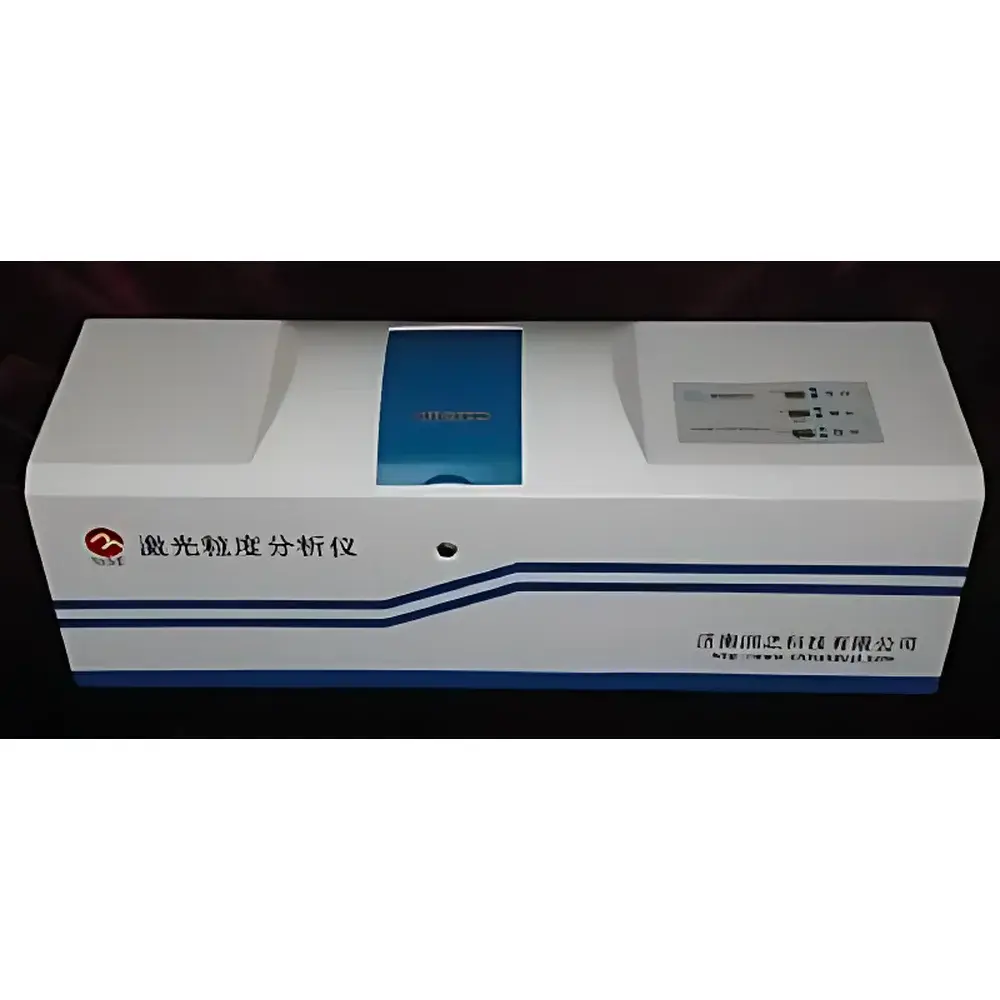
Rise RISE-2206 Fully Automated Laser Particle Size Analyzer
| Origin | Beijing, China |
|---|---|
| Manufacturer Type | Authorized Distributor |
| Origin Category | Domestic (PRC) |
| Model | RISE-2206 |
| Pricing | Upon Request |
| Measurement Range | 0.05–800 µm |
| Accuracy Error | < ±1% (D50, NIST-traceable standard reference materials) |
| Repeatability | < ±1% (D50, same sample, 3 consecutive runs) |
| Laser Source | He-Ne, 632.8 nm, >25,000 h lifetime |
| Detector Array | Non-uniform cross-3D扇-shaped matrix, max detection angle 105° |
| Power Supply | AC 220 V ±10%, 50 Hz, 200 W |
| Dimensions (L×W×H) | 1000 × 330 × 320 mm |
| Weight | 39 kg |
| Dispersion System | Integrated 400 mL wet dispersion cell with 100 W ultrasonic probe, automatic degassing, circulation, rinsing and drainage |
Overview
The Rise RISE-2206 Fully Automated Laser Particle Size Analyzer is an advanced wet-dispersion instrument engineered for high-precision, high-reproducibility particle size distribution (PSD) analysis across research, quality control, and production environments. It operates on the fundamental principle of Mie scattering theory—fully implemented across its entire measurement range—enabling rigorous optical modeling that accounts for particle refractive index, absorption coefficient, and dispersant optical properties. Unlike simplified Fraunhofer approximations, Mie-based inversion ensures metrological validity for both spherical and near-spherical particles in liquid suspension, particularly critical when analyzing polydisperse or optically heterogeneous samples (e.g., metal oxides, pharmaceutical actives, ceramic precursors, or polymer emulsions). The system employs a single, fixed-focus convergent optical path—eliminating Fourier lens stacks—to maximize signal-to-noise ratio, extend dynamic angular detection to 105°, and deliver intrinsic calibration stability without manual alignment. Its core architecture integrates a long-life helium-neon laser (632.8 nm, linewidth <0.002 nm), a proprietary non-uniform 3D fan-array photodetector, and a fully automated fluidic module compliant with ISO 13320:2020 requirements for laser diffraction particle sizing.
Key Features
- Fully automated operation sequence: auto-filling, degassing, ultrasonication (up to 100 W, programmable duration), circulation, measurement, drainage, and cleaning—all initiated by a single software command.
- Optimized detector geometry: a cross-3D扇-shaped (fan-shaped) photodiode matrix enables high-fidelity capture of forward-, side-, and back-scattered light, supporting robust inverse solution convergence without prior distribution assumptions.
- Unconstrained inversion algorithm: performs direct, non-parametric numerical inversion of raw scattering intensity data—no pre-assumed distribution (e.g., log-normal or Rosin-Rammler)—ensuring fidelity to true sample heterogeneity.
- Integrated dispersion unit: 400 mL stainless-steel circulation cell with variable-speed peristaltic pump, adjustable stirrer, and temperature-stable ultrasonic transducer—compatible with water, ethanol, isopropanol, and other low-viscosity dispersants.
- Self-diagnostic optical train: real-time laser power monitoring, detector saturation alerts, and bubble-detection logic prevent erroneous acquisitions caused by air entrainment or misalignment.
- Compliance-ready design: hardware and firmware support audit trails, user access levels, electronic signatures, and data integrity protocols aligned with FDA 21 CFR Part 11 and GLP/GMP documentation requirements.
Sample Compatibility & Compliance
The RISE-2206 is validated for use with a broad spectrum of industrially relevant particulate systems—including inorganic pigments, catalysts, battery cathode materials, food powders, agrochemical suspensions, and biopharmaceutical colloids. Sample introduction is limited to stable aqueous or organic suspensions; dry powder dispersion is not supported. All measurements adhere to ISO 13320:2020 (Laser diffraction methods—Guidance for the use of Mie theory), ASTM D4291–22 (Standard Test Method for Particle-Size Distribution of Pigments by Centrifugal Sedimentation), and USP <429> (Light Diffraction Measurement of Particle Size). Instrument qualification includes IQ/OQ documentation templates, and raw scattering data files (.DAT) are stored with full metadata (timestamp, operator ID, method name, dispersant ID, ultrasonication parameters) to satisfy traceability mandates under ISO/IEC 17025.
Software & Data Management
The PADMAS (Particle Diameter Measure & Analysis System) v4.x software provides a validated, modular interface for method development, acquisition, and reporting. It supports up to 130 user-defined size channels between 0.02–2000 µm, with default binning optimized for Mie inversion accuracy. Output includes differential and cumulative volume-based distributions, D10, D50, D90, span, specific surface area (volume- and mass-weighted), and customizable statistical overlays. Reports export natively to Excel (.XLSX), PDF, PNG, and SVG formats; header/footer fields are editable to meet institutional branding or regulatory submission standards. Audit trail logs record all parameter modifications, result exports, and user logins with timestamps. Optional modules enable trend analysis across batches, SPC charting (X-bar/R), and comparative overlay of up to eight distributions within a single plot—essential for formulation optimization or supplier qualification studies.
Applications
- Pharmaceutical solid dosage development: quantifying micronized API particle size impact on dissolution rate and content uniformity per ICH Q5A and Q6A guidelines.
- Advanced materials R&D: characterizing sintering behavior of nano-ceramics via D50 shift monitoring after ball milling or calcination cycles.
- Quality assurance in pigment manufacturing: verifying batch-to-batch consistency against master standards using D90 tolerance bands defined in ISO 8781-2.
- Academic colloid science: correlating hydrodynamic diameter (from DLS) with volume-based PSD from RISE-2206 to assess aggregation state in stabilizer screening assays.
- Environmental particulate analysis: determining sediment grain-size composition in soil/water extracts for erosion modeling or regulatory classification (e.g., USDA texture triangle).
FAQ
Does the RISE-2206 support dry powder measurement?
No. The RISE-2206 is configured exclusively for wet dispersion analysis. Dry powder measurement requires a separate pneumatic dispersion module not included in this model.
Can the instrument be calibrated using NIST-traceable standards?
Yes. Certified reference materials (e.g., NIST SRM 1963, 1973a) are supported for daily verification and periodic recalibration. Calibration certificates and uncertainty budgets are provided with each SRM shipment.
Is method transfer possible between different RISE-2206 units?
Yes—provided identical dispersant, ultrasonication settings, and optical alignment status are maintained. Cross-unit reproducibility studies show D50 variation < ±0.8% (n=5 units, same SRM lot) under controlled environmental conditions (23±1°C, <50% RH).
What level of IT validation support is offered for regulated laboratories?
Rise provides IQ/OQ protocol templates, CSV-compliant installation documentation, and a 21 CFR Part 11 readiness package—including role-based access configuration, electronic signature workflow, and audit trail review tools.
How frequently does the He-Ne laser require replacement?
The integrated He-Ne laser is rated for >25,000 hours of continuous operation. Under typical lab usage (2–4 hours/day), expected service life exceeds 12 years with no performance degradation or wavelength drift.
Related Products



