
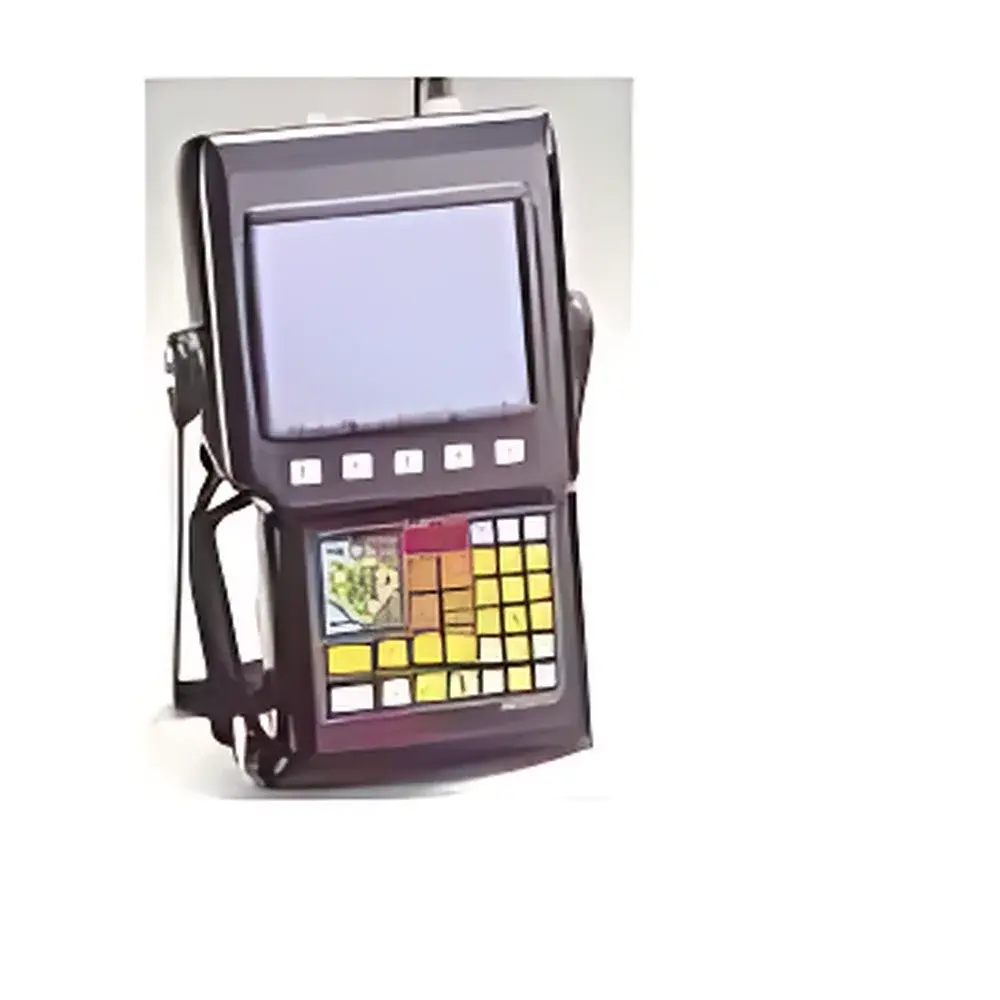
Olympus EPOCH 4 PLUS Portable Ultrasonic Flaw Detector
| [Origin | USA |
|---|---|
| Manufacturer Type | Authorized Distributor |
| Origin Category | Imported |
| Model | EPOCH 4 PLUS |
| Pricing | Available Upon Request] |
Overview
The Olympus EPOCH 4 PLUS is a high-performance, portable ultrasonic flaw detector engineered for precision NDT inspection in demanding field and industrial environments. Based on advanced digital signal processing architecture, it employs pulse-echo, through-transmission, and dual-element ultrasonic measurement principles to detect discontinuities—including cracks, voids, inclusions, and laminations—in metallic, composite, and non-metallic materials. Its 25 MHz RF bandwidth supports high-resolution inspection of thin-section components, while configurable pulse generation (negative spike or adjustable square-wave) enables optimal penetration in both low-attenuation thin materials and highly attenuating thick sections. The instrument complies with core ultrasonic testing standards including ASTM E114, ASTM E317, ISO 10893-4, and EN 12668-1, and its design facilitates traceable, repeatable inspections under GLP and pre-GMP workflows.
Key Features
- Full-color VGA LCD display (320 × 240 pixels) with brightness adjustment and dynamic waveform color mapping—waveforms shift hue in real time when echoes exceed user-defined amplitude thresholds or minimum depth criteria
- 60 Hz minimum A-scan refresh rate ensures fluid waveform visualization during scanning
- Configurable pulser: selectable negative spike (up to 400 V) or adjustable square-wave excitation with variable voltage (100–400 V) and damping (50–400 Ω)
- Programmable narrowband filtering to enhance signal-to-noise ratio at high gain settings
- Dual-gate echo-to-echo thickness measurement in both rectified and RF modes
- Automatic probe validation: real-time zero-offset and sound velocity calibration using known reference reflectors
- EMAT probe optimization support for electromagnetic acoustic transducer applications
- External trigger I/O port for synchronization with motion encoders, robotic scanners, or multi-channel acquisition systems
- Onboard memory capacity: up to 6,400 waveforms/calibrations or 128,000 thickness readings, each tagged with alphanumeric file IDs and customizable metadata
- Real-time freeze function for capturing transient indications and associated sound path data
- Peak memory and peak capture modes for comparative analysis between live A-scan and envelope history
- Multi-standard DAC/TVG implementation—including ASME Section V Article 4, ASME III Appendix VIII, JIS Z 2344, and user-defined curves—with 80%/20% evaluation zones and configurable warning envelopes
Sample Compatibility & Compliance
The EPOCH 4 PLUS accommodates a broad range of material types and geometries, supporting longitudinal and shear-wave inspections across steel, aluminum, titanium, austenitic stainless steels, composites, and plastics. It accepts standard LEMO-1 and BNC probes (with adapter), and its adjustable refracted angle range (10°–85° in 0.1° increments) enables precise angle-beam setups per AWS D1.1, API RP 2X, or EN ISO 17640 requirements. All measurement data—including gate positions, DAC points, and TVG profiles—are stored with full timestamping and operator ID tagging. Audit trails are preserved in accordance with FDA 21 CFR Part 11 readiness when used with GageView Pro software, supporting regulatory documentation for aerospace, power generation, and pressure equipment sectors.
Software & Data Management
Data export and reporting are streamlined via the optional GageView Pro PC application, which provides bidirectional communication over USB 2.0. GageView Pro supports real-time screen capture, customizable color palettes, database backup/recovery, and multi-window waveform comparison. It generates compliant reports containing raw A-scans, thickness maps, DAC/TVG overlays, and pass/fail annotations aligned with ASME or ISO reporting templates. Stored files retain full metrological context—including instrument configuration, probe parameters, calibration certificates, and environmental conditions—and can be exported as CSV, XML, or PDF for integration into enterprise quality management systems (QMS). Firmware updates are secured via encrypted remote deployment using the built-in safety key authentication protocol.
Applications
The EPOCH 4 PLUS is routinely deployed in weld inspection (pipeline girth welds, structural joints), corrosion mapping (CUI assessment, tank floor scanning), aerospace component screening (engine disks, landing gear), rail axle testing, and manufacturing QA/QC of castings and forgings. Its RF-mode polarity detection and echo-to-echo capability make it particularly effective for backwall-limited measurements in coarse-grained or layered materials. Field technicians use its ergonomic form factor (283 × 166 × 66 mm; 2.6 kg) and 5–7 hour battery life for extended shift operations, while lab-based NDT engineers leverage its high-fidelity analog front-end (0.3–20 MHz bandwidth, −3 dB) for method development and validation per ISO/IEC 17025.
FAQ
Does the EPOCH 4 PLUS support compliance with ASME BPVC Section V?
Yes—it implements ASME-compliant DAC construction, gate-based evaluation logic, and report formatting templates required for Code Case acceptance.
Can the device store and recall multiple calibration setups for different probes and materials?
Yes—up to 6,400 waveform-based calibrations can be saved with unique identifiers, including probe type, frequency, wedge angle, and material velocity.
Is USB the only interface for data transfer?
No—USB 2.0 is primary, but the instrument also features a high-speed parallel port for alarm triggering and external synchronization, plus VGA output for presentation and analog outputs for thickness/amplitude monitoring.
What languages does the interface support?
English, French, German, Spanish, Italian, Russian, Japanese, and one user-defined language—all selectable via on-device keyboard.
How is measurement traceability ensured during field use?
All stored data includes embedded timestamps, operator ID fields, calibration verification records, and full configuration snapshots—enabling full reconstruction of inspection conditions per ISO 17025 Clause 7.7 requirements.



