
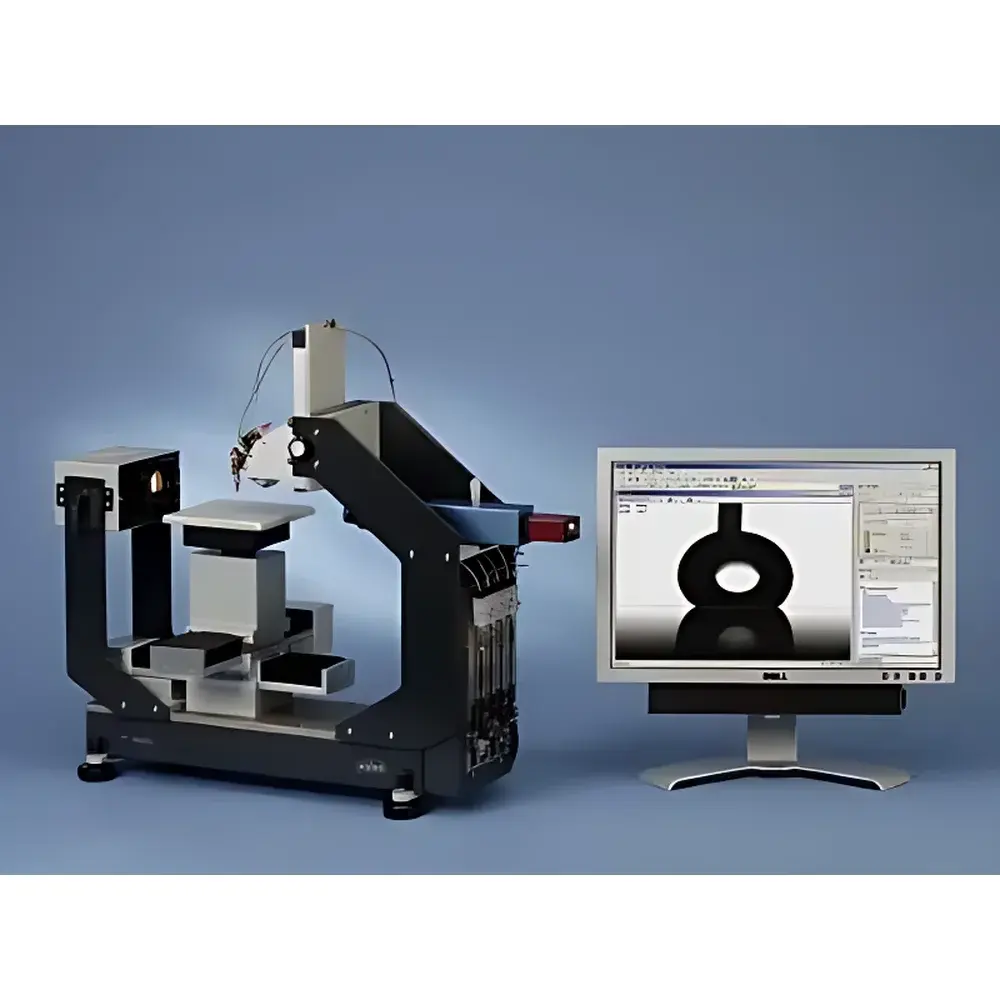
Krüss DSA30 Advanced Video-Based Contact Angle Analyzer
| Origin | Germany |
|---|---|
| Instrument Type | Benchtop Laboratory System |
| Measurement Principle | Optical Imaging (Video-Based Drop Shape Analysis) |
| Contact Angle Range | 0°–180° |
| Contact Angle Resolution | ±0.01° |
| Surface/Interfacial Tension Range | 0.01–2000 mN/m |
| Surface Tension Resolution | 0.01 mN/m |
| Optical Magnification | 7× (motorized, software-controlled) |
| Field of View (FOV) | 3.2–23 mm |
| High-Speed Camera | 311 fps (standard), optional full-frame ultra-high-speed up to 20,000 fps |
| Image Resolution | 780 × 580 pixels (standard) |
| Sample Stage Dimensions (max. accommodated) | 320 mm (W) × ∞ (D) × 275 mm (H) |
| Stage Mobility | Motorized X/Y/Z translation (X/Y: ±100 mm |
| Z | ±38 mm) |
| Dispensing Systems | Dual automated syringe modules (0.01 µL minimum step), manual dispensing unit, auto-refill & auto-cleaning module, dedicated 50 nL precision dosing system |
| Data Throughput | 800 MB/s |
Overview
The Krüss DSA30 Advanced Video-Based Contact Angle Analyzer is a high-precision benchtop instrument engineered for quantitative characterization of solid–liquid and liquid–liquid interfacial behavior. It operates on the principle of video-based drop shape analysis (DSA), leveraging optical imaging and advanced image processing algorithms to determine contact angles, surface free energy components, and interfacial tension values with metrological rigor. Designed for research laboratories requiring reproducible, traceable measurements under controlled environmental conditions, the DSA30 integrates a thermally stabilized optical path, motorized precision mechanics, and calibrated high-speed imaging—enabling static, dynamic (advancing/receding), and roll-off angle measurements, as well as pendant/sessile drop tensiometry via Young–Laplace equation fitting. Its architecture supports both fundamental surface science investigations and applied quality control workflows compliant with ISO 19403 (contact angle), ASTM D7490 (coating wettability), and ISO 1409 (interfacial tension).
Key Features
- Motorized 7× zoom optics with software-controlled focus and adjustable LED illumination intensity—ensuring optimal contrast across diverse sample reflectivities and droplet volumes.
- High-speed imaging platform: standard 311 fps at 780 × 580 resolution; optional ultra-high-speed camera (up to 20,000 fps) for transient wetting dynamics, oscillating drop rheology, and rapid evaporation studies.
- Modular, multi-path liquid handling: includes dual automated syringes (0.01 µL resolution), a dedicated low-volume 50 nL dispenser for nanoliter-scale deposition, manual override capability, and integrated auto-refill and auto-cleaning sequences to minimize carryover in high-viscosity or particulate-laden samples.
- Expandable sample stage: accommodates specimens up to 320 mm wide and 275 mm tall, with motorized X/Y/Z positioning (±100 mm lateral, ±38 mm vertical) enabling precise regional mapping and multi-point measurement protocols.
- Real-time data acquisition engine delivering 800 MB/s throughput—synchronizing image capture, stage motion, and dispensing events without frame loss or timing jitter.
Sample Compatibility & Compliance
The DSA30 supports heterogeneous sample geometries—including flat substrates, curved surfaces, porous membranes, fibers, and irregularly shaped industrial components—without requiring vacuum fixation or conductive coating. Its open-stage design allows integration with environmental chambers (humidity, temperature, gas atmosphere) for in situ conditioning per ISO 8510-2 and ASTM D5725. All measurement routines adhere to GLP-compliant audit trails: timestamped raw images, parameter logs, user authentication records, and version-controlled calibration certificates are embedded within each dataset. Software export formats comply with ASTM E2682 (data exchange standards) and support FDA 21 CFR Part 11 requirements when deployed with validated electronic signature modules.
Software & Data Management
The proprietary ADVANCE software provides unified control over imaging, motion, dispensing, and analysis. It implements nine established surface energy models (Owens–Wendt, Wu, Fowkes, van Oss–Chaudhury–Good, etc.) to decompose polar, dispersive, and hydrogen-bonding contributions—generating wettability maps and thermodynamic work-of-adhesion profiles. Dynamic contact angle analysis includes automated baseline detection (horizontal, curved, or user-defined), multiple contour-fitting algorithms (circle, ellipse, Young–Laplace), and hysteresis quantification. Oscillating drop modules enable viscoelastic interface characterization via storage/loss modulus derivation from amplitude–phase response curves. All results are exportable in CSV, XML, and PDF formats—with metadata conforming to ISA-88/ISA-95 hierarchical data structures for LIMS integration.
Applications
The DSA30 serves cross-disciplinary research and industrial QA/QC applications: hydrophobicity screening of medical device coatings (ISO 10993-4), inkjet printability assessment of flexible electronics substrates, optimization of anti-fouling marine coatings (ASTM D3359), evaluation of battery separator wettability with electrolytes, characterization of functionalized nanomaterials for catalysis, and validation of cleaning efficacy in semiconductor wafer processing. Its ability to quantify contact angle hysteresis and dynamic spreading kinetics makes it indispensable for developing responsive smart surfaces and stimuli-triggered release systems.
FAQ
What environmental conditions are required for stable operation?
The DSA30 is designed for ambient laboratory environments (15–30 °C, <60% RH non-condensing); optional climate chambers extend operational range to –20 °C to +80 °C and 10–95% RH.
Is calibration traceable to national standards?
Yes—optical calibration uses NIST-traceable stage micrometers and certified contact angle reference standards (e.g., Krüss PTFE and silicon wafers with certified θwater values).
Can the system measure buried interfaces (e.g., oil–water–solid triple phase)?
While primarily configured for air–liquid–solid systems, custom cuvette holders and refractive-index-matched immersion media enable limited subsurface interface analysis per ISO 19403-4.
How is data integrity ensured during long-term unattended runs?
The system logs all hardware states, thermal drift corrections, and image checksums in real time; automatic fail-safe shutdown triggers upon motion timeout, dispensing error, or camera buffer overflow.
Does the software support custom scripting or API access?
ADVANCE includes a COM-based automation interface compatible with Python, MATLAB, and LabVIEW—enabling integration into automated test sequences and custom algorithm development.



