
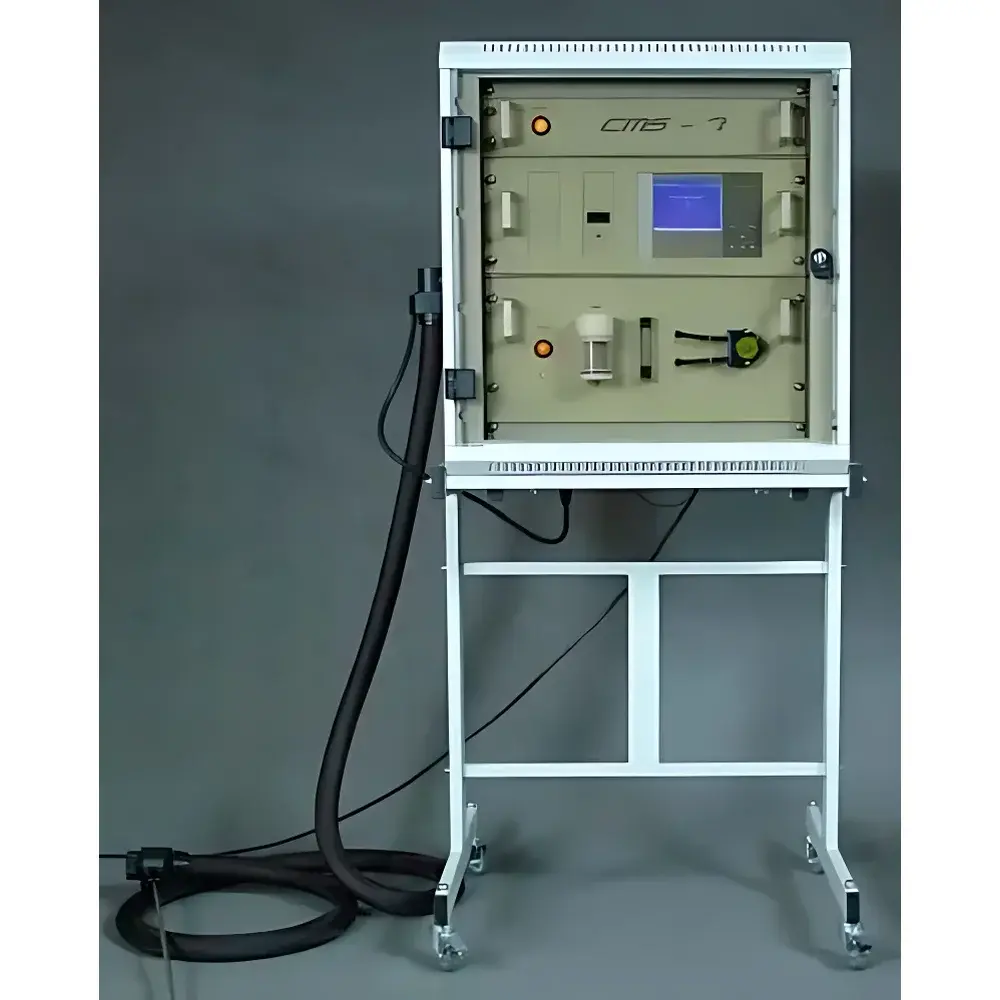
Madur CMS-7 Fixed (Online) Flue Gas Analyzer
| Brand | Madur |
|---|---|
| Origin | Austria |
| Model | CMS-7 |
| Instrument Type | Continuous Emission Monitoring System (CEMS) |
| Accuracy | ±5% of reading |
| Repeatability | ≤2% |
| Response Time (T90) | 45 s |
| Stability | ≤5% drift over 1 h |
| Gas Detection Principle | NDIR (CO₂, CH₄, CO), Electrochemical (CO, NO, NO₂, SO₂, H₂S, H₂), Paramagnetic/Zirconia (O₂) |
| Temperature Range (Operating) | 10–40 °C |
| Dimensions (L×H×W) | 600 × 635 × 518 mm |
| Weight (excl. probe) | 48 kg |
| Display | 320×240 pixel backlit LCD |
| Data Storage | 256 MB MMC card |
| Analog Outputs | 8 channels, 0–10 V / 0/4–20 mA |
| Communication | RS232C |
| Power Supply | 230 VAC, 50–60 Hz |
| Sample Flow Rate | 90 L/h (adjustable diaphragm pump) |
| Condensate Handling | Peltier-cooled condensate separator with peristaltic pump |
| Heated Sampling Line | 3 m, integrated 20 µm filter |
| Probe | Heated gas probe (standard 300 mm, custom lengths available) |
| Pressure Measurement | Differential and absolute pressure sensors (±25 hPa, 800–1200 hPa), resolution 0.1–1 Pa (configurable) |
| Flow Velocity | Pitot tube-based, 1–30 m/s |
Overview
The Madur CMS-7 Fixed (Online) Flue Gas Analyzer is a CE-marked, industrial-grade Continuous Emission Monitoring System (CEMS) engineered for long-term, unattended operation in demanding combustion environments. Designed and manufactured in Austria, the CMS-7 implements multi-physical measurement principles—including non-dispersive infrared (NDIR) spectroscopy for CO₂, CH₄, and CO; electrochemical sensing for trace toxic gases (NO, NO₂, SO₂, H₂S, H₂); and paramagnetic or zirconia-based detection for O₂—to deliver simultaneous, real-time quantification of up to 11 gas species. Its architecture complies with EN 15267-3 (performance certification of CEMS), EN 14181 (quality assurance requirements), and supports alignment with EPA Method 3A, ISO 12039, and DIN 33961 standards for flue gas analysis. The system integrates a Peltier-based gas conditioning unit with active condensate removal, heated sampling lines (up to 180 °C), and temperature-compensated differential pressure transducers—ensuring representative, dry-basis measurements under variable stack conditions. All critical components—including the gas processor, power supply, and analyzer module—are housed in a robust, lockable IP54-rated steel enclosure suitable for wall-mounting or bench installation.
Key Features
- Modular three-board design: independent power supply, Peltier gas processor, and analytical core for serviceability and thermal isolation
- Heated sampling train: 3-meter heated capillary line with integrated 20 µm particulate filter and 300 mm heated probe (custom lengths available)
- Multi-sensor flexibility: up to 3 NDIR channels + 1 O₂ sensor + up to 8 electrochemical sensors—configurable per application (e.g., biogas safety monitoring or waste incineration compliance)
- Comprehensive physical parameter acquisition: flue gas temperature (−20 to 2000 °C), ambient temperature (−20 to 100 °C), differential/absolute pressure (±25 hPa / 800–1200 hPa), flow velocity (1–30 m/s via Pitot tube), and atmospheric pressure
- Onboard combustion diagnostics: real-time calculation of λ (excess air ratio), η (combustion efficiency), qA (heat loss), TI (toxicity index CO/CO₂), and stoichiometric parameters using 22 preloaded fuel tables (DIN/OENORM compliant) and user-definable fuel profiles
- Robust data handling: 256 MB internal MMC storage, configurable averaging intervals (2–180 s), graphical trend display, and timestamped event logging with audit trail capability
Sample Compatibility & Compliance
The CMS-7 is validated for continuous monitoring of wet, hot, and particulate-laden flue gases from diverse sources including municipal solid waste incinerators, biogas upgrading plants, greenhouse heating systems, industrial boilers, and cement kilns. Its heated sampling path (120–180 °C) prevents acid condensation and preserves sample integrity for SO₂ and NOₓ measurement. The Peltier cooler maintains dew point < 2 °C prior to sensor inlet, minimizing water vapor interference without chemical drying agents. All gas sensors are factory-calibrated against NIST-traceable standards and support in-situ O₂/CO₂ span calibration during operation. The system meets EU Directive 2010/75/EU (IED) requirements for CEMS performance, and its software architecture supports 21 CFR Part 11-compliant electronic records when used with optional PC software and audit-log-enabled configurations. It is suitable for GLP/GMP environments where traceability, calibration history, and change control are mandated.
Software & Data Management
The CMS-7 includes embedded firmware with automatic start-up self-check, cross-sensitivity compensation algorithms, and temperature-drift correction for all sensors. Its intuitive menu-driven interface supports full parameter programming—including alarm thresholds, output scaling, averaging windows, and fuel selection—via the front-panel keypad and LCD. Data export is enabled via RS232C to host PCs running Madur’s proprietary CMS-PC software, which provides live telemetry, historical trend analysis, report generation (PDF/CSV), and remote configuration. The software maintains full calibration logs, sensor lifetime tracking, and diagnostic event histories. Eight analog voltage (0–10 V) and current (0/4–20 mA) outputs allow direct integration into DCS/SCADA systems for regulatory reporting or process control loops. Optional OPC UA or Modbus RTU gateways can be deployed for Industry 4.0 interoperability.
Applications
- Regulatory compliance monitoring at waste-to-energy facilities per EU IED Annex VIII and local permitting requirements
- Real-time combustion optimization in biomass and natural gas-fired thermal systems to minimize NOₓ and maximize η
- Safety-critical CH₄ (0–5 %v/v) and CO₂ (0–2000 ppm) monitoring in anaerobic digestion and biogas upgrading units
- Process control feedback for lime kilns, glass furnaces, and ceramic ovens requiring precise O₂ and CO balance
- Stack testing and periodic verification in accordance with EN 15267-3 QAL1/QAL2 protocols
- Research and development of low-emission burner technologies, supported by high-resolution time-series data and derived combustion indices
FAQ
What certifications does the CMS-7 hold for use in regulated emission monitoring?
The CMS-7 is CE-marked and designed to meet EN 15267-3 (QAL1 certification framework), EN 14181 (ASTM D6522 equivalent for QA/QC), and supports compliance with EPA Performance Specification 3 (PS-3) and ISO 12039 for stationary source emissions. Factory calibration certificates are traceable to national metrology institutes.
Can the CMS-7 measure both high-concentration CO₂ (e.g., in biogas) and trace-level NO₂ simultaneously?
Yes. The system uses dedicated NDIR channels for CO₂ (0–25 %v/v, 0.01 % resolution) and electrochemical sensors for NO₂ (0–1000 ppm, 1 ppm resolution), with independent signal conditioning and temperature compensation to ensure accuracy across orders-of-magnitude concentration differences.
Is remote diagnostics and firmware updates supported?
Remote access is enabled via RS232C-connected PC or optional Ethernet gateway. Firmware updates require authenticated .hex files and follow a dual-stage verification protocol to preserve measurement integrity and prevent unauthorized modification.
How is zero and span calibration performed in field operation?
Zero calibration uses certified nitrogen or synthetic air; span calibration employs certified gas mixtures traceable to ISO 6141. Both can be executed manually or scheduled automatically. The system logs all calibration events with operator ID, gas lot number, and deviation values.
Does the CMS-7 support integration with existing plant SCADA systems?
Yes. Eight isolated 0/4–20 mA and 0–10 V analog outputs provide direct connection to PLCs and DCS. Optional Modbus RTU or OPC UA communication modules enable digital integration with modern automation platforms while preserving data fidelity and timestamp synchronization.
Related Products







