
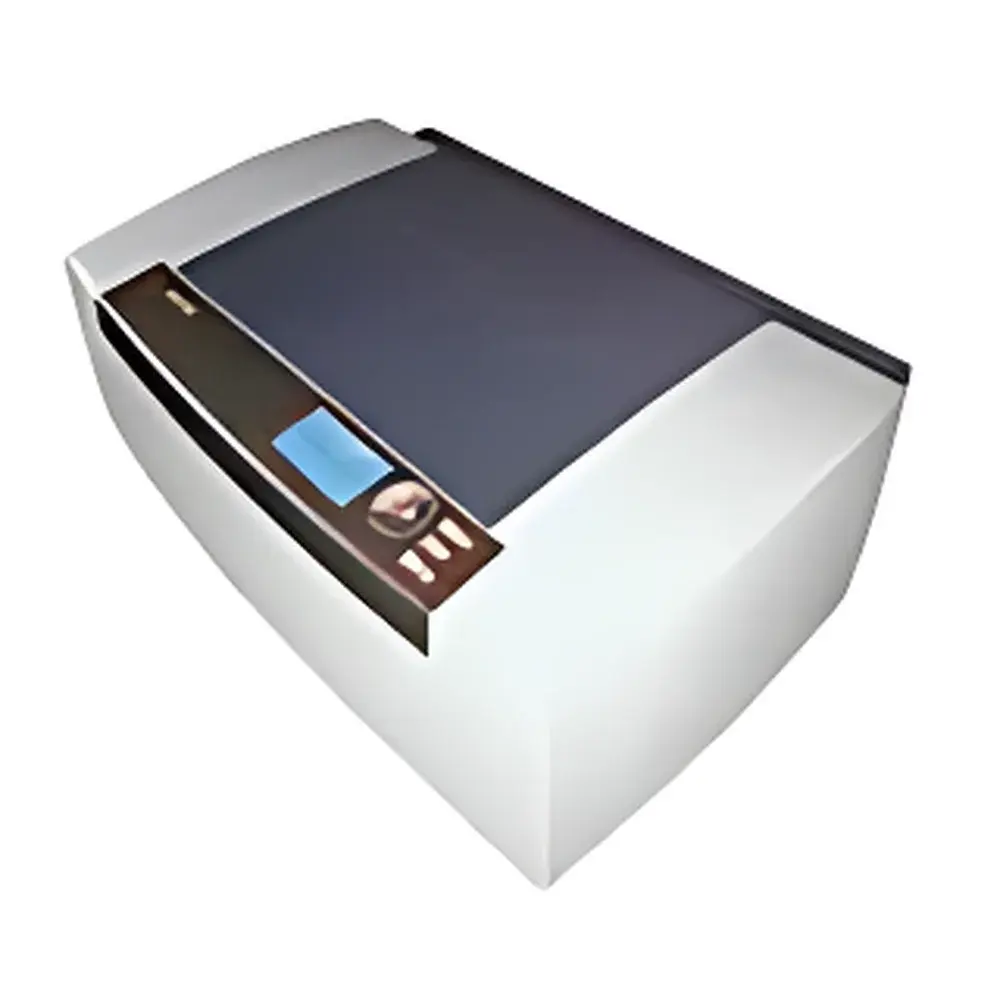
ET1200 Infrared Spectrophotometric Oil Analyzer
| Origin | Beijing, China |
|---|---|
| Manufacturer Type | Authorized Distributor |
| Origin Category | Domestic (China) |
| Model | ET1200 |
| Price Range | USD 1,400–7,200 |
| Instrument Type | Benchtop Laboratory Analyzer |
| Measurement Principle | Infrared Absorption Spectrophotometry (Triple-Wavelength IR at 3030 cm⁻¹, 2960 cm⁻¹, 2930 cm⁻¹) |
| Measurement Range | 0–1000 mg/L (as oil in water) |
| Detection Limit | 0.2 mg/L (in C₂Cl₄ extract) |
| Accuracy | ±0.4 mg/L (C < 10 mg/L) |
| Repeatability | RSD < 3% (typical) |
| Resolution | 0.2 mg/L (in tetrachloroethylene matrix) |
| Wavenumber Range | 3400–2400 cm⁻¹ |
| Wavenumber Accuracy | ±2 cm⁻¹ |
| Measurement Cycle Time | ≤25 s per sample |
| Operating Temperature | 5–35 °C |
| Power Supply | 220 V ±10%, 50 Hz |
| Dimensions | 500 × 380 × 220 mm |
| Weight | 15 kg |
| Data Interface | RS-232 serial port |
| Compliance | GB/T 16488–1996 (China National Standard for Petroleum & Animal/Vegetable Oil in Water) |
Overview
The ET1200 Infrared Spectrophotometric Oil Analyzer is a dedicated benchtop instrument engineered for precise quantification of total petroleum hydrocarbons (TPH), animal and vegetable oils, and airborne cooking oil aerosols (i.e.,油烟) in environmental and industrial matrices. It operates on the principle of infrared absorption spectrophotometry, specifically targeting the asymmetric and symmetric C–H stretching vibrations of aliphatic hydrocarbons at three characteristic wavenumbers—3030 cm⁻¹ (aromatic C–H), 2960 cm⁻¹ (CH₃ asymmetric stretch), and 2930 cm⁻¹ (CH₂ asymmetric stretch)—as defined in GB/T 16488–1996. This triple-wavelength algorithm enables selective, interference-resistant measurement of oil content without chromatographic separation. The system employs a high-stability optical path with temperature-compensated detection, minimizing drift across ambient laboratory conditions (5–35 °C). Unlike scanning FTIR systems, the ET1200 utilizes a precision step-motor-driven grating monochromator, eliminating belt-driven mechanisms and reducing mechanical hysteresis to ensure long-term spectral reproducibility.
Key Features
- Standalone operation capability: Full measurement workflow—including zero calibration, sample analysis, and result display—executed directly on the integrated LCD interface without external PC dependency.
- Automated multi-measurement protocol: Each sample undergoes ≥3 consecutive absorbance readings; mean concentration is calculated and displayed with standard deviation, supporting GLP-compliant data integrity.
- Zero-point memory function: Once calibrated, the instrument retains baseline offset until power-off—reducing operator exposure to extraction solvents (e.g., tetrachloroethylene or low-toxicity alternatives) and improving throughput.
- Temperature-compensated photometric engine: Real-time thermal correction applied to detector response and optical path length ensures consistent accuracy across seasonal lab temperature fluctuations.
- High-resolution digital readout: Concentration (mg/L), absorbance (A), and transmittance (%T) displayed simultaneously; resolution of 0.2 mg/L maintained across full 0–1000 mg/L dynamic range.
- Modular connectivity: RS-232 serial interface supports bidirectional communication with LIMS or custom data acquisition software for audit-trail generation and 21 CFR Part 11–compliant electronic records.
Sample Compatibility & Compliance
The ET1200 is validated for aqueous matrices including surface water, groundwater, domestic wastewater, and industrial effluents—as well as air filter extracts (for kitchen hood monitoring). Extraction follows standard liquid–liquid protocols using tetrachloroethylene (C₂Cl₄) or EPA-approved non-halogenated substitutes. Instrument performance conforms to GB/T 16488–1996, with traceability to national reference standards for mineral oil and triolein. While not certified to ISO 8217 or ASTM D7097, its spectral methodology aligns with the foundational principles of ISO 9377-2 (petroleum hydrocarbons in water) and EN ISO 9377-1 (extraction procedures). All units undergo 100% functional verification per GB/T 2828.1 (AQL Level II sampling plan), with incoming optical components subjected to incoming inspection under ISO 9001:2015-controlled procedures.
Software & Data Management
When paired with optional PC software, the ET1200 supports full spectral scanning (3400–2400 cm⁻¹), quantitative calibration curve generation (linear/nonlinear), peak identification, and organic functional group analysis—extending utility beyond oil quantification to general IR spectroscopy applications in academic and industrial R&D labs. Software logs include timestamped measurements, operator ID fields, calibration history, and raw absorbance values at all three wavelengths. Audit trails are exportable in CSV/Excel format; metadata fields support integration into validated LIMS environments requiring ALCOA+ (Attributable, Legible, Contemporaneous, Original, Accurate, Complete, Consistent, Enduring, Available) compliance.
Applications
- Regulatory monitoring by municipal and provincial environmental protection bureaus for discharge compliance (e.g., DB11/307–2013, GB 8978–1996).
- Process control in petrochemical refineries, metalworking facilities, and food processing plants where emulsified oil contamination affects wastewater treatment efficiency.
- Drinking water safety assessment in source-water intake and distribution systems following GB 5749–2022.
- Occupational hygiene evaluation of kitchen exhaust systems in commercial catering establishments per HJ 644–2013.
- Teaching laboratories for undergraduate instruction in instrumental analysis, environmental chemistry, and spectroscopic quantitation principles.
FAQ
Does the ET1200 comply with U.S. EPA Method 1664 or ISO 9377?
The ET1200 implements the spectral logic of GB/T 16488–1996 and is not formally validated to EPA 1664 (n-hexane extraction + gravimetric/IR) or ISO 9377 series. However, its triple-wavelength IR approach demonstrates strong correlation (r² > 0.995) with EPA 1664 results when using C₂Cl₄ extraction under controlled interlaboratory studies.
Can non-halogenated solvents be used for extraction?
Yes—method validation data confirm equivalent sensitivity and linearity using low-toxicity alternatives such as cyclohexane or isohexane, provided extinction coefficients are re-established during calibration.
Is the instrument suitable for field deployment?
No—the ET1200 is designed exclusively for stable laboratory environments (5–35 °C, non-condensing humidity). It lacks battery power, shock isolation, or IP-rated enclosure required for mobile use.
What maintenance is required for long-term optical stability?
Annual verification of wavenumber accuracy (±2 cm⁻¹ tolerance) and detector dark-current drift is recommended. Optical surfaces require cleaning only if visible contamination is observed; solvent-resistant coatings minimize residue adhesion.
How is data integrity ensured during unattended operation?
All measurements store internal timestamps, sample IDs, and calibration parameters. When connected via RS-232, software can enforce user authentication, electronic signatures, and immutable audit logs meeting GLP/GMP documentation requirements.
Related Products







