
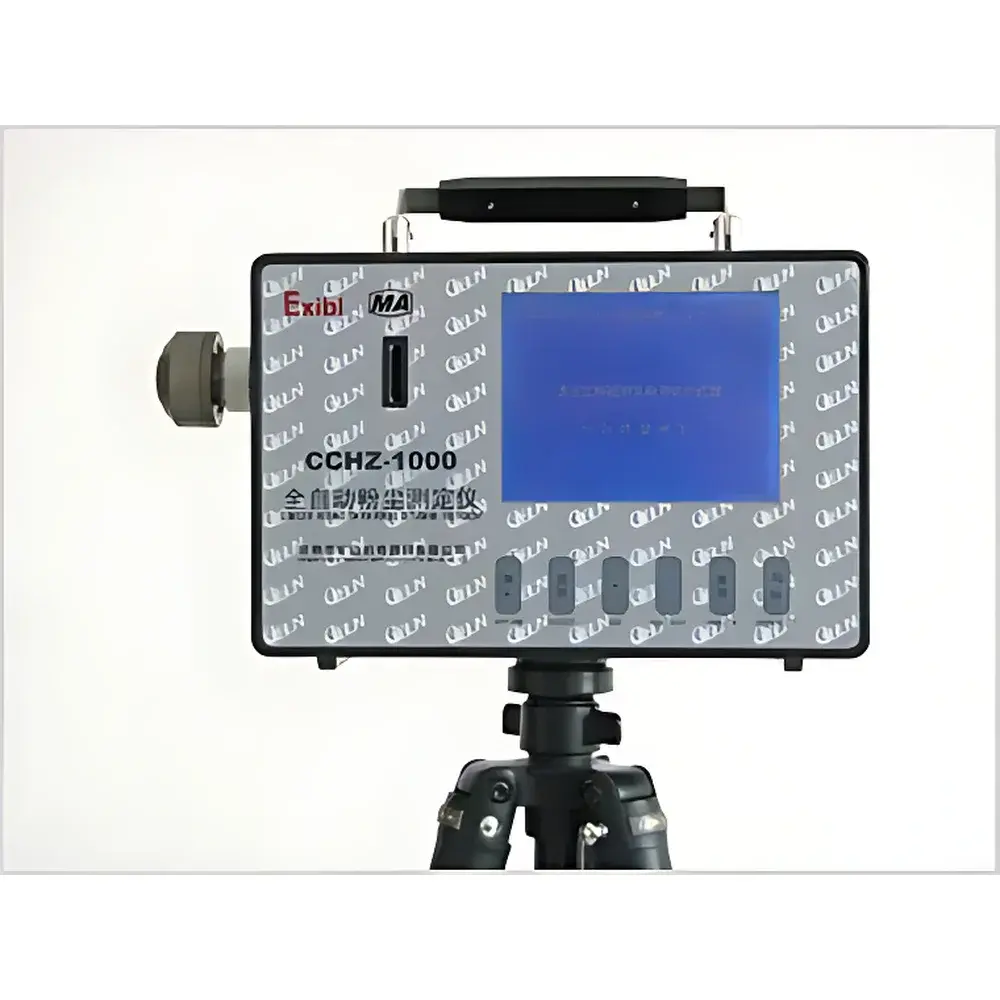
CCHZ-1000 Automatic Dust Monitor
| Origin | Beijing, China |
|---|---|
| Manufacturer Type | Authorized Distributor |
| Country of Origin | China |
| Model | CCHZ-1000 |
| Pricing | Available Upon Request |
| Dust Measurement Range | 0–1000 mg/m³ |
| Measurement Accuracy | < ±10% |
| Stability Relative Error | ±2.5% |
| Sampling Flow Rate | 2 L/min |
| Flow Rate Accuracy | < ±2.5% |
| Intrinsic Safety Rating | ibdI (150 °C) |
| Compliance | MT163–1997 |
Overview
The CCHZ-1000 Automatic Dust Monitor is a certified, intrinsically safe environmental monitoring instrument engineered for real-time, quantitative assessment of airborne particulate mass concentration in high-risk industrial environments—particularly underground coal mines and other locations with explosive gas atmospheres. It operates on the principle of light scattering (nephelometry) coupled with gravimetric calibration traceability, delivering direct-reading dust concentration values in milligrams per cubic meter (mg/m³). Designed in strict accordance with MT163–1997 (“General Technical Specifications for Direct-Reading Dust Concentration Meters”), the instrument integrates a precision-calibrated sampling train, a high-efficiency respirable dust cyclone conforming to the British Medical Research Council (BMRC) inhalability curve, and a microprocessor-controlled data acquisition system. Its robust architecture supports both time-weighted average (TWA) and short-term exposure limit (STEL) monitoring protocols, enabling compliance with occupational hygiene standards such as ISO 7708:2022 (Air quality — Particle size fraction definitions for health-related sampling) and China’s GBZ 2.1–2019 (Occupational Exposure Limits for Hazardous Agents in Workplace Air).
Key Features
- Intrinsically safe and flameproof dual-certified enclosure (ibdI, T150 °C), approved for use in Zone 0/1 hazardous areas containing methane (CH₄) and coal dust mixtures.
- Dual-mode sampling operation: programmable automatic timed cycles (1–60 min intervals) or manual trigger-based collection, supporting flexible adherence to local regulatory sampling schedules.
- Integrated BMRC-compliant respirable dust cyclone with ≥90% cut-point efficiency at 4 µm aerodynamic diameter, validated per ISO 13137:2013 (Workplace air — Requirements for pump performance).
- High-stability diaphragm sampling pump delivering nominal 2.0 L/min flow with closed-loop pressure compensation; flow accuracy maintained within ±2.5% across battery voltage decay and filter loading conditions.
- Onboard non-volatile memory storing up to 50 timestamped measurement records—including date/time stamp, concentration value, flow rate, battery status, and error flags—with UTC-synchronized clock support.
- Backlit monochrome LCD interface with Chinese-language menu navigation, real-time graphical trend display, and audible/visual low-battery and flow-failure alerts.
Sample Compatibility & Compliance
The CCHZ-1000 is validated for simultaneous measurement of total suspended particulates (TSP) and respirable dust fractions in ambient and workplace air. Its cyclone-based size-selective inlet meets internationally recognized inhalability criteria (BMRC curve), ensuring alignment with occupational exposure assessments required under OSHA 1910.1200, EU Directive 2004/37/EC (CARC), and China’s AQSIQ/MPS Joint Standard AQ 1020–2006 (Technical Specifications for Coal Mine Dust Monitoring). The device carries mandatory CCC (China Compulsory Certification) marking and complies with electromagnetic compatibility (EMC) requirements per GB/T 18268.1–2010 and safety specifications per GB 3836.1–2010 (Explosive Atmospheres – Part 1: Equipment – General Requirements).
Software & Data Management
Data export is supported via standard USB 2.0 interface (CDC class) for direct transfer to Windows-based analysis workstations. Raw measurement logs are stored in CSV format with ISO 8601 timestamps and SI-unit metadata, facilitating integration into enterprise-level EHS platforms (e.g., Sphera, Intelex, or custom LIMS). Firmware supports field-upgradable calibration coefficients and configurable alarm thresholds (e.g., 5 mg/m³ for respirable coal dust per GBZ 2.1–2019). Audit trail functionality includes operator ID tagging (via optional RFID badge reader module), change logs for calibration parameters, and tamper-evident file hashing—enabling alignment with GLP and internal QA/QC documentation requirements.
Applications
- Continuous dust exposure monitoring in underground coal mine roadways, longwall faces, and conveyor transfer points.
- Respirable crystalline silica (RCS) assessment during rock drilling, shotcreting, and abrasive blasting operations.
- Validation of local exhaust ventilation (LEV) system performance in foundries, cement plants, and biomass processing facilities.
- Regulatory compliance auditing for national occupational hygiene programs under China’s State Administration of Work Safety (SAWS) directives.
- Baseline environmental impact studies in proximity to open-pit mining or bulk material handling terminals.
FAQ
Does the CCHZ-1000 require periodic factory recalibration?
Yes—annual traceable recalibration against NIST-traceable reference aerosols (e.g., Arizona Test Dust, ISO 12103-1 A1) is recommended. Field verification using zero-air and span-gas challenges should be performed before each shift.
Can the instrument store data without an external power source?
Yes—the internal rechargeable Li-ion battery maintains memory integrity for ≥72 hours after shutdown and supports ≥8 hours of continuous sampling at 2 L/min.
Is the BMRC cyclone included as standard equipment?
Yes—the unit ships with a pre-assembled, individually tested BMRC cyclone meeting ISO 7708:2022 geometric tolerances and flow-characterized cut-point performance.
What communication protocols does the USB interface support?
The device implements CDC ACM (Abstract Control Model) serial emulation, requiring no proprietary drivers on Windows 10/11 or Linux systems; terminal emulation tools (e.g., PuTTY, Tera Term) can access live telemetry and download logs.
How is intrinsic safety verified during installation?
Installation must follow GB 3836.15–2017 (Explosive Atmospheres – Part 15: Electrical Installations Design, Selection and Erection), including barrier certification (e.g., KFD2-STC4-EX1) for signal/power wiring and documented loop resistance validation.
Related Products







