
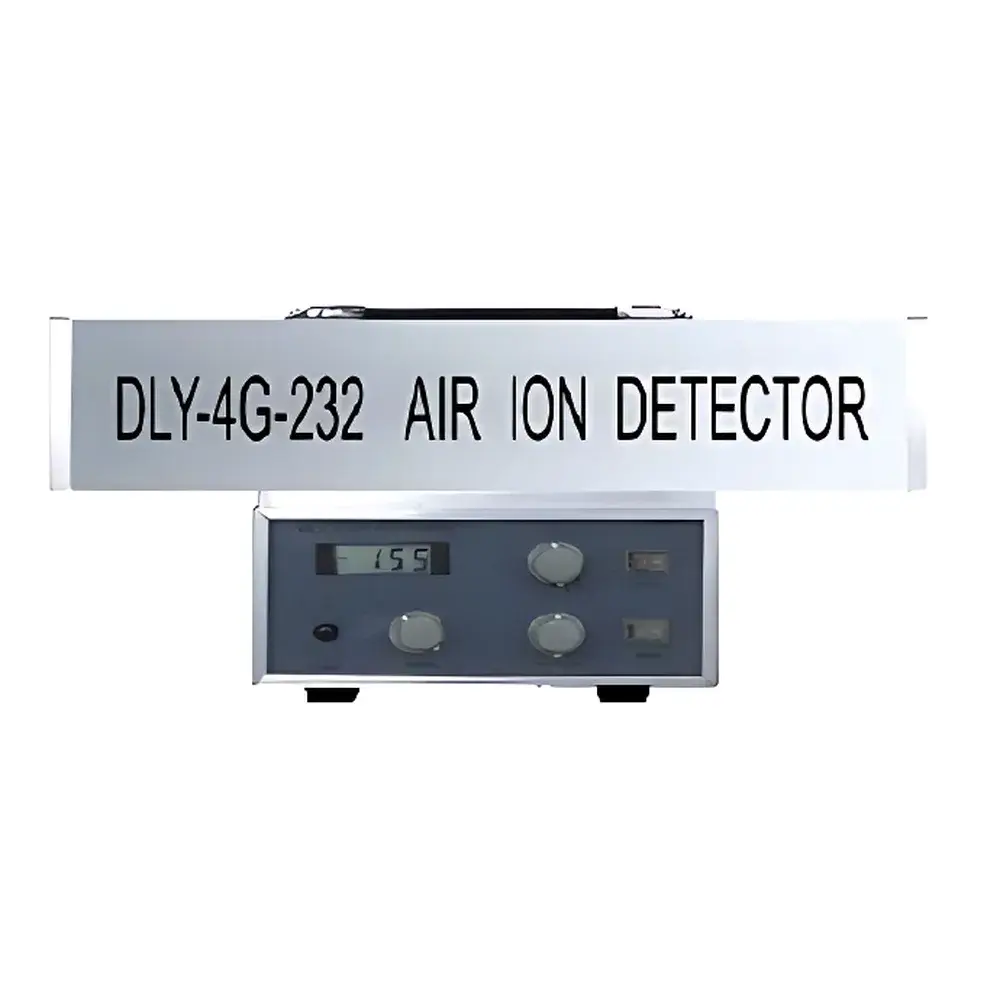
DLY-4G-232 Automatic Dehumidifying Air Negative Ion Concentration Analyzer
| Origin | Beijing, China |
|---|---|
| Manufacturer Type | Authorized Distributor |
| Origin Category | Domestic (PRC) |
| Model | DLY-4G-232 |
| Pricing | Available Upon Request |
| Ion Concentration Range | 10–1.999×10⁹ ions/cm³ |
| Resolution | 1 ion/cm³ |
| Ion Mobility Ranges | 1.0 / 0.4 / 0.15 cm²/(V·s) (3-step selectable) |
| Sampling Air Velocity | 180 cm/s |
| Response Time Constant | ≈15 s |
| Accuracy | ±10% for ion concentration and mobility |
| Interface | RS-232 serial port |
| Power Supply | DC 14.4 V or AC 220 V / 110 V (configurable) |
| Operating Environment | −0 to +40 °C, ≤99 % RH |
Overview
The DLY-4G-232 Automatic Dehumidifying Air Negative Ion Concentration Analyzer is a precision electrostatic measurement instrument engineered for high-sensitivity detection of atmospheric negative ions in ambient air and low-emission material surfaces. It operates on the principle of Gerdien tube-based aspiration condenser electrometry—where sampled air is drawn through a cylindrical collector electrode under controlled laminar flow, enabling charge integration proportional to ion concentration and mobility. Unlike conventional ion counters relying on passive diffusion or corona discharge biasing, the DLY-4G-232 employs active airflow-driven sampling at 180 cm/s, ensuring representative volumetric capture while minimizing boundary-layer interference. Its design specifically addresses two critical challenges in low-concentration ion metrology: (1) ambient background ion interference during material emission testing (e.g., textiles, functional coatings, mineral-based building materials), and (2) humidity-induced signal drift due to surface conduction on high-impedance collector insulation. The instrument’s core architecture integrates a guarded triaxial collector assembly with temperature-stabilized guard ring biasing, achieving stable input impedance >10¹⁴ Ω even under 99 % relative humidity conditions.
Key Features
- Integrated automatic dehumidification system: A thermally regulated Peltier-driven desiccant module activates upon internal humidity sensor threshold detection (≥85 % RH), restoring collector insulation integrity within ≤8 minutes without manual intervention or disassembly.
- Three-step ion mobility selection: User-selectable mobility ranges (1.0, 0.4, 0.15 cm²/(V·s)) enable discrimination between small, intermediate, and large cluster ions—critical for distinguishing natural atmospheric ions (e.g., CO₃⁻·(H₂O)ₙ) from material-generated species.
- Sub-ion-per-cm³ resolution: Digital signal processing with 24-bit ADC and real-time baseline drift compensation supports reliable quantification down to 1 ion/cm³, validated per ISO 16000-32 Annex B protocols for low-flux emission testing.
- RS-232 serial interface compliant with EIA/TIA-232-F standards: Enables direct integration into automated environmental monitoring networks, GLP-compliant data logging systems, and third-party SCADA platforms.
- Robust mechanical design: IP54-rated enclosure with corrosion-resistant aluminum alloy housing and anodized collector electrodes ensures long-term stability in field-deployed or laboratory benchtop configurations.
Sample Compatibility & Compliance
The DLY-4G-232 is validated for use in both open-air ambient monitoring and controlled material emission testing per ASTM D7702–19 (Standard Practice for Measuring Negative Ion Emission from Solid Surfaces). Its modular test chamber accessory kit (optional) allows standardized sample placement at fixed distance (100 mm) and airflow orientation (perpendicular incidence), eliminating convective artifacts common in static plate assays. The instrument meets electromagnetic compatibility requirements per IEC 61326-1:2020 Class B for laboratory environments and conforms to safety standards IEC 61010-1:2010 for measurement equipment. All firmware and calibration procedures are traceable to NIM (National Institute of Metrology, China) reference ion sources; full audit logs—including humidity-triggered dehumidification events—are timestamped and exportable for FDA 21 CFR Part 11–aligned quality assurance workflows.
Software & Data Management
The analyzer supports native ASCII protocol over RS-232, permitting seamless integration with custom Python, LabVIEW, or MATLAB acquisition scripts. Optional PC software (DLY-Control Suite v3.2) provides real-time spectral visualization, time-series trending with configurable averaging windows (1–300 s), and automated report generation compliant with ISO/IEC 17025 documentation requirements. Data files are stored in CSV format with embedded metadata headers (timestamp, mobility setting, RH%, temperature, operator ID), enabling direct ingestion into LIMS or statistical analysis pipelines. Firmware updates preserve all user calibration coefficients and historical log integrity, satisfying change control requirements under ISO 9001:2015 Clause 8.5.1.
Applications
- Ambient air quality assessment in urban parks, forest ecosystems, and indoor wellness environments where sub-100 ions/cm³ variations correlate with biogenic VOC profiles and aerosol aging states.
- Functional material certification: Quantitative evaluation of negative ion emission from tourmaline-infused fabrics, photocatalytic wall coatings, and ceramic tiles—supporting claims under GB/T 35607–2017 (Chinese eco-label standard).
- Research-grade validation of ion generator performance under variable humidity loads, including accelerated aging tests simulating tropical or monsoon climatic exposure.
- Academic studies on ion–aerosol coagulation kinetics, requiring stable baseline measurements over extended durations (>72 h continuous operation).
FAQ
How does the automatic dehumidification system prevent measurement drift during high-humidity operation?
The integrated Peltier-cooled desiccant module lowers local dew point inside the collector chamber by up to 22 °C below ambient, condensing moisture before it reaches the insulated electrode surfaces—preserving >10¹³ Ω inter-electrode resistance per IEC 60068-2-30 humidity cycling validation.
Can the DLY-4G-232 distinguish between positive and negative ions?
No—it is configured exclusively for negative ion detection via reverse-polarity collector biasing; positive ion measurement requires hardware reconfiguration and is not supported in this model.
Is calibration traceable to international standards?
Yes—factory calibration uses NIM-certified radioactive ²¹⁰Po reference sources; users receive a certificate of calibration with uncertainty budget (k=2) and NIST-traceable chain-of-custody documentation.
What maintenance intervals are recommended for sustained accuracy?
Collector electrode cleaning every 6 months using isopropyl alcohol and lint-free swabs; annual verification of airflow velocity (±2 %) and mobility range linearity using certified calibration kits (available separately).







