Micronics PFSE Portable Transit-Time Ultrasonic Flowmeter
| Origin | UK |
|---|---|
| Manufacturer Type | Distributor |
| Origin Category | Imported |
| Model | PFSE |
| Pricing | Upon Request |
Overview
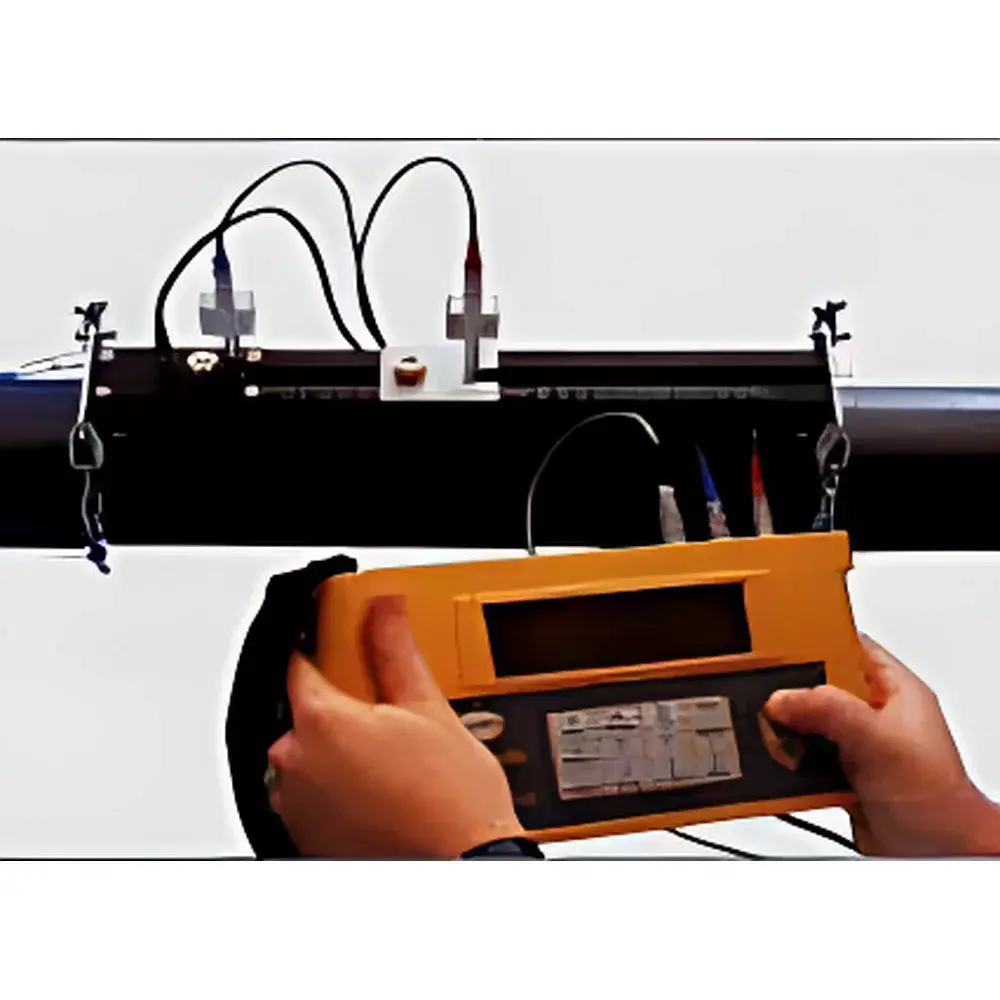
The Micronics PFSE Portable Transit-Time Ultrasonic Flowmeter is a field-deployable, non-intrusive flow measurement system engineered for high-reliability gas and liquid flow quantification in industrial pipelines. Utilizing the transit-time differential principle—where ultrasonic pulses are transmitted upstream and downstream across the pipe cross-section—the PFSE calculates volumetric flow velocity by precisely measuring the time-of-flight difference between co-current and counter-current acoustic signals. This method ensures minimal pressure drop, zero moving parts, and immunity to fluid conductivity, density, or viscosity variations. Designed for rapid deployment in utility, petrochemical, water treatment, and HVAC applications, the PFSE delivers calibrated accuracy under turbulent flow conditions (Re > 4,000) and supports bidirectional flow detection with real-time polarity indication. Its compact, handheld architecture integrates signal processing, data logging, and human-machine interface into a single ruggedized unit compliant with IP65 environmental protection standards.
Key Features
- Transit-time ultrasonic measurement principle with ±1–3% of reading accuracy (Re ≥ 4,000), repeatable to ±0.5% when sensor mounting remains unchanged
- Wide pipe diameter coverage: 50–1000 mm, compatible with carbon steel, stainless steel, copper, UPVC, PVDF, cement-lined, epoxy-coated, rubber-lined, and glass-lined pipes
- Flow velocity range: 0.12–12.39 m/s; configurable flow range from 0.5–12 m/s depending on pipe geometry and medium
- Integrated 16-key membrane keypad and backlit graphical LCD display supporting simultaneous visualization of instantaneous velocity, cumulative volume, timestamp, battery level, and signal strength
- Onboard diagnostics with contextual error codes and real-time signal quality feedback
- Internal rechargeable NiMH battery providing up to 10 hours of continuous operation; full recharge in 15 hours
- 0/4–20 mA analog output (750 Ω load, user-defined span) for integration with SCADA systems or external data loggers
- RS232-C serial interface compliant with standard handshake protocols for real-time data streaming or batch download
Sample Compatibility & Compliance
The PFSE operates across gaseous and liquid media that transmit ultrasound effectively—including compressed air, natural gas, steam (with optional high-temp sensors rated to 200 °C), water, glycol solutions, and hydrocarbons. It requires no process interruption during installation and accommodates both Z-path (diagonal) and V-path (reflector) transducer configurations to suit site constraints. The instrument meets IP65 ingress protection for dust and low-pressure water jets, while its ABS housing carries IP55 rating per unit enclosure. Operating temperature spans 0–50 °C (storage: −10–60 °C); sensor operating range extends from −20 to +125 °C (optional +200 °C variant available). While not certified for SIL or ATEX environments, the PFSE conforms to general-purpose industrial electromagnetic compatibility (EMC) expectations per IEC 61326-1 and supports traceable calibration practices aligned with ISO/IEC 17025 documentation frameworks.
Software & Data Management
Data acquisition and archival are managed via an embedded 100 KB memory capable of storing up to 50,000 discrete readings. Users may configure automatic logging intervals from 5 seconds to 1 hour and partition memory into up to 20 named blocks—enabling segmented campaign-based recording (e.g., shift-wise or zone-specific datasets). Logged parameters include volumetric flow (m³, L, imperial/US gallons), velocity (m/s, in/s), cumulative total (12-digit with forward/reverse flag), timestamp, and diagnostic flags. All records support export via RS232 to Windows-compatible analysis tools or Micronics’ proprietary software suite. Graphical trend plots and tabular reports can be rendered directly on-device or post-processed externally. Audit-ready data exports retain full metadata (start/stop timestamps, configuration version, sensor ID), facilitating GLP-aligned recordkeeping where electronic data integrity is required.
Applications
- Temporary flow verification during commissioning, maintenance shutdowns, or leak detection surveys
- Energy audits and submetering in district heating/cooling networks and compressed air distribution systems
- Performance validation of pumps, valves, and heat exchangers without process isolation
- Regulatory compliance monitoring for emissions reporting (e.g., stack gas flow in combustion control loops)
- Educational laboratory use for fluid mechanics instruction and Reynolds number correlation studies
- Field verification of permanent meter installations prior to regulatory acceptance testing
FAQ
What pipe materials are supported?
Carbon steel, stainless steel, copper, UPVC, PVDF, cement-lined, epoxy-coated, rubber-lined, and glass-lined pipes—all acoustically coupled ultrasonic transmission paths are supported.
Does the PFSE require wet calibration or fluid property input?
No. The transit-time method is inherently independent of fluid density, viscosity, or electrical conductivity; only pipe geometry and sound speed (predefined or measured) are required for setup.
Can the device operate continuously from AC power?
Yes—via universal 100–240 VAC input (±10%, 50/60 Hz) or optional 12/24 VDC transformer; internal battery remains charged during AC operation.
Is firmware upgrade capability available?
Firmware updates are performed via RS232 using Micronics-provided utilities; version history and changelogs are maintained in technical documentation.
How is measurement uncertainty validated in situ?
Users may perform zero-flow verification (no signal differential), compare dual-sensor path consistency, and cross-check against reference meters using NIST-traceable portable calibrators.