
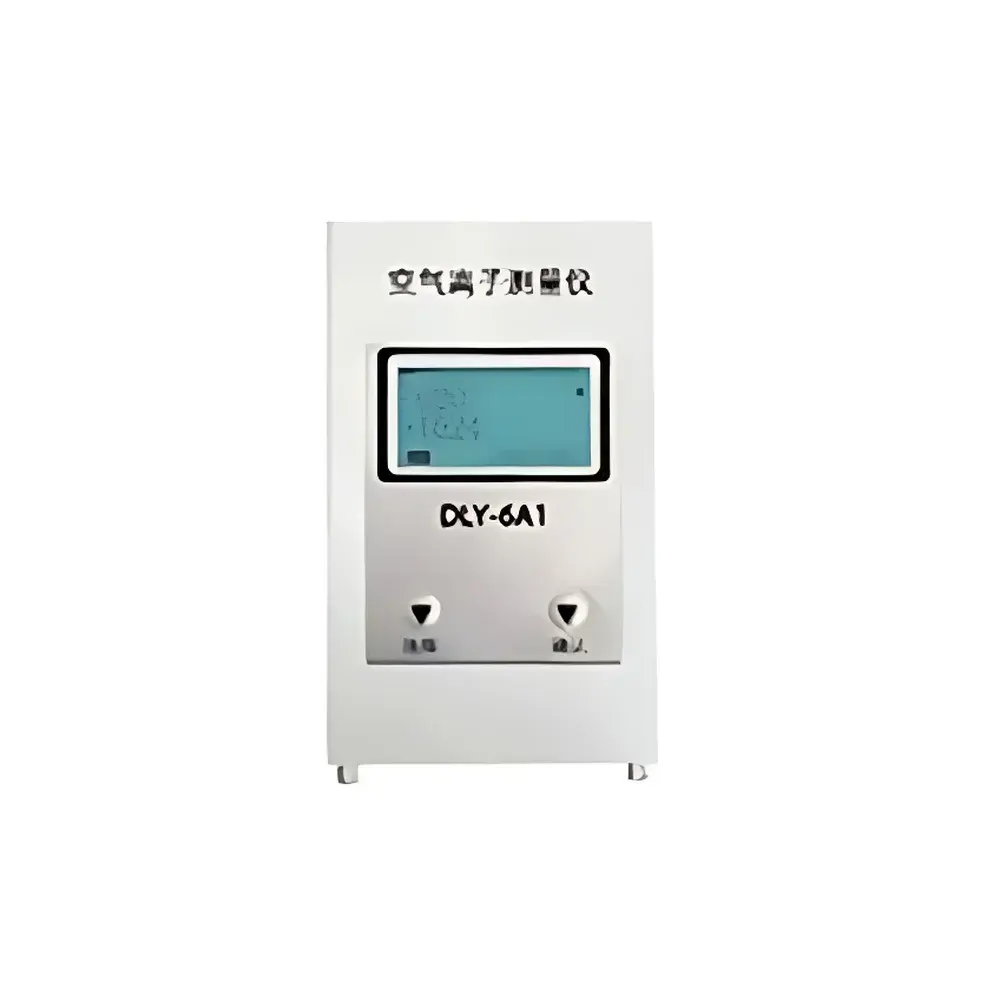
DLY-6A1 Smart Air Ion Counter
| Origin | Beijing, China |
|---|---|
| Manufacturer Type | Distributor |
| Origin Category | Domestic (China) |
| Model | DLY-6A1 |
| Price Range | USD 700–1,400 |
| Measurement Range | 1–1.5×10⁶ ions/cm³ |
| Polarity Detection | Positive and/or Negative Ions |
| Resolution | 2 ions/cm³ |
| Measurement Cycle | 60 seconds |
| Selectable Modes | Negative Ion Only / Positive Ion Only / Dual Polarity (Simultaneous ±) |
| Ion Mobility | 0.4 cm²/(V·s) |
| Dimensions | 15 × 9 × 4.5 cm |
Overview
The DLY-6A1 Smart Air Ion Counter is a compact, field-deployable instrument engineered for quantitative measurement of small air ions—specifically unipolar or bipolar gaseous ions in ambient environments. It operates on the principle of Gerdien-tube aspiration electrometry: ambient air is drawn through a cylindrical collector electrode at a controlled flow rate; ions of defined polarity are attracted to and neutralized on the electrode surface under a fixed bias voltage, generating a current proportional to ion concentration. This current is amplified and converted to ion density (ions per cubic centimeter) using calibrated gain factors and airflow parameters. Designed for environmental health assessments, indoor air quality (IAQ) studies, forest-atmosphere interaction monitoring, and therapeutic environment validation (e.g., spa, wellness center, or hospital recovery zones), the DLY-6A1 delivers trace-level sensitivity with real-time digital output and built-in auto-ranging functionality.
Key Features
- Automatic full-range ion concentration measurement from 1 to 1.5 × 10⁶ ions/cm³ without manual range switching
- Dual-polarity detection capability: independent or simultaneous quantification of positive and negative air ions
- High-resolution readout of 2 ions/cm³, enabling detection of subtle spatial or temporal variations in ion distribution
- Standardized ion mobility setting of 0.4 cm²/(V·s), aligned with widely accepted atmospheric ion classification protocols for small ions (diameter < 1.6 nm)
- Fixed 60-second integration cycle ensures statistical stability while maintaining operational responsiveness for routine surveys
- Compact ergonomic housing (15 × 9 × 4.5 cm) with integrated sampling inlet, battery-powered operation, and LCD display for on-site use
- Three selectable operational modes: Negative Ion Mode, Positive Ion Mode, and Dual-Polarity Mode — configurable via front-panel interface
Sample Compatibility & Compliance
The DLY-6A1 is optimized for ambient air sampling under standard temperature and pressure (STP) conditions (25 °C, 101.3 kPa). It is not intended for use in high-humidity (>85% RH), high-particulate, or chemically aggressive atmospheres (e.g., industrial exhaust streams) without pre-filtration or environmental conditioning. While the device does not carry CE, UKCA, or FCC certification, its electrical design adheres to IEC 61000-4 immunity standards for portable instrumentation used in non-industrial settings. Data acquisition complies with basic GLP documentation requirements when paired with external logging software; however, it does not implement FDA 21 CFR Part 11-compliant audit trails or electronic signature functions. Users deploying the instrument for regulatory reporting should validate its performance against reference-grade ion counters per ISO 16000-27 (Indoor air — Part 27: Determination of air ion concentrations) or national metrological guidelines.
Software & Data Management
The DLY-6A1 operates as a standalone unit with no embedded Bluetooth, USB, or Wi-Fi connectivity. All measurements are displayed in real time on the integrated monochrome LCD and retained in volatile memory for immediate review. For data export, users must manually record values or integrate the device into third-party acquisition systems via analog voltage output (0–5 V DC, scalable to full measurement range) — requiring external analog-to-digital conversion and timestamping. No proprietary PC software is provided; however, the analog output signal is compatible with common DAQ platforms (e.g., LabVIEW, MATLAB Data Acquisition Toolbox, or Arduino-based loggers) when configured with appropriate scaling and calibration coefficients. Calibration verification is recommended annually using certified radioactive ion sources (e.g., ²⁴¹Am) or electrostatic ion generators traceable to national standards.
Applications
- Environmental research: mapping ion gradients near waterfalls, forests, mountains, and coastal zones to correlate with natural ionization mechanisms
- Indoor air quality audits: evaluating ion depletion caused by HVAC filtration, synthetic materials, or electronic equipment emissions
- Wellness facility validation: verifying negative ion generation efficacy of commercial ionizers, salt rooms, or hydrotherapy environments
- Educational laboratories: demonstrating atmospheric electricity fundamentals, ion mobility physics, and aerosol charging dynamics
- Occupational hygiene screening: preliminary assessment of ion balance in office buildings, cleanrooms, or printing facilities where static-sensitive processes occur
FAQ
What ion size range does the DLY-6A1 measure?
The instrument detects small air ions—typically molecular clusters with diameters below ~1.6 nm—defined by the standardized mobility value of 0.4 cm²/(V·s). It does not resolve intermediate or large ions (e.g., charged aerosols > 10 nm).
Can the DLY-6A1 be calibrated in-house?
Yes, but only with traceable ion sources (e.g., ²⁴¹Am alpha-emitting foils) and controlled flow/temperature chambers. Field calibration requires adherence to ISO/IEC 17025 procedures if used for accredited reporting.
Is temperature or humidity compensation available?
No. The DLY-6A1 provides raw ion concentration values assuming STP conditions. Users must apply empirical correction factors if operating outside 15–30 °C or 30–70% RH.
Does the device meet any international air quality standards?
It supports measurement methods referenced in ISO 16000-27 and Chinese national standard HJ 972–2018 (Technical Specification for Monitoring of Air Negative Ions), but is not certified for compliance testing under regulatory frameworks such as EU Indoor Air Quality Directive or US EPA IAQ guidelines.
What power source does the DLY-6A1 use?
It operates on four AA alkaline or rechargeable Ni-MH batteries (not included), providing up to 8 hours of continuous operation under typical sampling conditions.







