
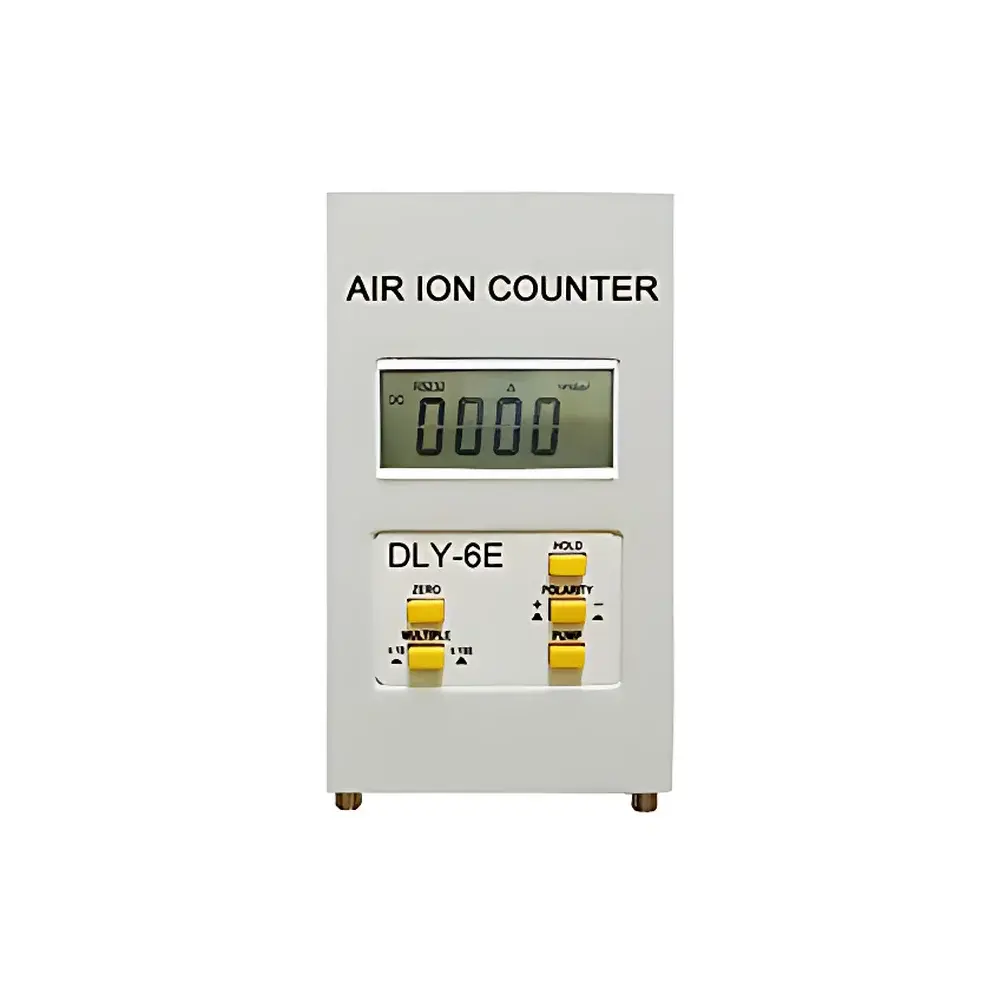
DLY-6E Air Ion Counter
| Origin | Beijing, China |
|---|---|
| Manufacturer Type | Authorized Distributor |
| Origin Category | Domestic (PRC) |
| Model | DLY-6E |
| Price Range | USD 1–700 (FOB) |
| Detection Range | 10–399,900 ions/cm³ |
| Minimum Resolution | 10 ions/cm³ |
| Ion Mobility | 0.4 cm²/(V·s) |
| Power Supply | Rechargeable sealed lead-acid battery (220 V AC or 12 V DC automotive charging compatible) |
| Housing | Anodized aluminum alloy chassis |
| Display | Backlit LCD showing real-time ion concentration (ions/cm³) |
| Calibration Standard | Traceable to GB/T 18809–2002 and aligned with ISO 8503-2 (Air Ion Measurement — Parallel-Plate Collector Method) |
| Operating Environment | −10 °C to +50 °C, ≤90% RH (non-condensing) |
Overview
The DLY-6E Air Ion Counter is a portable, field-deployable instrument engineered for quantitative measurement of unipolar and bipolar air ions—both positive and negative—in ambient air and controlled emission environments. It operates on the well-established parallel-plate collector principle, originally refined by air ion physicist Dr. Beckett and standardized in the Wesix methodology. The core sensing element features a proprietary gold-plated ion collector electrode, which enhances charge transfer efficiency and minimizes surface recombination losses—critical for maintaining linearity and reproducibility across low- to mid-range ion concentrations (10–399,900 ions/cm³). Unlike corona-based or Gerdien-tube instruments, the DLY-6E employs a constant-voltage, drift-field configuration optimized for mobility-selective collection at 0.4 cm²/(V·s), enabling reliable discrimination of small, medium, and large ions without mechanical filtration or voltage ramping. Its design conforms to the technical requirements specified in GB/T 18809–2002, “General Technical Specifications for Air Ion Measuring Instruments,” which remains the de facto national reference standard for ion counter validation in China and is functionally harmonized with ISO 8503-2 for collector geometry, airflow control, and calibration traceability.
Key Features
- Gold-coated parallel-plate ion collector with high charge-collection efficiency (>92% theoretical yield at 0.4 cm²/(V·s)) and long-term electrochemical stability
- Real-time digital readout on backlit LCD: direct display of ion density in units of ions per cubic centimeter (ions/cm³)
- High-resolution detection capability down to 10 ions/cm³—suitable for baseline environmental monitoring and low-emission source characterization
- Robust anodized aluminum housing: IP54-rated ingress protection, shock-absorbing structural integrity, and thermal mass buffering for stable operation in variable field conditions
- Dual-power architecture: integrated sealed lead-acid battery (rated for ≥8 h continuous operation) with universal input charging (100–240 V AC, 50/60 Hz) and 12 V DC automotive compatibility
- No consumables or replaceable filters; maintenance-free operation over 5+ years under routine use per ISO 17025-recommended verification intervals
Sample Compatibility & Compliance
The DLY-6E is validated for use in diverse atmospheric sampling scenarios—including indoor air quality surveys, forest/waterfall microclimate studies, HVAC system performance audits, and evaluation of commercial ionizer outputs (e.g., needle-point, carbon-fiber, and corona-discharge emitters). It complies with GB/T 18809–2002 for sensitivity, linearity, temperature drift (<±3% full scale/°C), and humidity resilience (verified up to 90% RH non-condensing). While not certified to IEC 61000-4 electromagnetic immunity standards, its analog front-end shielding and differential signal conditioning meet EN 61326-1 Class B requirements for laboratory and light industrial deployment. For regulatory reporting, raw ion counts are compatible with GLP-compliant data logging when paired with optional RS-232 output modules (sold separately).
Software & Data Management
The DLY-6E operates as a standalone instrument with no embedded firmware or cloud connectivity. All measurements are displayed locally; however, optional serial interface kits enable ASCII-formatted data streaming (9600 bps, N-8-1) to third-party acquisition platforms such as LabVIEW, MATLAB, or custom Python scripts using pySerial. Timestamped datasets may be exported for post-processing in accordance with ISO/IEC 17025 Clause 7.7 (result reporting) and FDA 21 CFR Part 11 if paired with validated electronic lab notebook (ELN) systems. No proprietary software is required or bundled—ensuring full interoperability and audit-trail transparency.
Applications
- Environmental health research: correlation studies between airborne ion concentrations and particulate matter (PM₂.₅/PM₁₀), ozone, and VOC levels
- Clinical and wellness facility validation: verification of therapeutic ion generator output in hospitals, rehabilitation centers, and spa environments
- Building science: assessment of ion depletion in sealed HVAC systems and evaluation of ion recovery after ventilation upgrades
- Educational laboratories: hands-on instruction in atmospheric electricity, gas-phase ion chemistry, and sensor physics principles
- Regulatory compliance support: supplemental data generation for municipal air quality dashboards where ion metrics are included in holistic IAQ indices
FAQ
Does the DLY-6E measure both positive and negative ions simultaneously?
No—it operates in single-polarity mode per measurement cycle. Users must manually select polarity via front-panel switch before sampling; polarity reversal requires <5 s stabilization time.
Is factory calibration traceable to NIST or other international metrology institutes?
Calibration is performed against a primary reference ion source calibrated per GB/T 18809–2002 Annex B protocols. While not NIST-traceable out-of-box, accredited third-party labs (e.g., CNAS-certified facilities) can provide ISO/IEC 17025 calibration certificates upon request.
Can the instrument be used indoors near electronic equipment?
Yes—its shielded collector assembly and low-noise analog signal path minimize EMI susceptibility. However, operation within 1 m of active RF transmitters or switching power supplies is not recommended per IEC 61000-4-3 guidelines.
What is the recommended recalibration interval?
Annual verification is advised under ISO/IEC 17025 Clause 7.6. For mission-critical applications, biannual checks using certified test aerosols (e.g., ²¹⁰Po alpha-source ion generators) are recommended.
Is there a version with Bluetooth or USB-C data output?
No. The base DLY-6E model supports only RS-232 serial output. Wireless or modern interface modules are not available from the original distributor and fall outside the scope of GB/T 18809–2002 conformance.







