
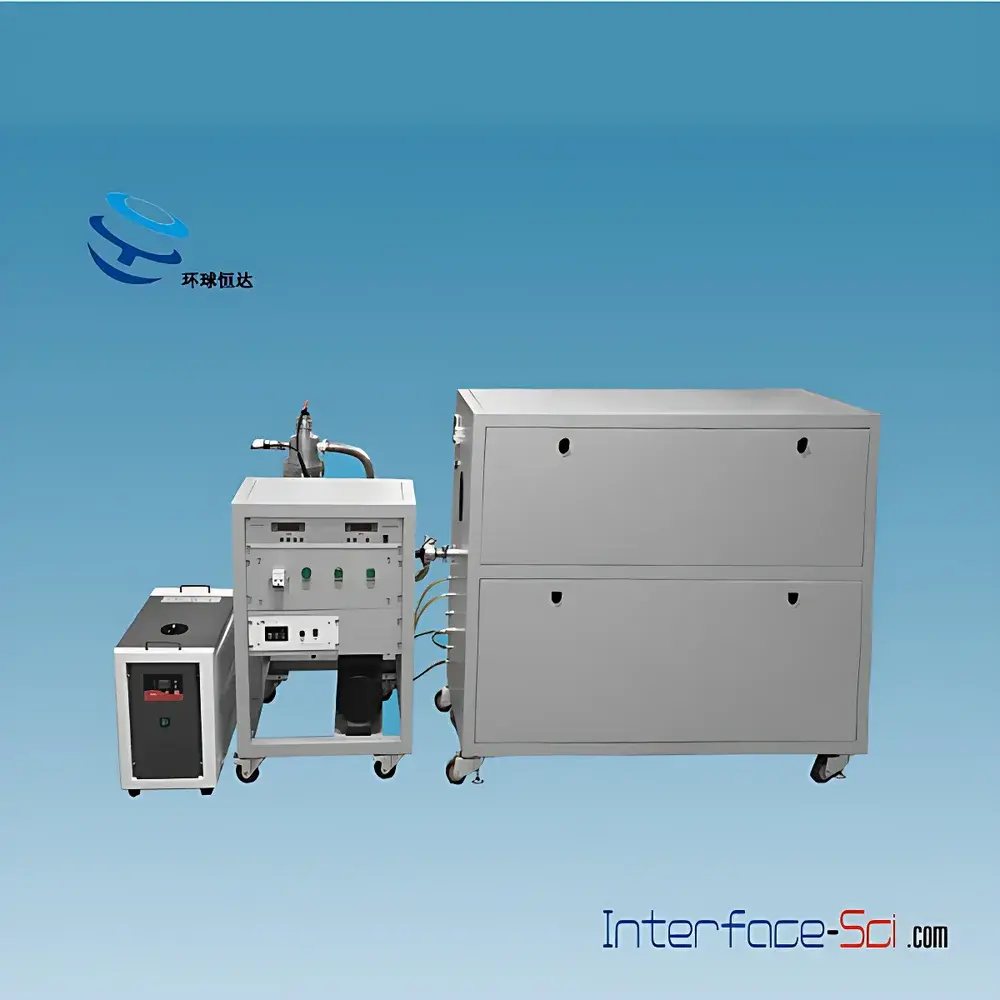
SCI-1100 High-Temperature Vacuum Contact Angle Analyzer
| Origin | Beijing, China |
|---|---|
| Manufacturer Type | Authorized Distributor |
| Origin Category | Domestic (China) |
| Model | SCI-1100 |
| Price Range | USD 14,000–28,000 |
| Instrument Class | High-Temperature Vacuum Contact Angle Measurement System |
| Form Factor | Benchtop Laboratory System |
| Contact Angle Range | 0° < θ < 180° |
| Contact Angle Accuracy | ±1° (θ/2 method), ±0.1° (Circle Fitting Method) |
| Sample Stage Dimensions | Ø14 mm × 10 mm |
| Optical Magnification | 0.7–4.5× |
| Surface/Interfacial Tension Range | 0.01–1000 mN/m |
| Surface/Interfacial Tension Resolution | 0.01 mN/m |
Overview
The SCI-1100 High-Temperature Vacuum Contact Angle Analyzer is an engineered optical tensiometer designed for quantitative characterization of solid–liquid interfacial behavior under extreme thermal and environmental conditions. Based on the video-based sessile drop method, it enables real-time observation and measurement of dynamic wetting phenomena—including contact angle evolution, spreading kinetics, and interfacial tension—within controlled high-vacuum (<5×10⁻⁵ Pa) or inert gas (e.g., Ar, N2) atmospheres. The system integrates a precision programmable high-temperature furnace (up to 1100 °C operational, 1000 °C continuous vacuum-rated), a water-cooled vacuum chamber with Ø20 mm sapphire viewport, and a calibrated optical train comprising a 300 mm focal-length telecentric lens and industrial-grade color CCD (1290×960 resolution, 0.0005 lux sensitivity). Its core application domain spans fundamental research and process development in advanced materials science where interfacial thermodynamics govern performance—such as ceramic sintering, active metal brazing, refractory coating adhesion, and molten alloy–substrate compatibility in aerospace and nuclear engineering.
Key Features
- High-temperature vacuum furnace with 40-segment programmable PID control, K-type thermocouple feedback, and ±1 °C thermal stability at 1000 °C (±0.1 °C below 1000 °C)
- Dual-stage vacuum system: mechanical roughing pump + turbomolecular pump achieving ultimate vacuum ≤5×10⁻⁵ Pa; compatible with inert gas purging and pressure regulation
- Optical subsystem optimized for high-temperature imaging: LED cold-light source (20,000 h lifetime), adjustable intensity, low-heat emission, and telecentric lens (0.7–4.5× magnification, 300 mm working distance)
- Automated temperature-triggered image capture: user-defined temperature setpoints or ΔT intervals initiate frame acquisition, supporting time-resolved wetting analysis
- Six validated contact angle calculation algorithms: θ/2, tangent, circle fitting, ellipse fitting, baseline-corrected (curved baseline), and automated edge-detection-based dynamic analysis
- Integrated surface tension computation via static sessile drop method (0.01–1000 mN/m range, 0.01 mN/m resolution), compliant with ASTM D7490 and ISO 19403-2
Sample Compatibility & Compliance
The SCI-1100 accommodates disk-shaped samples up to Ø14 mm × 10 mm thickness, suitable for dense ceramics, refractory metals (e.g., Mo, W, Ta), graphite, C/C composites, and oxide substrates. All internal furnace components—including heating elements, insulation, and sample holder—are selected for minimal outgassing and dimensional stability under thermal cycling. The system meets key regulatory and quality framework requirements for laboratory instrumentation: it supports audit-ready data logging (timestamped images, temperature metadata, operator ID), adheres to GLP principles for raw data traceability, and enables export of fully annotated results (contact angle, surface tension, temperature, frame number) into Excel-compatible formats. While not FDA 21 CFR Part 11-certified out-of-the-box, its software architecture allows integration with validated LIMS environments through standardized CSV/Excel I/O protocols.
Software & Data Management
The proprietary AnalySIS software provides a unified interface for hardware control, image acquisition, and quantitative analysis. It supports both single-frame and high-speed sequential capture (standard 30 fps; optional 60/100 fps cameras available). Key analytical capabilities include: left/right asymmetry quantification (critical for anisotropic surfaces), batch processing of multi-temperature image series, automatic curve generation (θ vs. T or θ vs. t), and overlay-enabled comparison of multiple experimental runs. All processed images retain embedded metadata—measured contact angle, interfacial tension, current furnace temperature, exposure settings, and algorithm parameters—ensuring full reproducibility. Data export options include PNG/JPEG with superimposed measurement overlays, AVI video sequences (for presentation or kinetic modeling), and structured Excel reports containing statistical summaries (mean, SD, min/max) across user-defined temperature segments.
Applications
- Wettability assessment of ceramic matrix composites during liquid-phase sintering (e.g., SiC–Al2O3 systems at 1000–1100 °C)
- Active braze alloy spreading kinetics on AlN or Si3N4 substrates under vacuum, informing joint design and process window definition
- Surface energy evolution of refractory metals (Nb, Mo) exposed to molten solder alloys, relevant to high-temperature electronics packaging
- Thermodynamic modeling of metal–oxide interfaces using Young–Dupré equation-derived work of adhesion, constrained by in-situ contact angle and surface tension inputs
- Quality control of thermal barrier coating (TBC) bond coats, where interfacial reactivity with molten CMAS (calcium–magnesium–alumino–silicate) dictates degradation resistance
FAQ
What is the maximum continuous operating temperature under high vacuum?
The SCI-1100 is rated for continuous operation at 1000 °C under vacuum (≤5×10⁻⁵ Pa); short-term excursions to 1100 °C are permissible with reduced thermal cycling frequency.
Can the system measure advancing and receding contact angles dynamically?
Yes—via sequential dosing or vapor condensation protocols using external syringe pumps or controlled humidity modules (optional add-ons); the base system captures static and pseudo-dynamic (temperature-driven) contact angle evolution.
Is the software compliant with 21 CFR Part 11 for regulated laboratories?
The standard software provides audit trails and electronic signatures; full Part 11 compliance requires site-specific validation documentation and optional secure user authentication modules.
What calibration standards are recommended for contact angle verification?
Certified reference surfaces (e.g., hydrophobic PTFE wafers with θ = 110° ± 2°, hydrophilic glass slides with θ = 20° ± 1°) traceable to NIST SRM 2800 are recommended for routine verification.
How is thermal drift compensated during long-duration measurements?
The system employs real-time thermal drift correction via fiducial marker tracking on the sample stage and adaptive baseline detection algorithms that account for substrate expansion-induced image displacement.



