
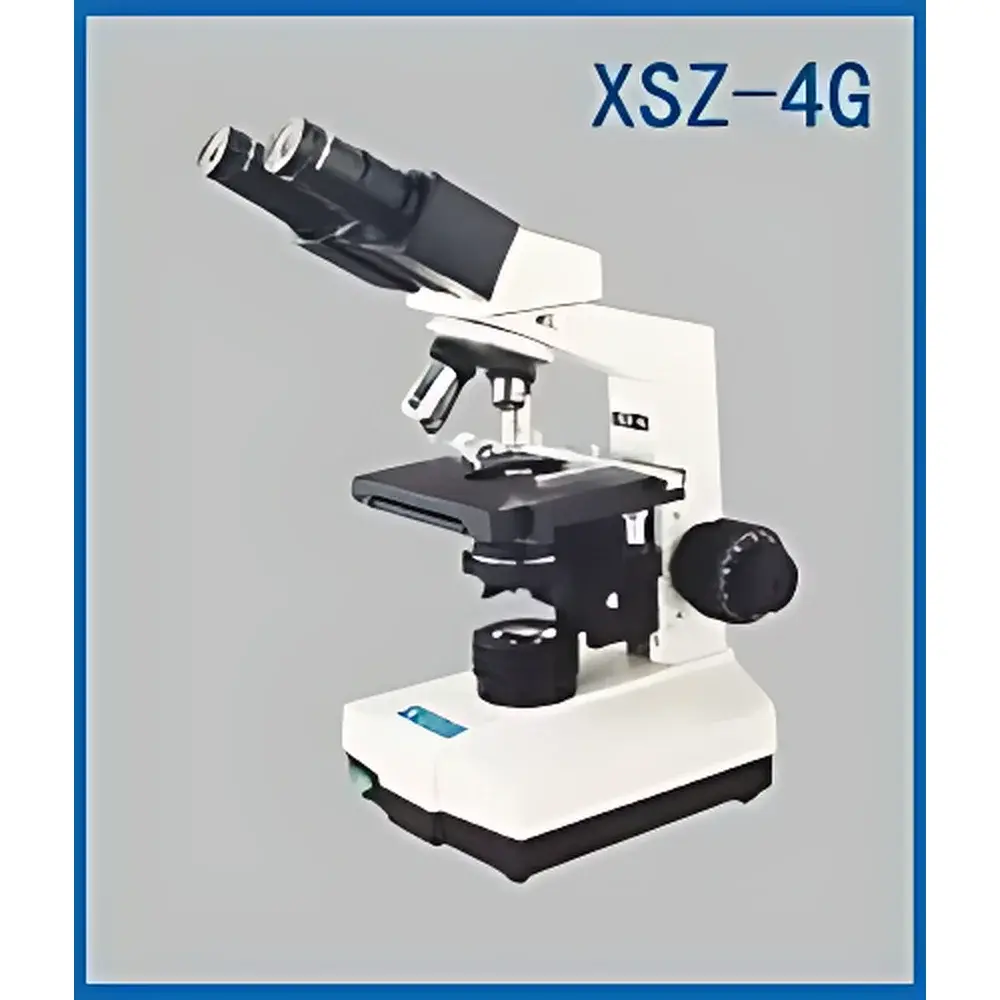
XSZ-G Series Biological Microscope
| Origin | Shanghai, China |
|---|---|
| Manufacturer Type | Distributor |
| Origin Category | Domestic (China) |
| Model | XSZ-G |
| Pricing | Upon Request |
Overview
The XSZ-G Series Biological Microscope is a robust, optomechanically engineered upright compound microscope designed for routine and advanced light microscopy in life science laboratories. Built on a classical finite-conjugate optical system with a standardized 160 mm mechanical tube length, the series complies with international optical design conventions for achromatic and plan-achromatic objectives. It operates on Köhler illumination principles—enabled by its high-NA (1.25) Abbe condenser—and supports brightfield observation across a total magnification range of 40× to 1600×. The instrument’s stable cast-metal frame, anti-slip stage stop mechanism, and precision-machined focusing assembly ensure long-term mechanical integrity and repeatable focus positioning—critical for teaching labs, clinical cytology workflows, and quality control environments where operational consistency and ergonomic safety are prioritized.
Key Features
- Seven configurable models (XSZ-2G, 2GA, 3G, 3GB, 4G, 4GB, 7G) optimized for varying user needs—from single-user instruction to dual-observer collaboration and documentation-ready setups.
- Optical train featuring plan-achromatic objectives (4×, 10×, 40×, 100× oil immersion) and wide-field 10×/16× eyepieces delivering flat, high-contrast fields of view with minimal edge distortion.
- Stage-mounted mechanical stop ring prevents uncontrolled downward movement during coarse focusing—a safety-critical feature for extended daily use in teaching or clinical settings.
- Adjustable Abbe condenser (NA 1.25) with iris diaphragm and centering screws ensures optimal resolution and contrast control per specimen thickness and staining method.
- Large rectangular stage (130 × 125 mm) with 60 × 30 mm travel range and vernier scale (0.1 mm resolution) enables precise specimen navigation and reproducible coordinate referencing.
- Coarse focus mechanism with 25 mm travel and calibrated micrometer scale (0.002 mm per division) provides tactile feedback and fine positional repeatability without reliance on digital encoders.
Sample Compatibility & Compliance
The XSZ-G series accommodates standard 1″ × 3″ glass slides and coverslips (0.13–0.17 mm thickness), supporting both fixed and live unstained specimens under transmitted brightfield illumination. Its optical design conforms to ISO 8578:2017 (Microscopes — Requirements for compound microscopes) and aligns with ASTM E289–22 (Standard Practice for Calibration of Microscope Objectives). While not certified for GLP/GMP-regulated production environments, the instrument meets essential requirements for educational validation, academic research, and non-GxP diagnostic support—including hospital-based hematology, urinalysis, and microbiological screening. Optional phase contrast or darkfield accessories may be integrated via compatible nosepiece threads (RMS standard).
Software & Data Management
The XSZ-G platform is hardware-ready for third-party digital imaging integration. The XSZ-7G variant features a trinocular head with C-mount (1× or 0.5× photo port) supporting USB 3.0 CMOS cameras (e.g., 5 MP–20 MP sensors), HDMI-capable video capture devices, and DSLR adapters for photomicrography and time-lapse recording. Compatible software suites—including open-source tools like Fiji/ImageJ and commercial packages such as NIS-Elements Basic—enable annotation, measurement (distance, area, particle count), histogram analysis, and export in TIFF, PNG, or multi-page PDF formats. All digital outputs retain EXIF metadata (objective magnification, exposure time, camera model), facilitating traceability in student lab reports or internal QC documentation.
Applications
- Clinical Diagnostics: Peripheral blood smear review, urine sediment analysis, Gram-stained bacterial morphology assessment, and fungal hyphae identification in hospital pathology departments.
- Academic Instruction: Undergraduate cell biology labs (mitosis staging, organelle visualization), plant histology (vascular bundle cross-sections), and immunohistochemistry slide evaluation in medical and pharmaceutical curricula.
- Food & Agricultural Testing: Detection of microbial contaminants (yeast, mold, coliforms) in raw materials; grain quality inspection; pollen morphology analysis for botanical authentication.
- Pharmaceutical R&D: Crystallization monitoring of active pharmaceutical ingredients (APIs), excipient particle sizing, and tablet coating uniformity assessment at low-to-mid magnifications.
- Veterinary & Livestock Science: Parasite egg identification in fecal floats, tissue biopsy screening, and semen motility evaluation using phase contrast add-ons.
FAQ
Is the XSZ-G Series compliant with FDA 21 CFR Part 11?
No—the XSZ-G is a general-purpose optical microscope without embedded electronic data acquisition, audit trail functionality, or user-access controls required for Part 11 compliance. Digital image capture must be managed externally using validated third-party systems.
Can oil immersion objectives be used with all models?
Yes—100× oil immersion objectives are mechanically and optically compatible across all XSZ-G variants, provided the condenser NA (1.25) and immersion medium (Type A cedarwood oil or synthetic substitutes) meet ISO 8578 recommendations.
What power supply options are available for electrically illuminated models?
XSZ-2GA, XSZ-3G, XSZ-4G, and XSZ-7G accept universal input (100–240 V AC, 50/60 Hz) with built-in LED or halogen illuminators (6 V / 20 W typical), offering stable color temperature and >10,000-hour lifetime.
Does the microscope support fluorescence observation?
Not natively—the standard configuration lacks excitation/emission filter sets, dichroic mirrors, or high-intensity mercury/xenon lamp housings. Fluorescence capability requires retrofitting with after-market epi-illumination modules meeting RMS threading and focal plane alignment specifications.
Are replacement parts and service manuals available internationally?
Yes—original OEM components (objectives, eyepieces, condensers, bulbs) and English-language technical documentation are distributed globally through authorized regional partners and comply with ISO 9001-certified logistics channels.




